
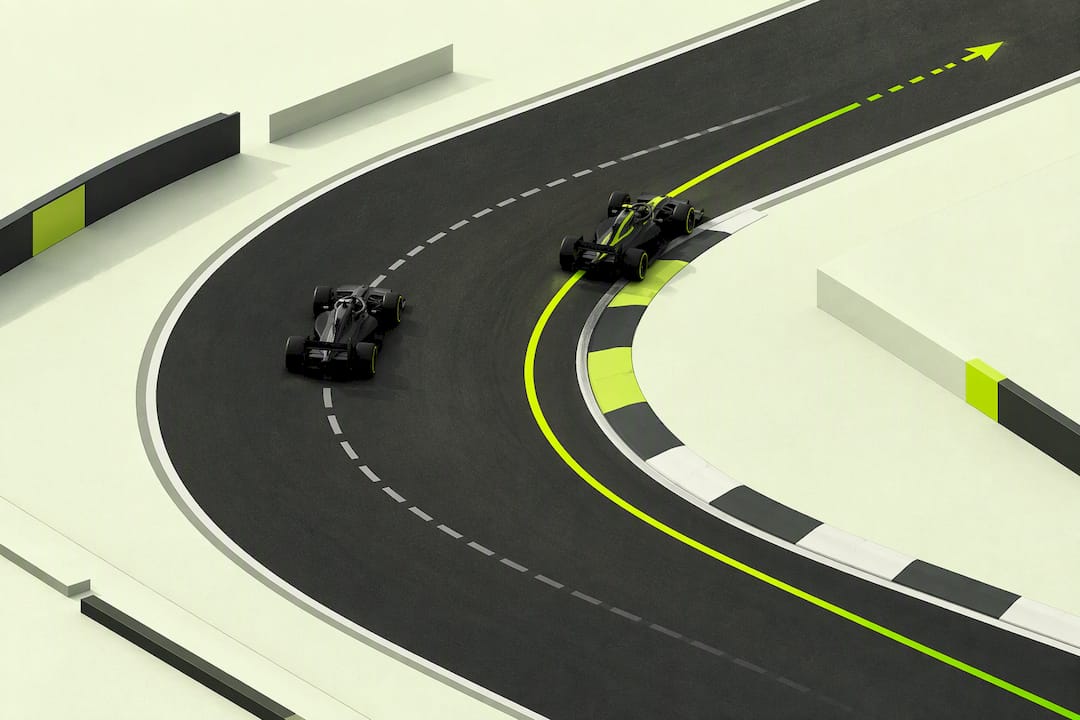
Late apexes protect exit speed and usually win where a corner feeds a meaningful straight, while early apexes trade exit speed for mid-corner speed and only pay off in short or linked corner sequences. The rule of thumb: pick the apex that wins the section of track that matters most, and for the majority of F1 26 corners, that section is the exit.
TL;DR:
- Choose an early apex in tight linked corners when the next entry matters more; lighter cars may also benefit from preserving corner speed.
- Delay turn in beyond the geometric center, trail brake to keep the front tires loaded, and apply throttle once the car points toward the exit.
- Compare early, late, and usual lines over three laps, holding fuel, tire compound, and ERS constant, then record exit speed and section time.
- Rotation practice belongs in isolated sessions with low fuel and fresh tires, because poor brake control can turn the maneuver into a spin.
- If you run wide at an exit, delay turn in before assuming you braked too late, and use a kerb or board as a marker.
Table of Contents
- What counts as an apex: geometric, early, and late explained
- Why exit speed usually beats entry speed
- How to execute each apex line in F1 26
- Common apexing mistakes and how to fix them
- Practice drills to find the right apex for a corner
- How I coach apex choice for F1 26 drivers
- How Virew helps you pick and practice the right apex
- FAQ
- Sources
What counts as an apex: geometric, early, and late explained
The apex is simply the point in a corner where you stop driving in and start driving out, the moment you switch from turning the wheel further to unwinding it toward the exit. The geometric apex sits at the true center of the corner's radius, and any apex point you touch after that center counts as a late apex.
In F1 26, you can spot these points using a few consistent markers:
- The inside kerb strip, where your car's edge should brush at the apex you are targeting.
- Your braking marker boards, which set up how deep you carry speed before turn-in.
- A fixed sightline through the corner exit, which tells you where you are actually pointing the car, not just where the wheel is turned.
Camera choice matters here. The TV Pod perspective, combined with a tuned field of view, gives a clearer read on the kerb and exit line than the cockpit view, which is why most quick F1 26 drivers favor it for picking consistent reference points. Eau Rouge and Turn 1 at Suzuka both reward a noticeably later apex than their geometric center suggests.
Why exit speed usually beats entry speed
The core tradeoff comes down to where you spend the corner's grip. An early apex lets you carry more speed into the corner and through the middle, but it points the car toward the outside of the track too soon, which forces you to wait longer before applying throttle. A late apex costs you some entry and mid-corner speed, but it points the car straight at the exit earlier, which means you get back on the throttle sooner and carry that speed all the way down the following straight.

That compounding effect is why late apex usually wins. According to Bradshaw Autosport's analysis of racing line theory, exit speed carries forward through an entire straight, so a small gain at the exit multiplies into a much larger gain by the next braking zone, while the time saved by a faster entry mostly disappears the moment you lift or brake again.
Certain corner types make the case for late apex especially strong:
- Corners that feed a long straight, where every extra kilometer per hour at the exit pays off for several seconds.
- Decreasing-radius corners, which tighten after the geometric center and punish anyone who apexes early by forcing a wide, scrubbing exit.
- Linked corner sequences and chicanes, where the exit of the first corner sets your entry speed into the next.
Car behavior shifts the balance too. Heavier, more aero-dependent setups tend to reward a later apex that protects exit speed onto the straight, while lighter, momentum-sensitive setups can afford an earlier apex that keeps corner speed high through tighter, technical sections, a distinction Bradshaw Autosport ties directly to how much a car relies on carried speed versus traction out of the corner.
How to execute each apex line in F1 26
Both lines start the same way: brake in a straight line, then trail off the brake as you turn in. What changes is timing and reference point.
For an early apex:
- Brake slightly earlier and turn in sooner than you would for a late line.
- Aim your apex point before the corner's geometric center.
- Hold a wider mid-corner arc to keep speed through the middle.
- Unwind the wheel gradually, accepting a later and gentler throttle application.
For a late apex:
- Brake marginally later, carrying a touch more speed into the corner.
- Delay turn-in and aim past the geometric center for your apex.
- Trail brake into the apex to keep the front tires loaded and the car rotating.
- Get on throttle earlier and more aggressively once the car points at the exit.
Advanced drivers can push this further with deliberate rotation, using trail braking to unsettle the rear slightly so the car rotates faster than a pure braking line would allow. Ross Bentley's coaching notes describe this as a way to carry more entry speed while still arriving at a late-apex position, though it demands precise brake modulation and sometimes a small brake-bias shift toward the rear.
Pro Tip: Practice rotation only in isolated sessions with low fuel and fresh tires, never mid-race, since an overcooked rotation attempt easily turns into a spin.
Common apexing mistakes and how to fix them
Most lap time lost on apex choice comes from three repeatable errors.
- Turning in too early. This points the car at the apex kerb before the car has scrubbed off enough speed, which forces you wide at the exit and costs throttle time. Fix it by deliberately delaying your turn-in point by a car length and checking whether your exit line tightens up.
- Lifting or chopping throttle early. Easing off the moment you feel the car rotate kills the compounding exit speed that makes late apexing worth it in the first place, and the loss shows up across the entire following straight, not just in the corner.
- Losing your reference points. Drivers who scan too far ahead or too close to the car lose consistency in exactly where they turn in. Fix this by picking one fixed kerb or board as your apex marker and using it every lap until it becomes automatic.
Pro Tip: If you keep running wide at the exit of the same corner, assume you apexed too early before assuming you braked too late.
Practice drills to find the right apex for a corner
The most reliable way to settle an apex debate on a specific corner is a controlled three-lap test.
- Pick one corner and hold everything constant: fuel load, tire compound, and ERS deployment.
- Drive lap one with a clearly early apex, lap two with a clearly late apex, and lap three with your usual line.
- Compare exit speed at a fixed point past the corner and the sector time for that section only.
- Repeat the test after any car balance change, since a different aero or tire setup can shift which apex wins.
Pair this with a single-corner repetition drill: run the same corner ten times in a row, nudging your turn-in point later by a small amount each run, and note where the exit speed stops improving. This fits the Drive, Analyze, Improve, Repeat loop without needing telemetry: you are comparing what you felt and what the clock showed, lap over lap. Use looser, early-apex-biased lines in race trim practice where tire wear and traffic matter, and save the aggressive late-apex and rotation testing for qualifying or Time Trial sessions.
How I coach apex choice for F1 26 drivers
My rule of thumb: favor the exit, and therefore the late apex, on any corner that feeds a straight worth defending into. Save early apexes for tight, linked sequences where the next entry matters more than this exit. Rotation drills come later, once turn-in timing is already repeatable, and only in low-pressure practice sessions rather than race trim. A structured loop, drive, review what happened, adjust one thing, repeat, beats guessing lap after lap.
— Virew
How Virew helps you pick and practice the right apex
We built our coaching around the exact question this article answers: was that apex early, late, or geometric, and what did it cost you? When you upload an F1 26 lap, our lap analysis breaks down corner entry, apex timing, and throttle roll-on corner by corner, so you can see which corners are costing you exit speed without guessing.
Run the three-lap test from this guide, then upload the laps and let our coaching flag exactly where your turn-in or throttle timing is working against you. Our Free and Pro plans both turn that single session into a concrete next step rather than another guess.
FAQ
Which racing line is the fastest?
There is no single fastest line for every corner. The fastest line is whichever apex choice, early, late, or geometric, produces the highest exit speed for the corner's exit and the straight that follows it.
What does apex mean when driving?
The apex is the point in a corner where you stop turning further in and start unwinding the wheel toward the exit. Any apex point reached after the corner's geometric center is classified as a late apex.
How to determine the apex of a corner?
Start from the corner's geometric center, the true midpoint of its radius, then decide whether hitting the apex earlier or later than that point better protects your entry speed or your exit speed. Corners feeding a long straight usually call for a later apex that favors the exit.
What is apex in karting?
The apex in karting works the same way it does in F1 26: it is the point where the kart transitions from turning in to accelerating out. Because karts carry less momentum and rely heavily on rotation, drivers often favor an earlier apex than cars with more aero-dependent cornering.
Sources
- The Racing Line: First Principles of Going Fast — Bradshaw Autosport
- Ross Bentley — Speed Secrets: No, do not release early
- F1 25: 2026 season edition tips and tricks — EA