
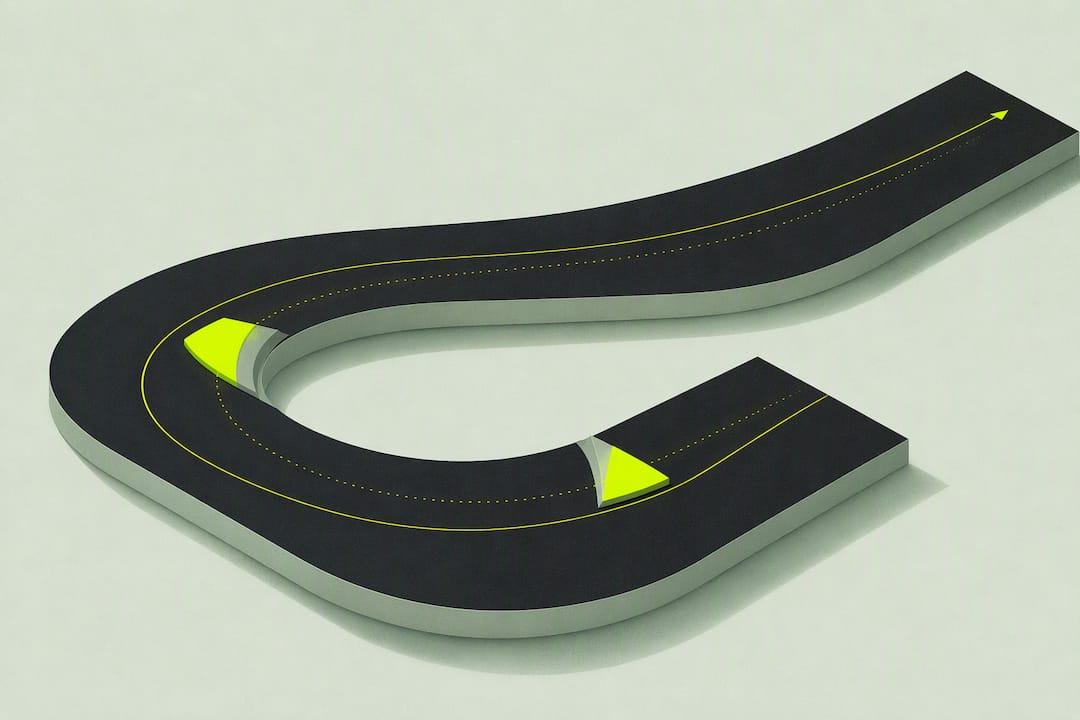
A double apex is a cornering approach for long-radius or variable-curvature turns where you deliberately clip a wide, early midcorner point before tightening onto a second apex closer to the exit. In F1 26 it lets you carry more entry speed and reach full throttle sooner, which produces a faster, more repeatable run onto the next straight. The technique matters most in Time Trial and Qualifying, where a clean exit defines the lap, though it also pays off in Race once you weigh tire wear and traffic.
TL;DR:
- A double apex works best on long-radius corners with variable curvature and when a long straight follows, providing more exit speed than a single apex.
- Committing fully in Time Trial and qualifying allows for maximum speed gains, but track and traffic conditions require cautious use in race scenarios.
- Proper execution involves precise phase sequencing: wide setup, smooth turn-in, midcorner stability, and timely clipping of the second apex before full throttle.
- Common errors include late turn-in, early throttle, excessive steering, and ignoring tire wear, all of which reduce the technique’s effectiveness.
- AI coaching tools analyze laps to identify specific timing issues, helping drivers improve cornering by focusing on individual phase errors.
Table of Contents
- What a double apex corner looks like and when to choose it
- The physics and geometry: why a double apex line can be faster
- Step-by-step driving execution: entry to exit
- Common mistakes sim racers make with double-apex corners
- Practice drills and lap exercises to master the double apex
- How AI coaching speeds up the double-apex learning loop
- When to choose a double apex and when a single apex wins
- Get corner-specific feedback on your own double-apex laps
- Sources
- FAQ
What a double apex corner looks like and when to choose it
Not every corner rewards this line. A double apex earns its place on long-radius bends, corners with variable curvature (they tighten or open mid-turn), and anywhere a long straight follows the exit. Think of a sweeping right-hander that opens into a back straight: hitting one tight apex forces you to carry a slow, pinched line through the whole corner, while treating it as two apexes lets you stay wide early and unwind the wheel sooner.
Session context changes how aggressively you should use it. In Time Trial, where every tenth counts and there's no traffic to manage, you can commit fully to the early-wide line and chase the fastest possible exit speed. In Qualifying, the same logic applies, but track evolution and other cars on an out lap mean you need to double-check the entry is clear before committing to the wider arc. In Race, a double apex is still valuable, but you'll sometimes trade a little exit speed for a tighter, more defensive line if a rival is close behind.
Reading the corner in-game comes down to a few visual habits:
- Watch the curb geometry on the inside of the corner: a long, gently curving curb usually signals a double-apex opportunity, while a short, sharp curb usually means a single, late apex is faster.
- Check where the track opens up on exit: if the exit curb runs wide and flat for a long stretch, that's a strong cue the corner rewards an early-wide line.
- Note the length of the following straight on the track map: the longer it is, the more a fast exit is worth relative to a fast midcorner.
The physics and geometry: why a double apex line can be faster
Cornering speed is governed by radius. A larger radius allows a higher sustainable speed at the same level of grip, which is the entire reason a double apex line exists. By treating a long-radius corner as two smaller-radius sections instead of one tight arc, you open up the effective radius through the middle of the turn, and that lets you carry more midcorner speed than a single, late-apex line would allow.
The bigger payoff isn't peak speed, though. It's time at speed. A corner that leads onto a long straight rewards the driver who gets back to full throttle earliest, even if their absolute midcorner speed is a touch lower than someone who nailed a single, aggressive apex. Riding and racing coaching that compares early-wide and late-tight lines consistently shows the early-wide approach reduces time spent at low speed and lets drivers reach full throttle earlier on the exit, which is the exact trade-off F1 26 drivers are chasing when they carry speed onto a straight.
There's a grip cost to consider too. Widening your line through the middle of a corner and then tightening onto a second apex asks the front tires to change direction twice instead of once, and if you ask for too much steering angle at the second apex, you'll overload the front and induce understeer right when you want to be unwinding the wheel. The same coaching sources that recommend outside-in-out line choice for maximizing radius and exit speed also note that starting wide and finishing wide reduces sustained lean or lateral load compared to holding a tight radius the whole way through, which in F1 26 terms means less sustained lateral tire load and more consistent temperatures across a run.
In a race, that grip management matters over a full stint. A double apex line that keeps lateral loads lower for longer is gentler on tire wear than a line that holds the car at maximum lateral force through the entire corner, which is one reason the technique holds up even when you're managing a compound for 20 laps rather than chasing one perfect lap.
Step-by-step driving execution: entry to exit
Executing a double apex cleanly comes down to sequencing four phases correctly. Rush any one of them and the whole line collapses into either a tight, slow single apex or a wide, wasted arc that never sets up the exit.
- Set up the entry. Brake in a straight line or with minimal initial steering, and trail off the brake pressure as you turn in, aiming to be positioned wider than you'd normally go for a single-apex line.
- Control the turn-in. Use small, progressive steering inputs rather than one large input, and feed in a touch of throttle earlier than usual to help settle the car and hold the wide arc through the first phase.
- Stabilize through midcorner. Keep the car balanced and avoid adding more steering lock than you need. This is where you clip the first, wider apex and set the car up for the tightening phase ahead.
- Clip the second apex. Tighten your line with a slightly firmer steering input, timed so the car is settled and pointed at the exit the moment you clip this second point.
- Drive out. Begin applying throttle as soon as the car is stable at the second apex, building to full throttle progressively, and manage ERS deployment so you have full electrical power available the instant the track straightens.
Gear choice matters here too: short-shifting slightly before the second apex can keep the engine in a smoother part of the power band, which makes it easier to apply throttle cleanly rather than fighting wheelspin on corner exit.
In wet conditions, treat this as two sequential stability problems rather than one flowing line. Coaching resources that address wet double-apex corners recommend smaller steering inputs, delayed throttle onset, and accepting a lower peak exit speed in exchange for consistency, and that principle translates directly to F1 26: expect less front grip on turn-in, delay your throttle application at the second apex by a beat longer than you would in the dry, and prioritize finishing the corner in one piece over maximizing exit speed.

Pro Tip: Practice the corner in isolation using a rolling start from the same point every lap, so you're only ever comparing the corner itself rather than a different entry speed each time.
Common mistakes sim racers make with double-apex corners
Most drivers who struggle with this technique aren't lacking car control. They're making one of a handful of predictable errors in timing or input size.
- Turning in too late. This tightens your effective radius and forces a slower, single-apex-style line even though you intended a double apex. Fix it by moving your turn-in point earlier and more progressively, so you're already wide by the time you'd normally have turned in.
- Applying throttle too early or too aggressively at the second apex. This unsettles the rear before the car is pointed straight, costing you the very exit speed the technique is meant to deliver. Fix it by holding a steady, smaller throttle input until the car is visibly stable at the second apex, then building up.
- Adding too much steering angle midcorner. Overcorrecting the wide line with a big steering input creates understeer right as you need the front tires working. Fix it with smoother, smaller corrections, and if it keeps happening on the same corner, check your setup's front wing and differential settings for that circuit.
- Ignoring tire wear in races. Holding the double apex line at full commitment every lap can overheat the outside front tire faster than a slightly compromised, more conservative line. Fix it by shortening your midcorner radius slightly or lifting a fraction earlier once tire temperatures climb, trading a little exit speed for a longer-lasting compound.
Practice drills and lap exercises to master the double apex
Since these drills rely on what you can see and feel on track: entry speed, corner exit speed shown on the HUD, and how the car reacts to each input. Structured, repeated practice on a single corner is one of the fastest ways to build the feel for this line, and riding schools consistently find the biggest gains come from isolated, coached repetition rather than unfocused full laps.
- Isolate the corner. Use a Time Trial session and reset to the sector start every lap, focusing only on your entry speed and how quickly you're back to full throttle after the second apex.
- Run the A/B comparison. Drive the corner once with an early-wide line and once with a late-tight, single-apex line, then compare your exit speed on the HUD to feel the difference directly.
- Build entry speed progressively. Increase your corner entry speed in small increments, lap after lap, and check whether you can still hold the second apex cleanly at each new speed before pushing further.
- Adapt to the session. In Time Trial, push the drill to the limit of grip. In Race, repeat it with a heavier fuel load and worn tires to see how the line holds up under race conditions. In the wet, slow the whole sequence down and prioritize a clean, repeatable exit over outright speed.
How AI coaching speeds up the double-apex learning loop
Learning a double apex by feel alone works, but it's slow because you're relying on memory and guesswork to figure out which lap actually had the better line. A structured Drive, Analyze, Improve, Repeat loop shortens that process by turning each attempt into a specific, actionable note rather than a vague impression.

The details worth watching for on a corner like this are consistent: entry speed into the first phase, how wide the car actually gets at the midcorner point, whether the second apex is clipped early or late, and how quickly throttle builds on exit. Once you know which of those is holding you back, the next practice session has a clear target instead of a general instruction to "go faster."
an AI coaching tool analyzes uploaded F1 26 laps and returns plain-language coaching built around exactly these phases, adapting its feedback to session type and weather, treating wet and dry conditions as separate driving problems rather than comparing them directly. For a corner-specific technique like the double apex, that means the feedback can point at the actual phase where a lap lost time, whether that's a late turn-in, an early throttle application, or a compromised second apex, rather than leaving you to guess from lap time alone.
When to choose a double apex and when a single apex wins
The rule of thumb is simple: reach for a double apex when the corner has a genuinely long radius, a clear exit, and a long straight waiting on the other side. That's where the extra setup time pays for itself in exit speed. A single, later apex still wins in tighter or shorter corners, when you're defending a position and need to protect the inside line, or when you're managing tire wear late in a stint and a slightly slower but lower-load line keeps the compound alive longer.
The practical takeaway is that the double apex isn't a universal upgrade. It's a tool for a specific type of corner, and using it on the wrong one costs you more than it gives back.
— Virew
Get corner-specific feedback on your own double-apex laps
Reading about the double apex line only gets you so far. Seeing exactly where your own laps are losing time on a specific corner is what turns the theory into a faster lap.
Virew's F1 26 lap analysis looks at the lap you actually drove and breaks down braking, corner entry, apex timing, and throttle application in plain language, adapted to the session type and weather you were driving in. That's a more direct way to find out whether your double apex is losing time at the first phase, the midcorner, or the exit, compared with guessing from lap time alone.
- Upload a lap featuring a long-radius corner and get feedback focused on entry speed, midcorner positioning, and exit throttle timing.
- Compare a Time Trial attempt against a Race stint on the same corner to see how your line changes under different demands.
- Check the broader guide to getting faster in F1 26 for how corner-specific coaching fits into a full lap-time improvement plan.
Start with a free lap analysis at Virew and see where your own double-apex corners are costing you time.
Sources
- How To Tackle Long-Radius, Double-Apex Corners - Yamaha Champions Riding School
- How to ride berms & navigate banked turns successfully
FAQ
What is a double apex and how does it differ from a single apex?
A double apex is a line through a long-radius or variable-curvature corner where you clip two separate apex points instead of one, staying wider through the middle before tightening near the exit. A single apex uses one clipping point, which works better on tighter or shorter corners where there's no benefit to widening the midcorner radius.
Which F1 26 corners suit a double-apex line?
Long, sweeping corners that lead onto a long straight are the best candidates, especially those with variable curvature or a widening exit curb. Short, sharp corners or ones followed immediately by another turn usually respond better to a single, later apex.
How do I practice the double apex without telemetry data?
Use a rolling-start drill in Time Trial, resetting to the same point every lap so you can compare entry speed and how quickly you reach full throttle on exit by feel and by watching the HUD. Running an early-wide line back-to-back against a late-tight line on the same corner is one of the fastest ways to feel the difference in exit speed.
Does the double apex work the same way in the wet?
No, wet conditions call for smaller steering inputs, a delayed throttle application at the second apex, and accepting a lower peak exit speed in exchange for consistency. Treating the corner as two separate stability problems rather than one flowing line reduces the risk of losing the rear on corner exit.
Can AI coaching help me improve my double-apex technique faster?
Structured lap coaching can point directly at which phase of the corner, entry, midcorner, second apex, or exit, is costing you time, rather than leaving you to guess from lap time alone. Virew's lap analysis for F1 26 breaks a lap down by these phases and adapts its feedback to the session type and weather you were driving in.