
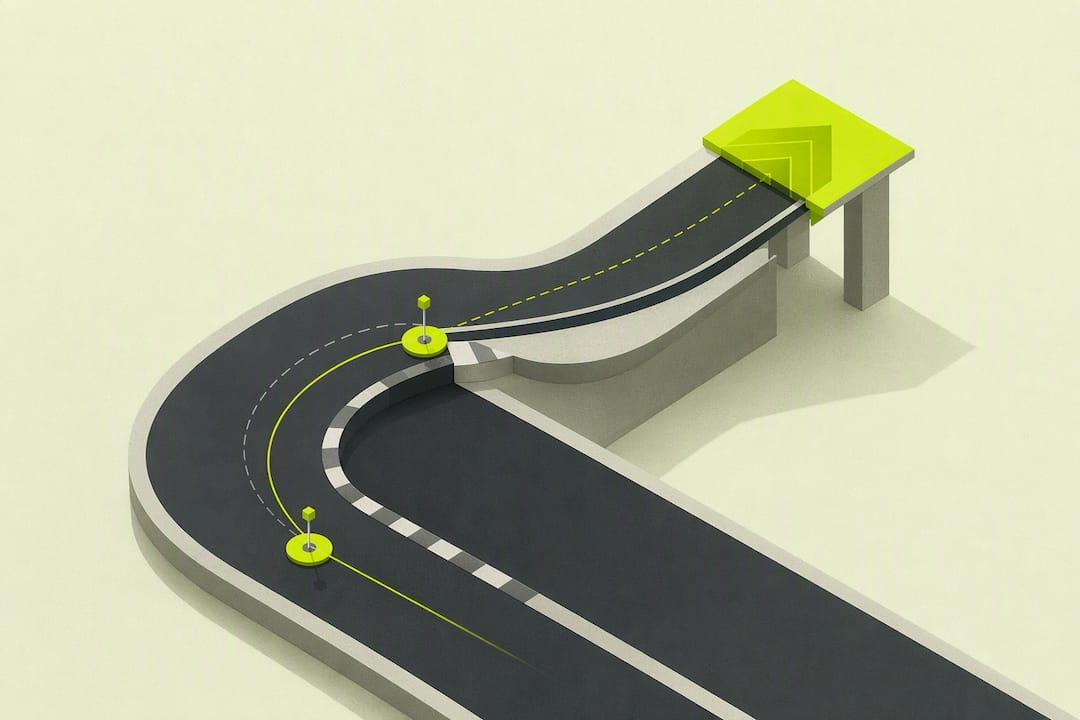
On most corners feeding a long straight, a late apex beats a geometric one because it maximizes exit speed, and exit speed is what actually shows up in your lap time. Hit the apex later and straighten the car sooner, and you get on the throttle earlier with less steering lock fighting the rear tires. The exception is very fast sweepers, where a geometric apex keeps a constant radius and there's no meaningful acceleration to gain anyway. In Time Trial and Qualifying, lean toward the aggressive late-apex line for outright pace; in races, adjust that timing to protect tires and manage ERS deployment.
TL;DR:
- Late apex driving generally maximizes exit speed on straights, unless approaching very fast sweepers where a geometric apex reduces time loss.
- Prioritize late apex turns when approaching DRS zones, long straights, or medium-speed corners requiring rotation, based on what follows the corner.
- Consistent, repeatable apex timing depends on precise brake, turn-in, steering, and throttle sequences, which benefit from focused drills and lap analysis tools.
- Common mistakes like early turn-in, missing the apex kick, or improper brake release can be fixed with targeted practice and review of onboard footage.
- Using lap analysis tools helps identify exactly where apex timing costs time, enabling session-specific adjustments for better pace.
Table of Contents
- Why Apex Timing Matters for Exit Speed and Lap Time
- How to Time the Apex: Braking, Turn-In, Apex, Throttle
- Common Apex-Timing Mistakes and How to Fix Them
- Drills to Build Consistent Apex Timing in F1 26
- How AI Lap Analysis Speeds Up Apex-Timing Improvement
- Get Session-Specific Apex Coaching With Virew
- A Coach's Note on Apex Timing
- Sources
- FAQ
Why Apex Timing Matters for Exit Speed and Lap Time
A small gain on corner exit speed doesn't sound like much until it compounds down a straight. Carry that extra speed through a long straight and you're crossing the next braking marker measurably quicker, which is where tenths per lap actually come from. That's the entire logic behind late apex versus geometric apex decision-making: it's not about looking fast through the corner, it's about what speed you're carrying when the straight begins.
The geometric apex, where you touch the inside of the corner at its true midpoint, works when the corner is fast enough that you're not going to accelerate much anyway. Think Copse at Silverstone or Turn 8 at Istanbul Park in F1 26. There's no exit to protect because you're already near the car's cornering limit.
A late apex is generally the better call when:
- The corner feeds a reasonably long straight, based on racing line guidance for late apex execution
- You're exiting into a DRS zone or overtaking straight
- The corner is a hairpin or medium-speed turn where rotation matters more than mid-corner carry speed
Pro Tip: If you're unsure which apex style a corner wants, look at what comes after it, not the corner itself. The straight decides the apex, not the bend.
How to Time the Apex: Braking, Turn-In, Apex, Throttle
Getting apex timing right in F1 26 comes down to a repeatable sequence, not a feel you either have or don't. Break it into five steps and you can drill each one individually.
- Brake at your marker, then shift your eyes. Hit your braking point, then immediately look toward the exit, not the apex. Your hands follow your eyes more than you'd think, and looking at the exit naturally sets you up for a wider, later turn-in.
- Turn in later than feels natural. A late apex means a later, more decisive turn-in. Resist the urge to dive for the apex early. Stay wide through the first third of the corner.
- Trail-brake toward the apex. Keep light brake pressure through turn-in, releasing it progressively as you approach the apex. This keeps the front tires loaded and rotates the car without needing extra steering lock.
- Add a small "kick" of steering at the apex. Right around minimum brake pressure, add a touch more steering angle to finish the rotation. This technique, sometimes called the apex kick in formula-style driving, helps point the car at the exit without scrubbing speed through excessive mid-corner lock.
- Unwind and feed throttle progressively. As soon as the car is pointed, start unwinding the steering while squeezing the throttle. The two should happen almost simultaneously, not one after the other.
Calibrating the "kick" takes practice because F1 26's physics reward a light touch. Too much extra angle at the apex and you'll get snap oversteer on corner exit, especially on cars running softer rear-end setups. Too little and you're just carrying a wide, slow line with no benefit.
Session context changes how aggressive you should be. In Time Trial, push the late apex hard since there's no tire or ERS cost to worry about across one lap. In Qualifying, the same aggression applies, but you only get one or two clean attempts, so consistency in your turn-in point matters more than squeezing the last percent. In a Race, dial back the aggression slightly on long runs. A slightly earlier, gentler apex reduces rear tire scrub over 20 laps even if it costs a tenth on a single lap.
Common Apex-Timing Mistakes and How to Fix Them
Most apex-timing problems in F1 26 trace back to one of three habits, and all three are fixable with focused practice rather than setup changes.
- Turning in too early. This puts your apex too soon and forces a wide, slow exit because you run out of track. Fix it by walking the corner backward mentally: pick your exit point first, then work back to where turn-in needs to happen to reach it.
- Skipping the apex kick, or holding steering angle too long after it. Both scrub speed. No kick means a rounder, slower rotation. Holding angle too long after the apex means you're still turning when you should be unwinding and accelerating. Practice releasing steering the instant the car is pointed, not a beat later.
- Over-trail-braking or releasing the brake too early. Too much trail brake past the apex kills rotation and stalls your throttle application. Releasing too early loses the front-end load you need for turn-in. Check your brake trace in a lap analysis tool. If pressure is still above 10 to 15% well past your turn-in point, you're carrying it too long.
Each of these shows up clearly in onboard replay. Watch your steering wheel angle through the corner exit specifically. If it's still moving after your throttle is applied, that's your apex-kick timing to fix first.
Drills to Build Consistent Apex Timing in F1 26
Improving apex timing isn't about one perfect lap. It's about repeatable comparisons that show you the actual time difference between two approaches.
- Back-to-back line comparison. Run 10 laps using a strict geometric apex through a chosen corner, then 10 laps using a late apex on the same corner. Compare sector time and exit speed at the next timing point. The drill methodology from formula-style driving guides backs this exact back-to-back approach for isolating the trade-off.
- Fixed reference exit-speed drill. Pick a visual marker at the end of the following straight, such as a sponsor board or bridge. Note your speed in mph or km/h at that point across five consecutive laps using a later apex, then five using an earlier one. The gap tells you exactly what the apex is worth on that specific corner.
- Consistency run. Complete 10 clean laps targeting the same apex point every time. Track how much your sector time varies lap to lap. Tight variance across all 10 laps matters more for race pace than one outlier fast lap.
A corner like Turn 14 at the Hungaroring, a slow hairpin feeding a long straight, is a strong candidate for this drill because the exit-speed penalty from a poor apex compounds heavily down that following straight. Log your sector times and exit speeds in a notes app or spreadsheet so you're comparing real numbers, not memory.
How AI Lap Analysis Speeds Up Apex-Timing Improvement
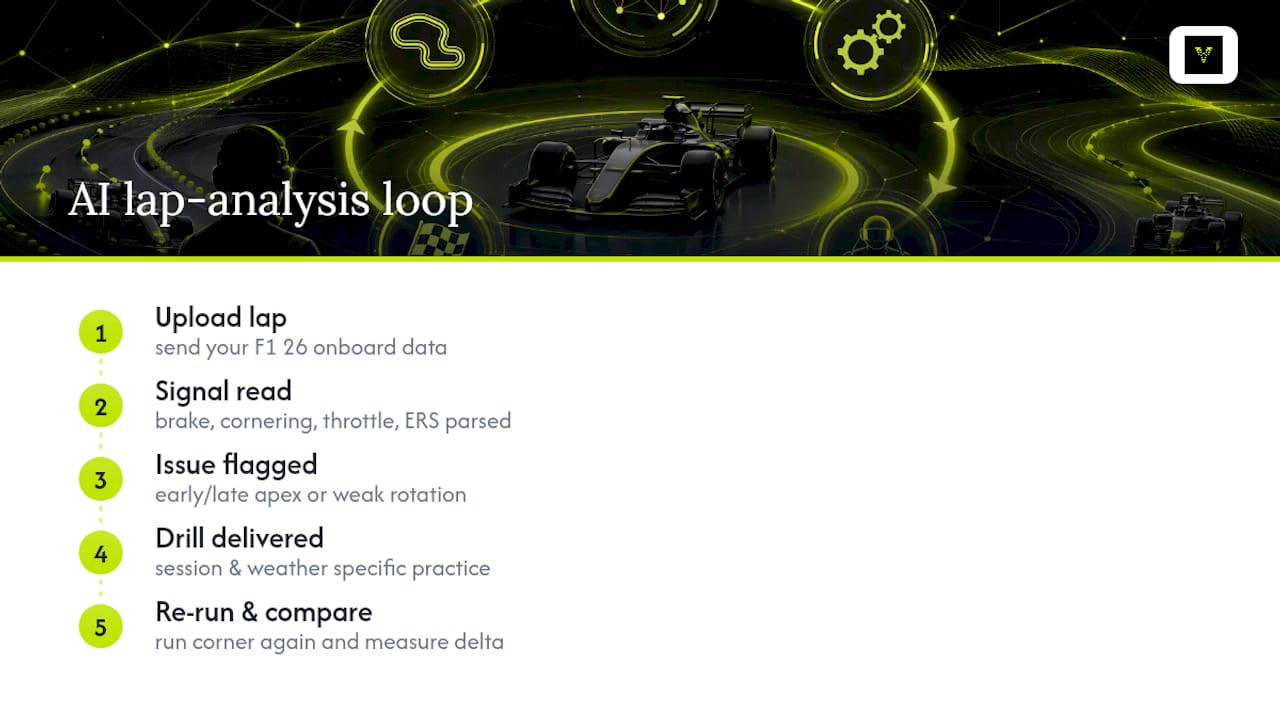
Spotting a mistimed apex from onboard footage alone is hard, because the difference between a good exit and a wasted one is often a fraction of a second in brake release timing or steering angle. Virew reads braking, cornering, throttle, and ERS signals directly from your F1 26 laps and flags exactly where the apex was too early, too late, or lacked the steering kick needed to rotate cleanly.
Because dry and wet conditions get separate treatment, along with distinct coaching for Time Trial, Qualifying, and Race sessions, the drills you get back match what you're actually training for. Upload a lap, get a specific target, re-run the corner, and compare the delta. That loop is faster than guessing from memory.
Get Session-Specific Apex Coaching With Virew
Reading your own onboard footage frame by frame only gets you so far. A tool like Virew's lap analysis turns your uploaded F1 26 laps into a coaching report that pinpoints exactly where your apex timing is costing exit speed, whether that's an early turn-in on a hairpin or a missing steering kick heading onto a DRS straight.
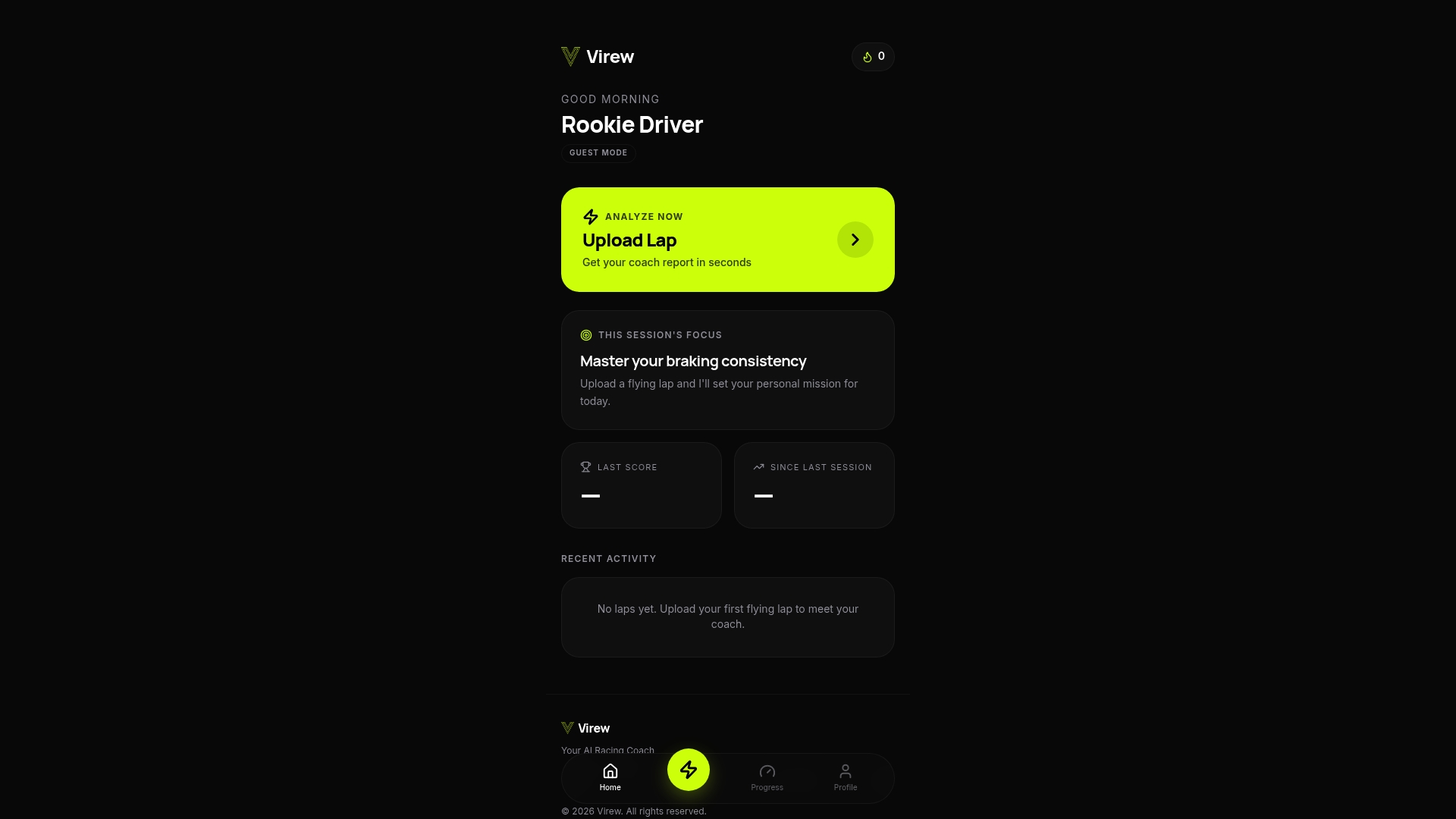
You get corner-specific feedback instead of generic advice, broken down by session type so Time Trial optimization doesn't get mixed up with race-pace conservation. If you're chasing a specific apex fix, the guide on getting faster walks through how the coaching reports translate into on-track changes. Upload a lap now and see where your own apex timing is actually losing time.
A Coach's Note on Apex Timing
Apex timing isn't a talent some drivers have and others don't. It's a mechanical habit built through repetition: drive it, analyze where the exit speed dropped, change one specific thing, repeat. Don't trust the feel of a lap. Trust the sector time and the exit speed number, then test the next change against them.
— Virew
Sources
The racing line breakdown with diagrams covers the geometry behind late versus geometric apex choices in more visual detail than a text explanation allows. The racing line execution guide lays out the practical mechanics of braking, turn-in, and throttle timing for a late apex. The formula-style driving technique guide explains the apex kick and recommends the back-to-back drill format used throughout this article.
- Racing Line Explained: Late vs Geometric Apex (with diagrams)
- Racing Line Guide: Late Apex, Early Apex & Fastest Line
- Formula Sim Racing Guide: F4 to F1 Driving Techniques
FAQ
What is a late apex in F1 26?
A late apex means turning in later than the corner's geometric midpoint, which straightens the exit line and lets you apply throttle earlier for a faster run down the following straight.
When should I use a geometric apex instead?
Use a geometric apex on very high-speed sweepers where the car is already near its cornering limit and there's little exit speed to gain, since the constant-radius line minimizes overall time loss there.
Does apex timing matter more in Time Trial or Race sessions?
Apex timing affects both, but Time Trial and Qualifying reward the most aggressive late-apex line for outright pace, while race sessions call for a slightly gentler apex to manage tire wear over a full stint.
How do I know if I'm turning in too early?
If you consistently run wide on exit or need to lift the throttle to avoid running off track, you're likely apexing too soon; walk the exit point backward to find a later, correct turn-in reference.
Can Virew help me fix apex-timing mistakes specifically?
Yes. Virew analyzes braking, steering, and throttle data from your uploaded F1 26 laps to identify where your apex was mistimed and gives session-specific drills to correct it.