
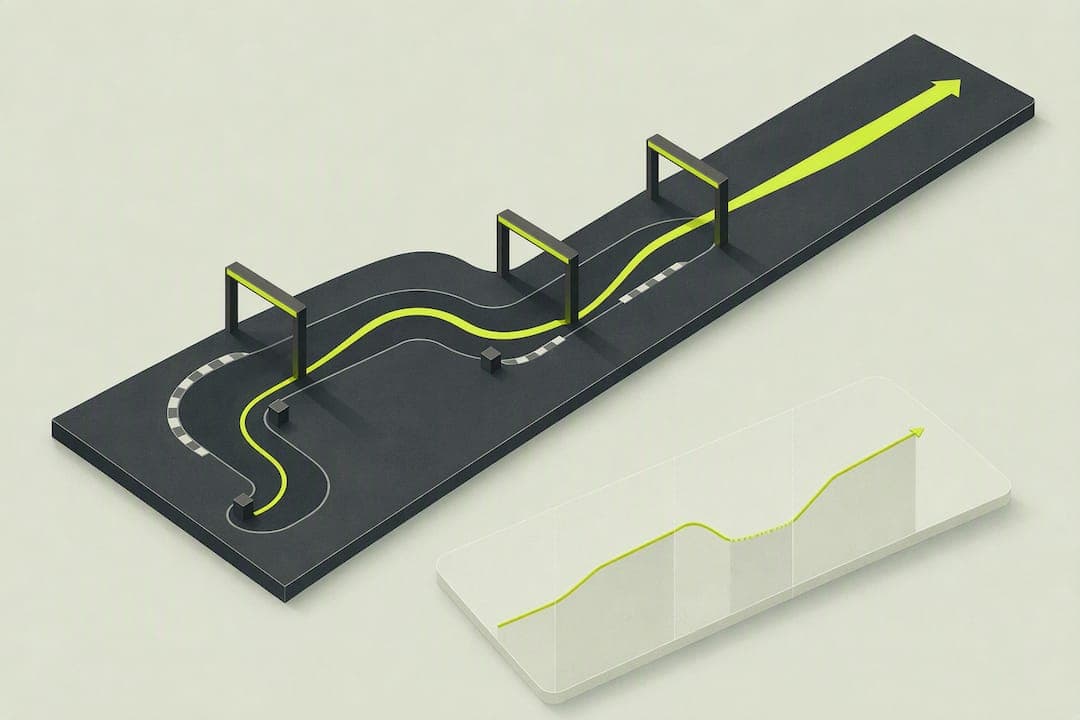
The fastest gains come from short, focused throttle-exit drills, throttle jump paired with a micro-correction, run on medium-speed corners and checked against telemetry every rep. Session type changes the target: Time Trial wants a clean single-lap throttle trace, Qualifying wants a repeatable jump size across two or three laps, Race wants exit speed that holds up on lap 40. Pull up your throttle trace now and run the first drill this session.
TL;DR:
- Focused throttle-exit drills are fastest when repeated on medium-speed corners and checked against telemetry to optimize exit speed and wheel slip.
- Proper throttle jump technique finds the tire’s peak friction window by applying a quick initial throttle, dipping briefly, then building gradually to prevent wheelspin.
- Practice should match the session goal: explosive, stable, or durable throttle control, with corner selection tailored for each, such as medium corners for speed or slow hairpins for precision.
- Telemetry analysis of throttle percentage, wheel slip, and exit speed helps identify specific issues and guide incremental improvements session by session.
- Using calibrated pedals, consistent setup, and linking throttle with steering and braking ensures a steady transfer of traction control skills to race conditions.
Table of Contents
- What Is Traction Control Practice in F1 26?
- Session Objectives: What "Good" Looks Like in Each Mode
- Practice Drills: Step-by-Step Exercises You Can Run Today
- Telemetry and Metrics: How to Know the Drill Is Working
- Setup and Control Tweaks That Make Practice Transfer to Lap Time
- Common Throttle Mistakes and How to Fix Them
- Track and Corner-Specific Traction Control Techniques
- How Weather and Track Conditions Change Traction Practice
- Blending Throttle With Steering and Braking Through the Corner
- Advanced Telemetry Analysis for Fine-Tuning Traction Control
- Mental and Physical Habits That Keep Throttle Control Consistent
- Why a Data-Driven Loop Shortens the Learning Curve
- Upload Your Laps and Let Virew Find the Real Problem
- Sources
What Is Traction Control Practice in F1 26?
Traction control practice, in in F1 26 terms, has nothing to do with flicking an assist on or off. It means training your right foot to apply throttle on corner exit without triggering wheelspin, using repeatable drills and telemetry feedback until the motion becomes automatic. Some players confuse this with the in-game Traction Control assist setting, but that's a different topic entirely. This article is about throttle discipline, the skill that separates a driver who spins the rears out of Turn 4 at Shanghai from one who carries speed onto the next straight.
The standard technique behind most of this practice is called the throttle jump: a quick initial application, a small deliberate dip, then a progressive build to full throttle. It's the mechanical foundation for everything below, and it works because it finds the tire's peak friction window before committing to full power, which helps rotation and exit speed without spinning the car.
Session Objectives: What "Good" Looks Like in Each Mode
Traction practice isn't one drill you run once and forget. What counts as progress in Time Trial looks different from what counts in a 50-lap Grand Prix, and picking the wrong corners to drill will waste a session.
Time Trial is about squeezing everything out of one perfect lap. Here, the target is a clean throttle trace with no correction spikes, minimal wheel slip, and the highest exit speed you can hold through 100 meters past the apex. You're not worried about repeating it forty times. You're worried about nailing it once.
Qualifying flips the priority toward reproducibility. A throttle jump you can only hit once in ten attempts is useless when you need two or three clean laps in Q3.
Race sessions care about durability more than peak performance. Wheelspin frequency and magnitude matter because every spin cooks the rear tires a little more. The goal shifts to limiting how often you trigger slip, protecting tire temperatures, and keeping exit speed within a tight band lap after lap, even as fuel burns off and grip degrades.
Corner selection should match the goal:
- Medium-speed corners (Turn 9 at Bahrain, Turn 3 at Suzuka) are ideal for throttle-jump reps because they reward an aggressive early application without punishing a mistake too harshly.
- Slow hairpins (Turn 12 at Monaco, the Loews-style corners) are better for pure modulation practice, where the margin for error is smaller and precision matters more than speed.
- Multi-corner chains (the Maggotts-Becketts-Chapel sequence style at Silverstone) train sequencing, where one exit's throttle timing dictates the next corner's entry.
Steering input plays into this more than most drivers realize. Cleaner, earlier steering at corner entry means less mid-corner correction, which means the throttle application on exit doesn't have to fight a car that's still rotating. Practicing smoother steering inputs alongside throttle drills often fixes traction problems that look like a throttle issue but are actually an entry issue.
Practice Drills: Step-by-Step Exercises You Can Run Today
These four drills build on each other. Run them in order during your next practice session rather than jumping straight to the hardest one.
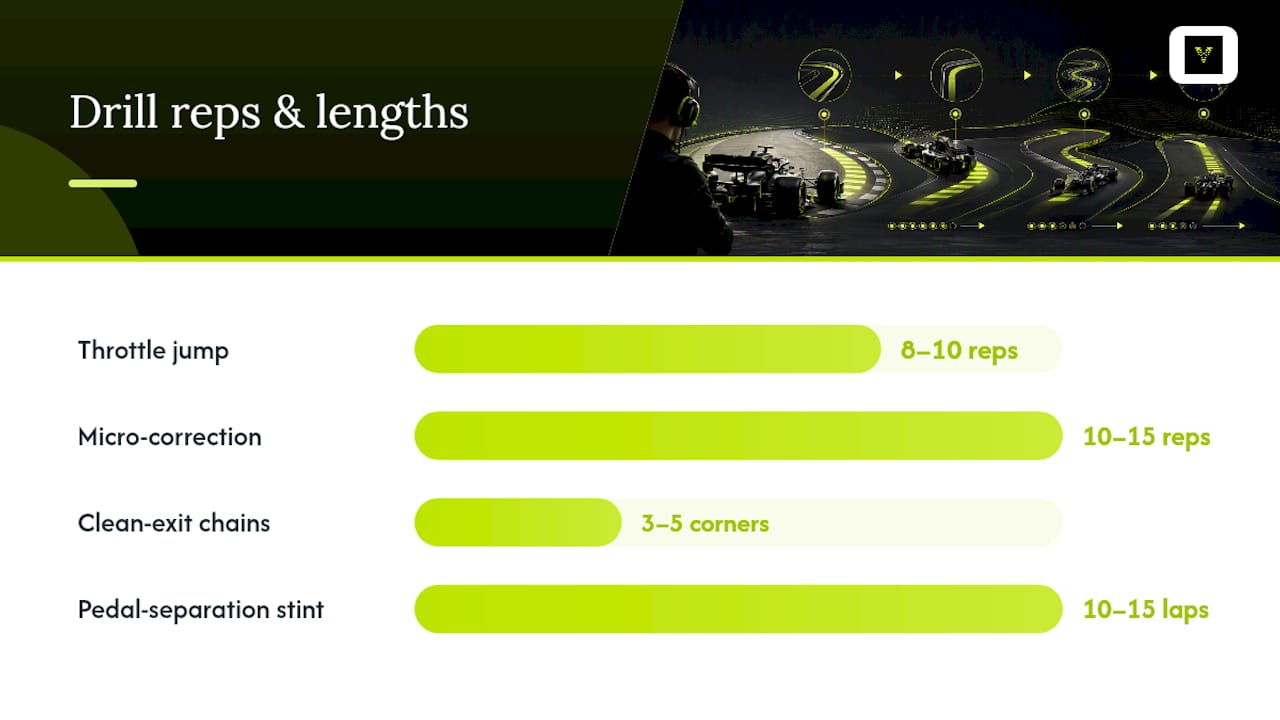
- Throttle jump drill. Pick one medium-speed corner exit. Start with a conservative initial jump of 20 to 30 percent throttle, hold briefly, then build progressively to full power. Run 8 to 10 reps at this level before reviewing your telemetry. If wheel slip stays low and exit speed climbs, increase the jump size in 10 percent steps toward 50 to 60 percent, checking telemetry after every batch.
- Micro-correction drill. This is the safety valve for the throttle jump. Practice the small back-off, a brief dip in throttle right after the initial spike, before building again. Run this in blocks of 10 to 15 reps, watching specifically for wheel slip spikes on your telemetry overlay rather than lap time.
- Clean-exit chains. Link three to five medium corners in sequence, ideally a section like Turns 7 through 11 at Suzuka. Run a few laps at a fixed, conservative pace to groove the sequencing, then push exit speed corner by corner once the rhythm feels automatic.
- Pedal-separation drill. Brake fully, come completely off the throttle, then reapply slowly. This isolates one input at a time rather than blending brake release and throttle application, which tends to build faster, cleaner motor habits than practicing both together. Check your telemetry for any throttle trace overlap with the brake trace, that overlap is the mistake you're trying to eliminate.
Once those feel solid, add pressure. Run a 10 to 15 lap stint with tire wear turned on and simulate dirty air by following an AI car closely into a corner. This forces you to practice conservative, disciplined exits under the kind of pressure that causes wheelspin mistakes in real races.
Pro Tip: Warm your tires with a full lap before starting throttle-jump reps. Cold tires have a much smaller safe jump size, and drilling on cold rubber teaches you the wrong lesson about where the grip limit actually sits.
Telemetry and Metrics: How to Know the Drill Is Working
Four traces matter more than any others when you're grading a traction drill: throttle percentage over time, wheel slip percentage, speed at the corner exit point, and RPM band relative to gear choice. Everything else is secondary.
The goal isn't to hit an absolute number pulled from someone else's setup. It's to watch these traces move in the right direction session over session:
- A tighter throttle trace shape, meaning fewer jagged corrections and a smoother climb to full power.
- Lower peak wheel slip spikes on the same corner exit compared to your last session.
- Higher speed 50 to 100 meters past the corner exit, which is where throttle discipline actually shows up on the stopwatch.
- Consistent RPM and gear selection across repeated laps of the same corner, a sign your inputs are becoming automatic rather than reactive.
Overlay your current lap's throttle trace against your personal best, or against a coach-supplied reference lap, and look for fewer correction dips and tighter timing between the two. If your trace lags the reference by even a tenth of a second on when the throttle jump starts, that's usually where the lap time is disappearing.
Small, specific telemetry targets, a percentage reduction in slip spikes, a measurable kph gain shortly after the exit, make improvement something you can actually verify rather than something you guess at. This is exactly where AI-assisted lap analysis tools like Virew add value: automated detection flags throttle spikes you might miss scrolling through a manual trace, suggests target ranges based on the corner type, and tracks the delta between sessions so you're not relying on memory to judge whether Tuesday's practice actually beat Monday's.
Setup and Control Tweaks That Make Practice Transfer to Lap Time
Drilling throttle control on a rig with input noise or a badly tuned differential teaches you to compensate for hardware problems instead of building real skill. A few checks fix that before you waste a session.
Start with your pedals. Small deadzones prevent phantom throttle-on-brake inputs, and precise, calibrated pedal hardware makes the difference between a clean micro-correction and one that reads as noise on your telemetry.
- Recalibrate pedals before every serious practice block, hardware drifts more than people expect.
- Test a smoother throttle sensitivity curve if your traces show jagged, stepped inputs rather than a clean build.
- Lower your on-throttle differential setting for slow corners to improve traction, accepting a small trade-off in rotation.
- Run a touch of forward brake bias for entry stability, and short-shift out of slow corners to cut wheelspin risk on exit.
- Nudge rear tire pressures slightly higher if slip persists, but watch tire temperatures climbing too far in response.
Circuit-specific setup work matters here too. A track like Shanghai rewards a traction-focused rear setup because of its heavy braking zones into slow corners, while a flowing circuit needs a different balance entirely.
Common Throttle Mistakes and How to Fix Them
Most wheelspin problems trace back to one of five habits, and all five show up repeatedly across F1-series lap data.
Touching the throttle while still on the brake is the most common, and it happens because drivers try to blend the transition instead of separating it cleanly. Fix it with the pedal-separation drill above until full release becomes automatic. Double inputting, tapping the throttle, lifting, then reapplying, usually comes from hesitation at the apex. The fix is committing to the initial throttle jump rather than testing the water with a tap.
Being too smooth is a mistake that sounds counterintuitive but costs real time: a perfectly gradual throttle application skips the aggressive initial jump that actually rotates the car, leaving speed on the table. Early throttle application, going to power before the car has finished rotating, causes understeer and pushes you wide, which then tempts an even earlier lift on the next lap. And stairstepping, applying throttle in visible steps instead of one continuous build, shows up clearly on a telemetry trace as a jagged line instead of a smooth curve. Each of these is fixable with isolated reps rather than full-lap practice, because full laps let you paper over one bad habit with another.
Track and Corner-Specific Traction Control Techniques
Not every corner asks for the same throttle approach, and treating them identically is a common reason practice doesn't transfer to race pace.
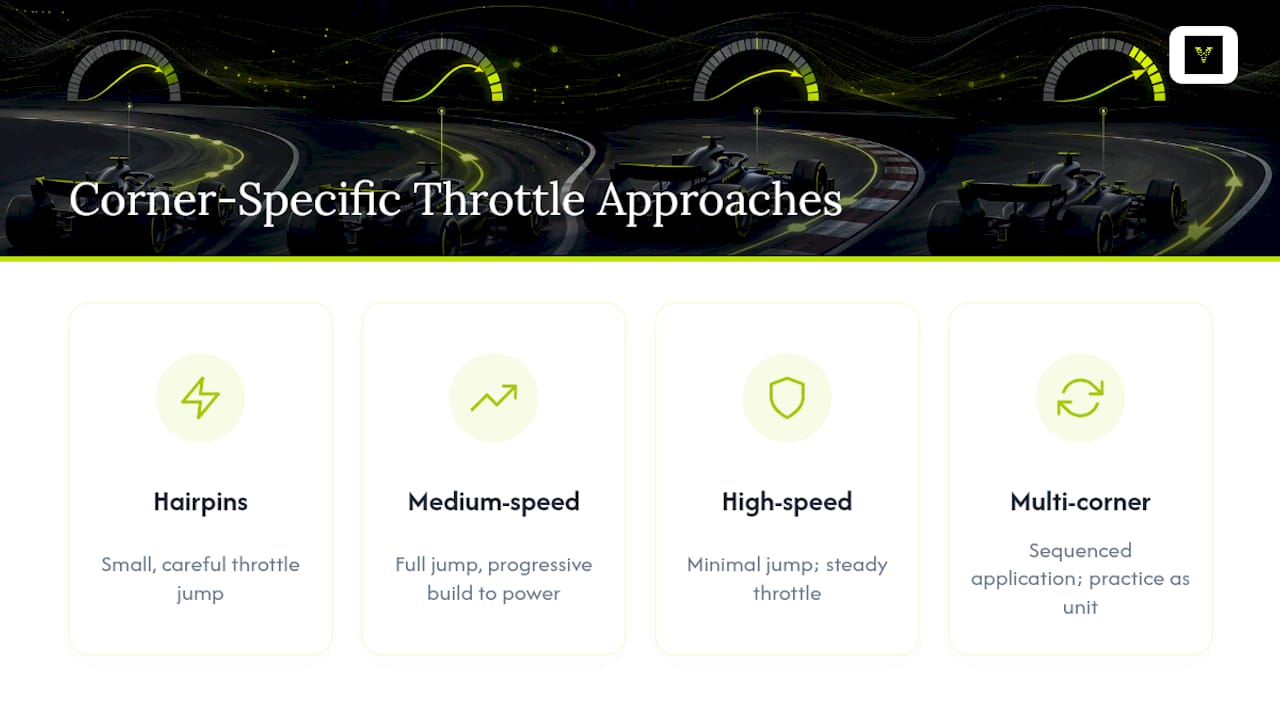
Slow hairpins, think the tight final corners at tracks with a Monaco-style layout, demand a smaller, more careful throttle jump because the car is barely moving and the rear tires have less momentum to work with. Push too hard here and the spin happens immediately, with no room to correct.
Medium-speed corners, the Turn 9 style exits found at Bahrain and similar circuits, are where the full throttle jump technique shines. There's enough speed for the tire to find grip quickly after the initial spike, and enough track ahead to build to full power progressively.
High-speed corners taken at partial throttle, like Turn 8 at Silverstone in older configurations, need almost no jump at all. The load through the tire is already high from cornering speed, and an aggressive throttle application here is more likely to unsettle the rear than help it.
Multi-corner chains need something else entirely: sequencing. The throttle application exiting corner one has to account for the entry demands of corner two, which means practicing these sections as a unit rather than isolating each corner. Run the chain slow first to learn the rhythm, then add pace once the sequence feels automatic.
How Weather and Track Conditions Change Traction Practice
Dry and wet traction practice are different skills, not variations on the same one, and drilling them together muddies your telemetry data.
In dry conditions, grip is relatively stable lap to lap outside of tire wear and track evolution, so your throttle-jump size should stay consistent once you've found it for a given corner. The main variable to track is tire temperature climbing over a stint, which slowly shrinks your safe jump size even if the track itself hasn't changed.
Wet conditions demand a completely different baseline. Grip levels change corner to corner depending on the racing line's rubber buildup, standing water, and whether you're on Intermediates or full Wet tires. The throttle jump technique still applies, but the safe jump size shrinks dramatically, and micro-corrections need to happen faster because a slide develops with far less warning. Practice wet traction drills separately, ideally in a dedicated wet-weather session, rather than switching conditions mid-practice and trying to compare telemetry across the two. The data won't be comparable, and you'll draw the wrong conclusions about what's actually working.
Track evolution within a single dry session also matters more than most drivers account for. A track that's rubbering in over a race weekend gains grip lap by lap, which means a throttle jump size that caused wheelspin on lap 3 might be completely safe by lap 15. Rerun your baseline drill periodically through a long session rather than assuming your settings from earlier still apply.
Blending Throttle With Steering and Braking Through the Corner
Traction control practice fails when you drill throttle application in isolation and ignore how it connects to what your hands are doing on the wheel. The two inputs are locked together mechanically: throttle applied while the car is still rotating through the corner asks the rear tires to do two jobs at once, generating cornering force and forward traction, and that's exactly when wheelspin happens.
The fix is timing your throttle jump to the rate your steering is unwinding, not to a fixed point on the track. As the steering angle straightens, the throttle can build more aggressively; apply full power while the wheel is still turned and you're fighting physics. This is why practicing steering technique and throttle control together, rather than as separate skills, produces faster results than drilling either one alone.
Braking connects to this too, though less directly. A late, hard trail-braking release that overlaps with early throttle application is one of the most common causes of throttle-on-brake wheelspin. Clean separation between brake release and throttle application, the pedal-separation drill covered earlier, solves this at the source rather than trying to fix it with a softer throttle curve.
Advanced Telemetry Analysis for Fine-Tuning Traction Control
Once the basic drills are grooved, the next gains come from reading telemetry more precisely rather than running more laps. Overlay comparisons between your current session and a personal best reveal exactly where the throttle trace diverges, often a fraction of a second before you'd notice it in the driving itself.
Look specifically at the gap between your steering unwind rate and your throttle build rate on the same corner exit. If the throttle trace climbs faster than the steering straightens, that gap shows up as a wheel slip spike even when your overall technique feels fine. This is the kind of detail that's nearly invisible watching a replay but obvious on an overlaid graph.
RPM and gear data matter more than most drivers check. If you're consistently a gear too low exiting a corner, the engine will be higher in the RPM band, and more torque delivered to the rear wheels at a given throttle percentage makes wheelspin far more likely. Sometimes the fix for a traction problem isn't throttle technique at all, it's shifting up one gear before the exit.
Session-to-session delta tracking is where automated analysis earns its place over manual review. Spotting a two percent reduction in peak slip on a specific corner across five sessions is tedious to track by hand, and easy to miss the trend entirely.
Mental and Physical Habits That Keep Throttle Control Consistent
Throttle discipline breaks down under fatigue and frustration faster than almost any other driving skill, because it's a fine motor input rather than a big, decisive movement like braking.
Physically, grip on the pedal and a stable seating position matter more than drivers expect. A foot that's shifting position between laps introduces small, inconsistent pressure changes that show up as noise in your throttle trace, noise that looks like a technique problem but is actually a posture problem.
Mentally, practicing one input at a time, as covered in the pedal-separation drill, works because isolating a single skill reduces cognitive load and builds a cleaner habit than trying to fix your braking, steering, and throttle all in the same lap. Stack too many corrections into one practice session and none of them stick.
Fatigue is worth tracking honestly. If your wheel slip numbers start creeping up late in a practice session with no setup change, that's often tiredness affecting fine motor control, not a sudden skill regression. Ending a session on a clean rep rather than pushing through a tired, sloppy one reinforces the correct habit instead of the mistake.
Why a Data-Driven Loop Shortens the Learning Curve
Guessing at throttle technique from feel alone takes far longer than checking a trace after every rep. Virew analyzes your throttle application and wheel slip patterns from uploaded F1 26 laps, then builds specific drills around whatever pattern is actually costing you time, rather than generic advice that assumes every driver's problem looks the same.
That's the core of the Drive, Analyze, Improve, Repeat loop: drive a session, see exactly where the throttle trace breaks down, run the targeted drill, then check whether the next session's data actually moved.
— Virew
Upload Your Laps and Let Virew Find the Real Problem
Virew is the difference between guessing at your throttle technique and knowing exactly which corner exit is costing you time. Upload a session from F1 26 and the AI lap analysis reads your throttle trace and wheel slip data automatically, flagging the specific exits where wheelspin or hesitation is eating into your lap time, then recommends drills matched to that exact pattern instead of generic advice.
Upload footage from your Time Trial, Qualifying, or Race session, PlayStation, Xbox, or PC all work, and focus on a lap where you felt the rear step out or lost drive on exit. That's the clip that gives Virew the most to work with. Full walkthroughs on getting the most out of a report are in the Virew usage guide, and the lap-time improvement hub is the place to start if you want the coaching tied directly to the drills covered here. Run your next session, upload the lap, and see exactly where the throttle jump is either winning or losing you time.
Sources
- Prevent Understeer in F1 25, LMU, & iRacing with the “Throttle Jump” Technique
- How to be fast in Formula 1 sim racing (hardware and technique) — Fanatec
- Steering technique in sim racing | SimXPro