

Throttle modulation is the skill of adjusting how much torque you request from the engine to match the grip actually available at the rear tires, rather than treating the pedal as an on/off switch. The core rule is simple: apply torque in a smooth ramp, never a step, and taper it the instant the rear steps out of line. On F1 26's Time Trial or an off-road crawl over loose rock, that single habit separates clean exits from spins.
TL;DR:
- Smooth, progressive throttle inputs reduce stair-step traces and spikes, improving exit speed consistency and decreasing tire wear through better torque modulation.
- Throttle response lag and inconsistency often result from mapping issues, hardware faults, or technique errors, necessitating targeted analysis and adjustments.
- Effective off-road brake-throttle modulation requires steady, coordinated pedal inputs, avoiding pulsing, to recover from low-traction situations without causing brake fade.
- Regularly reviewing lap telemetry and uploading data to analysis tools helps identify specific throttle errors, such as hesitation or wheelspin, enabling precise adjustments.
- Focusing practice on corner exit throttle control and analyzing your throttle trace significantly improves lap times more than solely working on braking.
Table of Contents
- What Is Throttle Mapping and How Does Pedal Position Become Torque?
- How Do You Read Telemetry to Fix Throttle Modulation Mistakes?
- What Is Brake-Throttle Modulation and When Should You Use It?
- Why Does Your Throttle Feel Laggy or Jerky?
- Your Weekly Modulation Practice Plan
- Why Throttle Modulation Deserves More Coaching Time Than It Gets
- Train Throttle Modulation With Real Lap Data
- Sources
- FAQ
What Is Throttle Mapping and How Does Pedal Position Become Torque?
Pressing the throttle pedal doesn't directly open a valve and dump power to the wheels anymore. In both real F1 cars and F1 26's simulated drivetrains, pedal position is a request that passes through a torque map before it becomes actual output. Renault Sport F1 engineer David Lamb has described the engine torque map as something close to a fingerprint: it dictates exactly how the engine behaves during lift-off and reapplication, and getting that curve wrong makes a car feel unpredictable no matter how good the driver is.
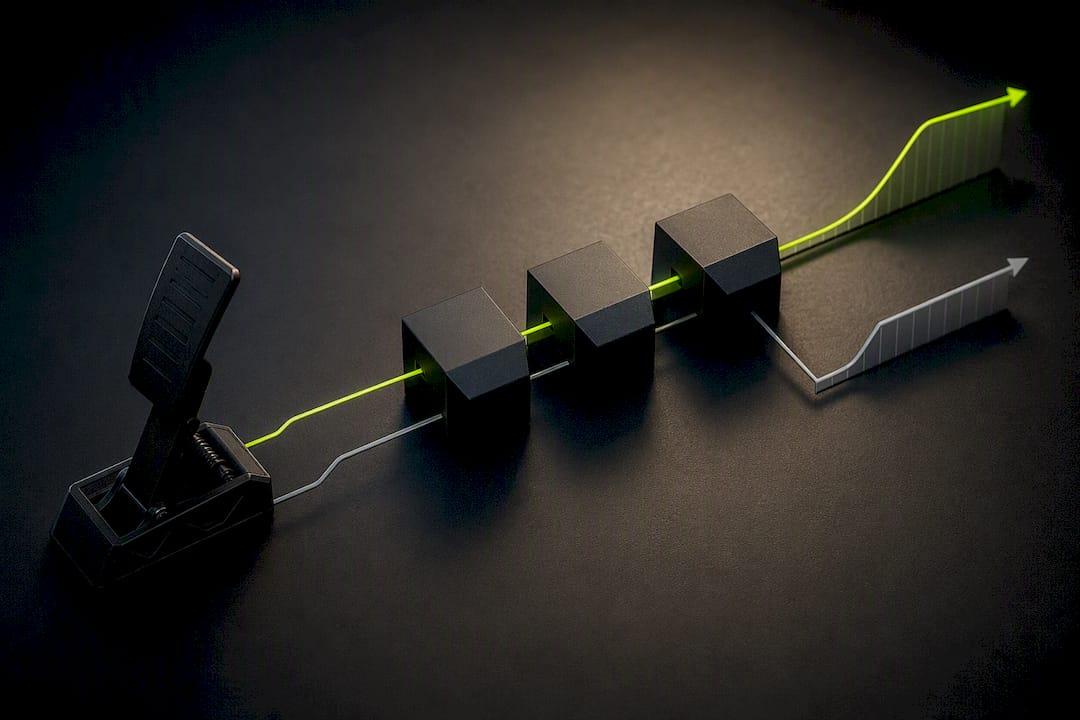
Two terms get confused constantly: pedal sensitivity and throttle response. Pedal sensitivity is how much pedal travel it takes to request a given torque change, a matter of the map's shape near the bottom of the pedal's travel. Throttle response is how quickly the engine actually delivers that requested torque once asked. A pedal can be extremely sensitive (tiny inputs cause big requests) while the engine still lags behind, because mapping algorithms and actuator dynamics govern the delay separately from the sensitivity curve.
Traction control adds another layer between your foot and the tarmac. These systems estimate wheel slip in real time and cut or filter the throttle reference before it reaches the engine, meaning your input can get overridden the moment a traction-control module detects excess slip. Engineers also tune pedal maps to influence tire wear, since a harsher low-end torque curve spikes slip angle and chews through rubber faster, a trade-off OptimumG documents in detail.
What this means for your inputs on track:
- Smooth, progressive pedal movement produces a smooth torque curve, even through a nonlinear map.
- Stabbing the throttle asks the ECU for a torque step it may not deliver cleanly, producing hesitation or a sudden snap.
- Your tire wear and lap-time consistency both depend on how gradually you build torque out of low-speed corners, not just how much you eventually apply.
How Do You Read Telemetry to Fix Throttle Modulation Mistakes?
Open your throttle trace after any F1 26 session and look for two shapes: stair-steps and spikes. A stair-step trace, where the line jumps in discrete jolts instead of climbing smoothly, usually means you're pumping the pedal instead of rolling into it. A spike followed by a sharp drop means you nailed the throttle, triggered wheelspin or a traction-control cut, then lifted in reaction. Neither shape should appear on a clean exit trace, which should look like a steady ramp from zero to 100 percent over the first few car lengths past the apex.
Feathering and pinning are the two extremes you're managing. Feathering means small, incremental throttle inputs used when the rear is light or the surface is marginal, common through low-speed technical sections like the Turn 6 hairpin at Hungaroring. Pinning it means committing to full throttle once the car is pointed straight and grip is available, which is the correct move once the exit angle is settled. Getting the transition point right, feathering through the rotation and pinning on exit, is what modulation training actually builds.
Two drills to run this week:
- Time Trial exit consistency drill: Pick one medium-speed corner, like Turn 9 at Silverstone, and run 10 consecutive laps focused only on throttle application from apex to track-out. Track exit speed on each lap and aim to get your variance under 3 km/h across all 10.
- Race-pace wheelspin drill: Run a 15 lap stint at race fuel and count wheelspin events flagged on your traction indicator. Your target is zero events by lap 10 as tire wear increases and grip drops.
ERS deployment should follow your throttle curve, not fight it. Deploying full electric power the instant you touch the throttle on corner exit adds a torque spike on top of an already sensitive moment, which is exactly when you don't want one. Feather ERS deployment in with the throttle ramp, then open both up together once the car is straight.
Pro Tip: Practice one gear higher than feels natural on tricky, low-grip exits. Less torque multiplication through the gearbox gives you a wider window to modulate the pedal before you hit the slip threshold.
What Is Brake-Throttle Modulation and When Should You Use It?
Brake-throttle modulation, known as BTM, is an off-road technique for low-traction situations where an open differential sends all available torque to whichever wheel has the least grip, usually the one spinning freely in mud, sand, or snow. Off-road communities have documented BTM as a reliable recovery method for exactly this scenario, described extensively in threads like the one on Tacoma World. Applying light, steady brake pressure with your left foot creates resistance at the spinning wheel, which forces the differential to route torque back to the wheel that still has traction.
Executing BTM cleanly takes coordination, not brute force:
- Apply throttle first to get the driveline loaded and turning, then add light, steady brake pressure with the other foot.
- Increase brake pressure gradually until you feel the vehicle start to move forward, not in one hard stomp.
- Keep both inputs steady rather than pulsing either pedal, since pulsing reintroduces the exact wheelspin you're trying to eliminate.
- Release both pedals together once the vehicle is moving and has regained forward momentum.
BTM isn't free. Holding both pedals down simultaneously builds heat in the brakes and puts extra load on the clutch or torque converter, so it should be a recovery technique for genuinely stuck situations, not a habit for every loose surface. Avoid it entirely if your brakes are already showing signs of fade or if the vehicle has a locking differential that solves the problem more directly. After any BTM attempt, check brake temperature, listen for unusual drivetrain noise, and confirm the vehicle is tracking straight before continuing.
Why Does Your Throttle Feel Laggy or Jerky?
Most modulation complaints break down into three categories, and figuring out which one you have determines the fix. Technique errors show up as jerky toe movements on the pedal, throttle hunting where you repeatedly correct a small input, or nailing full throttle mid-corner and inducing oversteer before the car is straight. Mapping and software causes look different on a trace: a non-linear pedal map that feels dead for the first 20 percent of travel then surges, or torque filtering and traction control interventions that clip your requested output. Hardware issues in a real vehicle show up as inconsistent readings from a worn pedal sensor or a failing actuator, and some drivers even try to fix drivability complaints by installing an aftermarket voltage-altering module between the sensor and ECU, which changes pedal feel but doesn't fix an underlying fault.
Quick checklist to isolate the cause:
- In F1 26, test a different throttle sensitivity or linearity setting in the control options before assuming it's you.
- Record a lap and check whether the trace is stair-stepped (technique) or clipped at a threshold (traction control cutting in).
- On a real vehicle, a dead zone at the top of pedal travel combined with erratic idle usually points to sensor wear, not driver error.
Your Weekly Modulation Practice Plan
Three focused sessions beat one long unstructured one. Structure your week like this:
- Session one, Time Trial focus: Ten laps on one circuit, throttle-only focus, reviewing your trace after every three laps for stair-steps.
- Session two, race-pace focus: A 15 to 20 lap stint tracking wheelspin events and tire temperature trends as the stint progresses.
- Session three, review and adapt: Upload your best and worst laps to Virew's lap analysis tool and compare throttle traces side by side to spot where the gap actually is.
Track three numbers across the week: exit speed variance at your chosen corner, count of wheelspin or traction-control events per stint, and your lap-time delta between session one and session three. In wet conditions, cut your target exit speed variance in half and expect feathering to dominate far more of the corner, since grip windows are narrower and less forgiving of a rushed throttle ramp.
Pro Tip: Run your review session on a different track than your practice sessions. If your throttle discipline holds up somewhere unfamiliar, the skill has actually transferred rather than just becoming memorized inputs for one corner.
Why Throttle Modulation Deserves More Coaching Time Than It Gets
Most drivers spend their practice time chasing braking points because braking mistakes feel dramatic and obvious. Throttle mistakes are quieter, a tenth lost here, a bit of exit speed given up there, and they compound over a full lap without ever announcing themselves the way a lockup does. That's exactly why it's a high-return skill to isolate in practice: fix your exit ramp on three or four corners and the time gain shows up everywhere, not just in one spot. Data-driven review shortens that process considerably, because a throttle trace shows you the stair-step or the spike immediately instead of leaving you to guess from a feel that was gone half a second after it happened. Wet running deserves its own separate practice block too. The margin for a rushed throttle application shrinks so much in the rain that treating wet and dry as the same skill with different grip levels will slow your progress in both.
— Virew
Train Throttle Modulation With Real Lap Data
Reading your own throttle trace tells you something happened. It doesn't always tell you why, or what to change next time you're on that same exit. Virew closes that gap by analyzing your uploaded F1 26 laps and flagging exactly where your throttle application created a wheelspin event, a stair-step, or a slower-than-ideal exit speed, then explaining what a cleaner input would have looked like at that specific corner.
After a session, upload your lap through the F1 26 lap analysis tool and get a corner-by-corner breakdown instead of a single lap time. You'll see your throttle trace against a target curve, a count of traction interventions, and a clear note on where feathering should have replaced a full stab. Pair that with the how to get faster in F1 26 guide for a full training structure, or check how to use Virew if this is your first upload. Run your next session, upload the lap, and see exactly where your throttle foot is costing you time.
Sources
- An insight into throttle mapping
- Throttle maps and tire wear | OptimumG
- Throttle mapping algorithms and pedal sensitivity | Pedal Commander
- Traction control system overview | Altair MotionView
FAQ
What Is Throttle Modulation?
Throttle modulation is adjusting how much torque you request through the pedal to match available grip, rather than applying it all at once. It relies on smooth, progressive inputs rather than sudden on/off pedal movements, and it's what separates a clean corner exit from a snap of oversteer.
What Are the Downsides of a Throttle Controller?
Aftermarket throttle-modifying devices alter the voltage signal between the pedal sensor and ECU to change how the vehicle responds to pedal input. They change feel but don't fix an underlying sensor or mapping problem, and they can mask symptoms of a fault that needs proper diagnosis instead.
What Are the Symptoms of a Bad Throttle Actuator Control Module?
Common symptoms include inconsistent pedal sensor readings, unexpected power cuts, or a throttle response that changes unpredictably between similar inputs. If a trace shows erratic torque delivery with no clear pattern tied to your pedal movement, hardware is a more likely culprit than technique.
How Do I Make My Throttle Response Better?
Start by separating pedal sensitivity from actual response time, since the two are governed by different parts of the system. In F1 26, testing different throttle linearity settings helps with sensitivity, while smoother, more progressive pedal inputs address response by avoiding the torque steps that trigger traction-control cuts. Uploading a lap to Virew's lap analysis shows exactly where your current inputs are creating those cuts.