
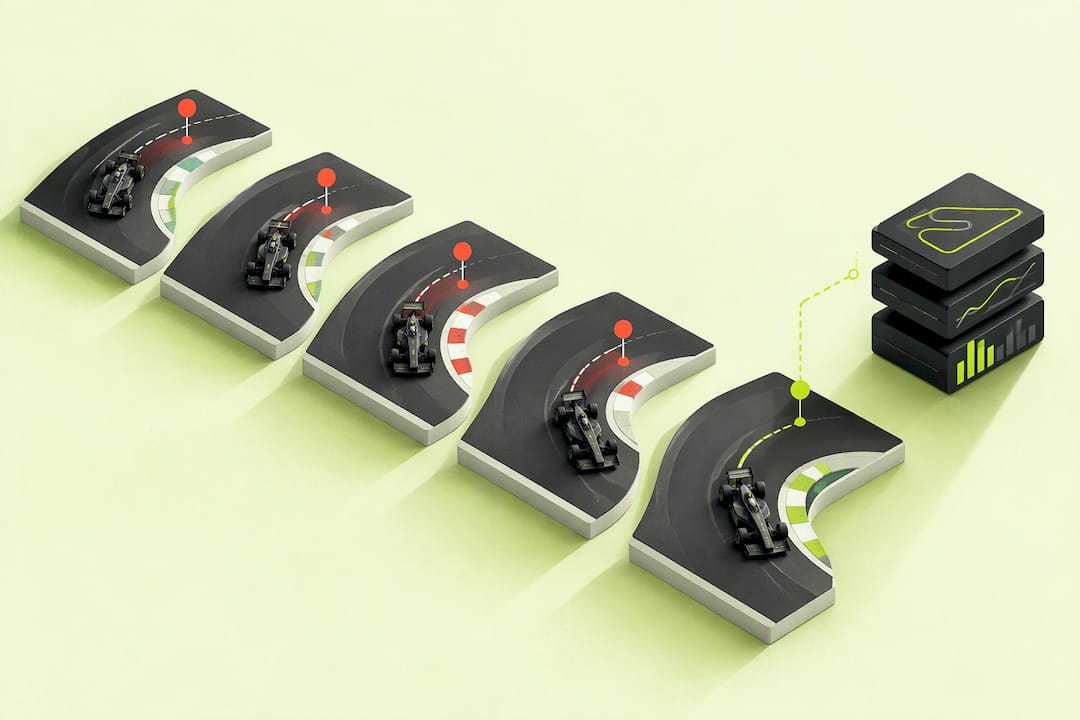
Smooth inputs in F1 26 mean deliberate, progressive throttle, brake, steering and ERS application that minimizes corrective steering and mid-corner balance shifts. The single best habit to build first is progressive throttle roll-on out of corners, practiced in Time Trial until it becomes automatic. Chase consistency before chasing lap time. Once your inputs stop fighting the car, the pace follows on its own.
TL;DR:
- Consistent, gradual throttle, brake, and steering inputs reduce mid-corner corrections and improve lap consistency more than aggressive approaches.
- Adjusting control settings like steering deadzone, linearity, and assist features can significantly lessen twitchy inputs during practice.
- Prioritizing micro-practice drills in Time Trial, such as throttle roll-on and steering rhythm exercises, accelerates input smoothness development.
- Tracking improvements through lap time variance and fewer corrections provides a clearer measure of evolving input smoothness than raw speed alone.
- Using AI lap analysis helps identify specific input errors, making targeted practice more efficient and reducing the number of sessions needed for improvement.
Table of Contents
- Why gradual inputs beat aggressive ones in F1 26
- Controls and calibration that make learning possible
- Repeatable Time Trial drills for smoother inputs
- Adjusting smoothness goals by session type
- A quick calibration and testing checklist
- How AI coaching fits into this practice cycle
- What actually separates fast beginners from slow ones
- Get faster practice feedback with Virew
- FAQ
- Sources
Why gradual inputs beat aggressive ones in F1 26
Every snap of the wheel or stab of the brake upsets the car's balance, and the car needs time to settle again before it can carry speed. That settling time is where beginners lose the most ground, not from a lack of commitment but from a surplus of correction. Beginners should ease onto the throttle after the apex rather than slamming it, since gradual roll-on keeps the rear tires loaded evenly and prevents the snap oversteer that turns a decent corner into a spin.
There's a difference between input timing (when you act) and input magnitude (how much you apply). Beginners usually fix timing first because it is easier to see, but magnitude control is what actually removes the mid-corner corrections that wreck consistency.
- Fewer corrections per lap almost always means tighter lap-to-lap times.
- Smooth is not the same as slow: a smooth driver can still brake hard and turn in decisively, just without snapping the inputs.
- Decisiveness matters at the moment of commitment, like turn-in or the initial brake application; smoothness matters in how that commitment is carried out.
Hands and feet that move with purpose, not hesitation, produce the progressive curve that keeps the car balanced through a corner.
Controls and calibration that make learning possible
Twitchy inputs often come from the settings menu, not from your hands. Before you touch a single drill, check your control setup.
- Turn on Anti-Lock Brakes and a light Traction Control setting while learning. These exist in F1 26 specifically to reduce the penalty for small input errors while you build muscle memory.
- Raise your steering deadzone slightly if your wheel or stick shows constant micro-twitches at center, and increase steering linearity so the first few degrees of input produce a gentler response.
- Set throttle linearity so early pedal or trigger travel doesn't dump full power instantly.
- Decide whether ERS deployment should be hold or toggle. Hold mode tends to produce smoother, more deliberate deployment because you have to actively maintain the input rather than flick a switch.
EA's own accessibility resources document these calibration and assist options across deadzone, linearity and assist presets, and the same framework carries into F1 26's control remapping and sensitivity settings.
Pro Tip: Test any single setting change over five identical Time Trial laps before deciding if it helped; one lap tells you nothing.
Repeatable Time Trial drills for smoother inputs
Time Trial is the best place to build these habits because it strips out fuel load, tire wear and traffic, letting you repeat the same corner until the input becomes automatic.
- Corner micro-practice. Pick one corner that gives you trouble and run it in three phases: approach only, apex only, exit only. Reset after each phase rather than trying to fix the whole corner at once.
- Brake release drills. Brake hard, then practice releasing pressure gradually rather than snapping off the pedal, which is what causes the rear to step out on entry.
- Throttle roll-on drills. From the apex, apply throttle in a steady curve rather than a sudden spike. This is the single habit beginner guides consistently point to as the fastest route off spins.
- Steering rhythm drills. Practice small corrective movements rather than big ones, hold a steady angle through the mid-corner phase, and unwind the wheel progressively on exit instead of snapping it straight.
- ERS timing drills. Deploy in short, deliberate bursts on straights rather than holding it open the whole way, and save a full battery for one planned push lap rather than spending it reactively.
Set a measurable target: aim for lap times inside a tight, repeatable band rather than chasing a single fast outlier, and track how many lockups or spins you get per session. When that number drops toward zero across ten laps, the input has become a habit.
- Treat each drill as its own short session, not a combined marathon.
- Reset immediately after a mistake rather than trying to salvage the lap.
Adjusting smoothness goals by session type
Each F1 26 session type rewards a slightly different balance of smoothness and commitment.
- Time Trial rewards pure repeatability. The goal is variance reduction: get your lap times clustering inside a tight band rather than swinging wildly from a perfect lap to a messy one.
- Qualifying rewards single-lap pace, so inputs can be slightly firmer at key moments like the final braking zone or the last apex, but the car still needs to be settled before you ask for maximum grip.
- Race rewards consistency over thirty or more laps, so throttle paths should be smoother than in qualifying to protect tire life, and ERS deployment should favor conservation over short-term speed.
- Wet conditions need earlier brake and throttle modulation across every session type, since grip arrives later and leaves faster, and ERS deployment should stay conservative until you've confirmed traction.
Pro Tip: If you're inconsistent in the wet, slow your hands down before you slow the car down: smoother inputs matter more than raw commitment when grip is unpredictable.
A quick calibration and testing checklist
A short, structured test beats guessing at settings.
- Run five laps with your current steering linearity and deadzone, noting how often you overcorrect mid-corner.
- Adjust one variable, either linearity or deadzone, never both at once.
- Run five more laps under identical conditions and compare lap time variance, not just the best lap.
- Check throttle linearity the same way: if you're spinning on exit despite smooth hands, the throttle curve itself may be too aggressive near the bottom of the pedal travel.
- Try small setup changes like brake bias or differential on-throttle settings only after your inputs are already consistent, since these levers change how forgiving the car is to the inputs you're already making.
A beginner-focused F1 26 guide recommends locking in basic settings and fundamentals before touching deeper setup changes, which keeps this testing process simple and isolates what's actually causing the twitch.
How AI coaching fits into this practice cycle
Self-review during a session tells you how a lap felt. Lap-specific feedback tells you what actually happened at the braking point, the throttle application, and the corner exit, which is harder to judge from the seat alone. AI coaching analyzes uploaded laps for braking points, throttle roll-on and corner entry and exit behavior, and ERS use, turning the drills above into specific, lap-by-lap tips rather than general advice. Session-aware feedback matters because a Time Trial lap and a race stint call for different throttle and ERS decisions, and seeing where a specific input cost time shortens the number of practice sessions needed to fix it.

What actually separates fast beginners from slow ones
Most beginners treat practice as lap after lap of the same full circuit, hoping consistency shows up eventually. It rarely does that way. The drivers who improve fastest break practice into short, specific blocks: thirty to sixty minutes, one corner or one input at a time, with a clear micro-goal like three consecutive clean exits before moving on. Drive, analyze what went wrong, change one thing, repeat. Smoothness doesn't feel dramatic while you're building it, but it compounds into real lap time faster than any single aggressive input ever will.
— Virew
Get faster practice feedback with Virew
Drilling smoother inputs is faster when you know exactly which input cost you time on a given lap, not just that the lap felt messy. This tool reads an uploaded lap and points to the specific braking point, throttle application or corner exit that needs work, so the drills above turn into targeted fixes instead of guesswork repeated across a full session.
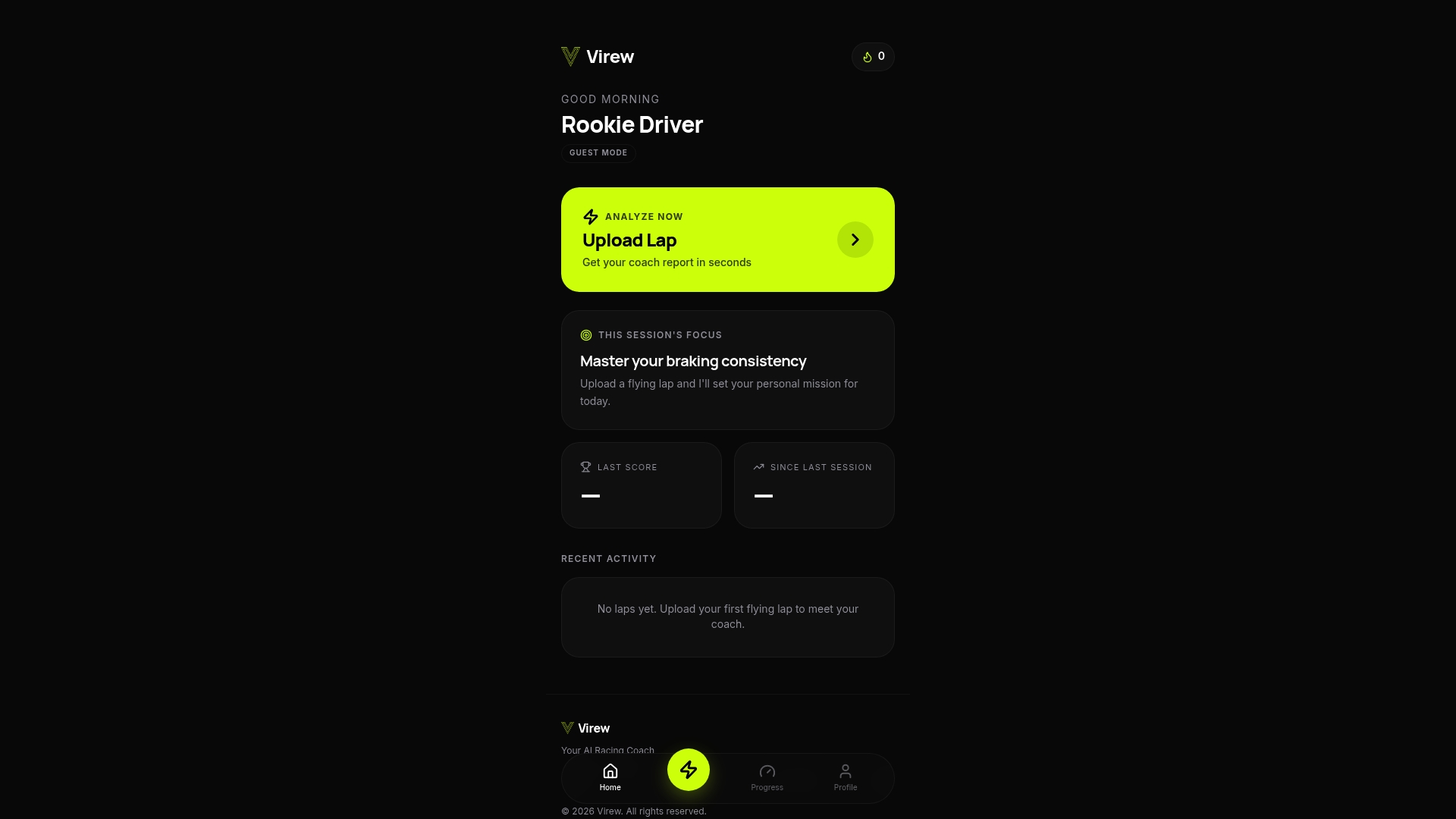
Our Free plan lets you upload a lap and see how the coaching works before committing to anything. If you want unlimited analyses and deeper history tracking, our Pro plan unlocks that. Either way, uploading a Time Trial lap after a practice block is the fastest way to confirm whether your inputs are actually getting smoother. Start with a lap analysis and see where the next gain is hiding.
FAQ
What does "smooth inputs" actually mean in F1 26?
It means progressive, deliberate throttle, brake, steering and ERS application that avoids sudden spikes and reduces mid-corner corrections. The goal is a car that stays balanced through a corner rather than one that snaps and needs constant correction.
Which assists should beginners use while learning smooth inputs?
Anti-Lock Brakes and a light Traction Control setting are good starting points because they reduce the penalty for small input errors while muscle memory develops. Adjusting steering deadzone and linearity alongside these assists softens the car's initial response to rough inputs.
Why is Time Trial the best mode to practice input smoothness?
Time Trial removes fuel weight, tire degradation and traffic, so you can repeat the same corner under identical conditions until the input becomes automatic. That repeatability makes it easier to judge whether a change actually reduced your lap time variance.
How do I know if my inputs are actually getting smoother?
Track how often you need mid-corner corrections and how many lockups or spins occur across a set of laps rather than focusing only on your fastest single lap. A shrinking lap time band across repeated attempts is a clearer sign of progress than one outlier fast lap.
Should I use ERS differently depending on the session?
Yes. In Time Trial and Qualifying you can deploy more aggressively for single-lap pace, while in Race sessions conserving battery for planned overtakes or defensive pushes protects your pace across the full distance.
Sources
- Tips And Tricks For Beginners And First Time Players In F1 25
- Master F1 26 Driving: Part 1 Guide
- F1® 25 Accessibility Resources - An Official EA Site