

Winning overtakes in F1 26 comes down to four things: choosing between an inside pass, a switchback, or an outside move based on the situation, building the attempt from the corner before, prioritizing exit speed over braking bravery, and using Overtake Mode with a plan for your battery state of charge. Pick one technique to focus on this session and watch one number as you drive, either how much better your exit speed is than the car ahead, or where your battery sits before the next straight.
TL;DR:
- Successful overtaking in F1 26 relies heavily on setting up the move a corner earlier, especially through better exit speed, rather than rushing into the braking zone.
- Inside passes require prior decision-making and precise timing, with risks including carrying too much speed and running wide, which can nullify the attempt.
- Outside passes and switchbacks work best when the defender takes an early apex or over-commits, allowing the attacker to exploit better grip or track width earlier in the corner.
- Managing Overtake Mode’s energy deployment wisely, especially during high-speed straights, is crucial for maximizing straight-line overtaking chances, since the defender’s power tapers at high speeds.
- Regular practice focusing on exit speed, slipstream timing, and racecraft, along with proper risk judgment, improves the odds of clean, consistent overtakes.
Table of Contents
- Out-braking and inside passes: setup, execution, risks
- Late braking and divebombs: when they work and when they don't
- Outside passes and commitment moves: when the outside wins
- Switchback and cutback: punishing full defenders
- Setting up a pass: exit speed, slipstream, and racecraft one corner earlier
- Defending correctly: fair defense, racing room, and managing trains
- Wet-weather overtaking: visibility, grip windows, and safe aggression
- Race strategy and 2026 Overtake Mode: tyre deltas, boxing to overtake, and energy planning
- Practice drills and session plans to improve overtaking
- The psychology behind a good overtaking decision
- How car setup shapes your ability to overtake
- Overtaking looks different on every track
- Common mistakes that turn a good move into a lost position
- Safety and etiquette rules to keep overtaking clean
- Why patient racecraft beats instinctive aggression
- Let Virew turn your overtaking practice into faster results
- Sources
- FAQ
Out-braking and inside passes: setup, execution, risks
An inside pass starts before the braking zone, not at it. You need to have already decided, a corner earlier, that you're going for the inside line, which means your exit from the previous corner has to leave you close enough to make the move at all. Coaches who teach sim racecraft describe this as the single biggest factor separating clean passes from wasted attempts: deciding your side a full corner in advance turns a 50/50 lunge into a planned move.
Once you're alongside on the run to the corner, brake later than the car ahead but keep the car dead straight under braking. Trail brake progressively rather than stabbing and releasing, since that keeps the front tires loaded and lets you rotate the car without losing the inside line.
A useful benchmark: if you're not roughly level with the other car's cockpit by turn-in, the move isn't on yet.
- Aim for close to level with the defender by the time you turn in, not just alongside at the braking marker.
- Abort early if you're not close: lifting a fraction and resetting is cheaper than a lockup or contact.
- Protect the inside on exit, since the defender will often try to cut back across you.
- Check your mirrors for a third car using the slipstream from behind before you commit to defending your new position.
The biggest risk with inside passes in F1 26 is carrying too much speed into the corner because you're focused on the gap rather than your own braking point. When that happens, you run wide, hand the position straight back, and often lose more time than if you'd waited a lap.
Late braking and divebombs: when they work and when they don't
A late-brake move is not the same as a divebomb, even though they look similar from the outside. A late brake is a calculated decision made with real information. A divebomb is a hope. Sim-racing coaching consistently flags that divebombs succeed far less often than patient, set-up passes, and frequently end both cars' races.
Before committing to a late-brake attempt, run through a short checklist:
- Pace advantage: do you actually have more grip or a fresher tire than the car ahead right now?
- Visibility: can you see the apex and the exit clearly, or is the defender's car blocking your view of the corner?
- Overlap timing: are you far enough alongside before the braking zone that the defender has to acknowledge you, not just react late?
- Escape room: is there track surface beyond the corner if you both run slightly wide?
If all four check out, brake in a straight line, release pressure smoothly rather than all at once, and be ready to catch a small amount of oversteer with a quick, small steering correction rather than a big counter-lock. After the pass, stabilize the car before worrying about the next corner.
Avoid the move entirely in low-visibility spray, on worn tires with unpredictable grip, or in a crowded midfield braking zone where a third car can appear from either side.
Outside passes and commitment moves: when the outside wins
The outside line looks harder because it's longer, but it wins more often than people expect when the defender has boxed themselves in on the inside. If the defender takes an early apex, they leave the entire outside of the corner open, and that's your cue.
Trust F1 26's braking model here: the outside line usually has similar or better grip than the dirty inside line the defender is protecting, since you're on a cleaner part of the track.
- Watch for an early apex from the defender, which signals they've committed to the inside and can't cover the outside.
- Get your overlap established before turn-in, since outside passes need more commitment earlier than inside moves.
- Think exit first: a wide entry that produces a strong exit beats a tight entry that leaves you slow.
- Use it at corners with real width, like Turn 3 at Bahrain or the final chicane at Suzuka, where the track surface actually supports two cars side by side.
A strong exit is what completes an outside pass. If you enter wide but exit slow, the defender simply drives back around you on the next straight, so the whole move has to be judged by where you are 100 meters past the apex, not at the apex itself.
Switchback and cutback: punishing full defenders
A switchback works when a defender commits too hard to defending the inside line into a corner, leaving themselves with a wide, slow exit. You let them have the inside entry, then use your own tighter line and better exit to cross behind them and come out ahead on the next straight.
The window opens the moment you see the defender turn in early and hard to block you. That's to tell that their exit speed is about to drop.
- Stay patient through entry, letting the defender take the inside without contesting it.
- Time the cross-behind for the exit, not the apex, so you're using their slow exit against them.
- Carry throttle earlier than the defender can, since their line has compromised their own exit.
- Close the door on your line once you're ahead, so there's no gap for an immediate retake into the next corner.
Pro Tip: A small fake toward the inside on entry can bait an aggressive defender into over-committing, which widens the switchback window on the exit.
Setting up a pass: exit speed, slipstream, and racecraft one corner earlier
Most overtakes in F1 26 are decided before the braking zone even arrives. The car with the better exit from the previous corner carries more speed onto the straight, which either sets up a slipstream run or removes the need for a risky move entirely. Sim-racing racecraft guides describe this pattern repeatedly: passes get set up a corner earlier, with the actual move often completed in the following braking zone rather than the current one.
The feel cues for a better exit are straightforward: less steering correction on throttle application, earlier full-throttle pickup, and a car that feels settled rather than nervous through the last third of the corner.
Slipstream use follows the same logic. Tuck in tight behind the car ahead through the middle of the straight to build the tow, then step out late enough that you're not exposed for long but early enough to complete the move before the braking zone. Sim-racing guidance on this is consistent: the slipstream is one of the most reliable overtaking tools available on a straight, more dependable than a lunge into a corner.
How you train this differs by session type.
| Session | Primary objective | Practice focus |
|---|---|---|
| Time Trial | Maximum single-lap time | Perfecting exit speed and racing line precision |
| Qualifying | Best single lap under pressure | Consistent braking points and clean exits lap after lap |
| Race | Consistency and tire life over a stint | Slipstream setup, defending, and energy management across laps |
Defending correctly: fair defense, racing room, and managing trains
Good defending in F1 26 is about controlling where the attacker can go, not about being physically immovable. Pick one defensive line per corner and commit to it early, since switching back and forth mid-corner is what causes contact and penalties.
The one-move rule matters here: you get to move once to defend a line, and you have to accept the exit consequences of that choice. Weaving twice is both against the spirit of clean racing and a common way to lose the position anyway.
- Commit to a single line early and hold it, rather than reacting corner by corner.
- Watch your mirrors before braking zones, not during them, so you already know where the attacker is.
- Concede early sometimes, since fighting too hard against a faster car often creates a three-wide moment or wrecks your own tires for the following laps.
- Preserve exit speed while defending, since a defensive line that kills your own exit just invites the next car in the train to pass too.
Pro Tip: On tight, wall-lined circuits like Monaco or Singapore, defend the inside line early and accept a slightly compromised exit rather than risk contact with the wall while covering the outside.
Wet-weather overtaking: visibility, grip windows, and safe aggression
Wet conditions change every part of an overtaking decision. Braking markers need to move earlier, since stopping distances grow and locking a wheel is far easier on a wet racing line. Overlap that would be enough in the dry often isn't enough in the rain, because reaction time for both cars drops when visibility is reduced by spray.
- Brake earlier and set up sooner, since wet grip windows punish late decisions much harder than dry ones.
- Expect reduced visibility from spray, which means you should only commit to a move when you can actually see the apex.
- Watch for fresh-wet tire windows, where a car on newer wet tires can find a brief pace jump; race analysis from wet sessions has shown fresh wet tires producing several seconds a lap of extra pace for a handful of laps.
- Target wider corners for wet passes, like the long right-hander at Turn 8 in Spa-style layouts, where there's more room to work with reduced grip.
Race strategy and 2026 Overtake Mode: tyre deltas, boxing to overtake, and energy planning
Race pace advantages don't always show up as an on-track pass right away, and in F1 26 that's often by design. A driver on a fresher tire can build a gap through undercut or overcut strategy, then use that tire delta to make the pass stick once they're back in range. The pace advantage needed varies by circuit: at a low-drag track like Monza, a lap time advantage of around 0.4 to 0.5 seconds per lap is often enough to force a pass, while tighter or higher-drag circuits usually need a bigger gap before a move becomes realistic.
Overtake Mode reshapes how you use a straight to close that gap. The system gives the attacking driver access to up to 350 kilowatts of electrical deployment, while the defending car's own electrical deployment starts to taper off once it passes roughly 290 kilometers per hour and drops to zero by around 355 kilometers per hour.
Overtake Mode changes the shape of every straight-line battle in F1 26. A fully charged attacker gains real straight-line advantage the faster the lead car goes, since the defender's power fades exactly when top speed matters most.
- Track your battery state of charge across the stint, since arriving at your best passing straight with a low battery wastes the entire setup.
- Choose one straight to spend Overtake Mode on, rather than triggering it reactively every time it's available.
- Watch the lead car's speed trend, since their deployment starts fading past roughly 290 kilometers per hour, which is your best window to commit.
- Rehearse energy budgets in practice sessions by running full stints and noting where your state of charge sits at each Overtake Mode opportunity.
Energy management under the 2026 ruleset effectively turns battery state of charge into a resource you plan around, the same way you'd plan tire life. Sim racers who rehearse Overtake Mode timing deliberately in practice stints, rather than discovering it mid-race, tend to make cleaner, better-timed moves when it counts. Practicing this in F1 26 with the 2026 car adaptation guide as a reference point helps translate the mechanics into lap-by-lap decisions.
Practice drills and session plans to improve overtaking
Technique only becomes racecraft once you've repeated it enough times to trust it under pressure. The Drive, Analyze, Improve, Repeat loop works well here: run a drill, look honestly at where it went right or wrong, adjust one thing, then run it again.
A simple weekly plan might dedicate one session to exits, one to slipstream timing, and one to full race-pace simulation with defending practice mixed in.
- Exit optimization repeat: run 8 to 10 laps at the same corner, focusing only on throttle pickup point and steering correction, and note whether your exit speed feels more settled each lap.
- Slipstream entry and step-out practice: pair up against an AI car of similar pace and practice tucking in early, then stepping out at different points to feel where the tow actually helps versus where it's too late to matter.
- Overtake Mode timing rehearsal: run full-length race stints and treat your battery state of charge as a budget, practicing which straight you deploy on based on your charge level rather than habit.
Pro Tip: Run defending practice against AI set to a slightly higher difficulty than your race pace, since it forces you to make real decisions about when to hold a line and when to concede.
You can simulate race-pace trains by running longer AI grids at race distance and practicing both sides of a fight, attacking and defending, without needing telemetry to know if it worked. If a pass felt clean and the exit speed afterward felt strong, it worked. If you can upload the session afterward, reviewing where you gained or lost time on exits helps confirm whether the feeling matched what actually happened on track.
The psychology behind a good overtaking decision
The best overtaking drivers aren't the most aggressive ones, they're the ones who correctly judge risk in the two or three seconds before committing to a move. That judgment call, whether the gap is real or closing, whether the defender has committed or is still deciding, is where most overtakes are actually won or lost, well before the braking zone.
Pressure changes decision-making in predictable ways. Under time pressure, like the closing laps of a race or a Qualifying lap with one shot left, drivers tend to commit to moves earlier than they would with a clear head, which is exactly when divebombs happen. Recognizing that your own patience drops under pressure is useful information, because it means the moves you make late in a session need extra scrutiny, not less.
A useful habit is separating the decision to attempt a pass from the execution of it. Decide during the previous corner, based on real gap and grip information, whether the move is on. Once you've decided, execute without second-guessing mid-corner, since hesitation during the move itself is often what causes contact. Drivers who overthink during the braking zone, rather than before it, tend to end up half-committed, which is the worst outcome of all.

How car setup shapes your ability to overtake
A car that rotates predictably on entry and picks up throttle cleanly on exit gives you more overtaking options than a car with slightly better outright pace but nervous handling. Setup choices in F1 26 directly affect which techniques are realistic for your car.
A front-heavy brake bias helps rotate the car into corners for inside passes, but too much can cause lockups under the later, harder braking that inside moves require. A rear-biased differential setting can help traction on exit, which supports the exit-speed-first approach that underpins most successful overtakes.
Downforce levels change which passes are viable on a given circuit. A lower-downforce setup trades some cornering grip for a higher top speed, which matters more on tracks with long straights where slipstream and Overtake Mode do the heavy lifting. A higher-downforce setup helps on tracks with fewer overtaking straights but more corners where exit speed out of a technical section is what creates the opportunity in the first place.
Tire pressures affect how the car behaves under the specific braking and cornering loads that overtaking maneuvers put on it, since a pass often asks more of the tires in a single corner than a normal racing lap does. A setup that feels fine on a clean lap can behave unpredictably when you're braking later or carrying more entry speed than usual to make a move.
Overtaking looks different on every track
The right technique changes completely depending on the circuit. On a low-drag, high-speed track like Monza, overtaking is mostly about slipstream and Overtake Mode timing on the long straights, since the corners themselves offer few real passing chances.
On a street circuit like Monaco, overtaking chances are rare and usually depend on a mistake from the car ahead rather than a clean move, which means defending well and staying patient often matters more than attacking technique.
At a flowing, medium-speed track like Silverstone or Suzuka, outside passes and switchbacks become more realistic, since there's more track width and more corners where a defender can overcommit to the inside.
On tight, technical layouts, the inside pass into a tight braking zone tends to be the highest-percentage move, since there's rarely enough width for an outside attempt to work cleanly.
Knowing which category a track falls into before the session starts helps you decide which techniques to practice and which to set aside for that particular circuit.

Common mistakes that turn a good move into a lost position
The most common overtaking mistake in F1 26 is deciding at the braking zone instead of a corner earlier, which leaves you neither fully committed nor fully patient, and usually ends with a compromised entry for both cars.
A second frequent error is chasing the gap instead of your own braking point, which causes drivers to carry too much speed into a corner and run wide, handing the position straight back.
Overusing Overtake Mode without a state of charge plan is a newer mistake specific to the 2026 ruleset: triggering it reactively every time it's available, instead of saving it strategically for the straight where the lead car's deployment is fading, wastes the advantage.
Finally, many drivers forget the exit entirely and treat the pass as finished the moment they're ahead at the apex, when the position isn't secure until the exit speed is settled and the door is closed on the inside line.
Safety and etiquette rules to keep overtaking clean
Clean overtaking depends on both cars having realistic space to complete the move, which is why visibility and overlap matter as much as pace. Guidance on safe passing consistently comes back to a simple principle: only commit to a move when you have a clear view and enough space to complete it, and yield when that isn't the case.
In league racing, this translates into a few practical habits: never overtake into a corner where you can't see the exit, always leave a defending car racing room rather than squeezing them toward the wall, and treat a car that hasn't seen you yet as a hazard rather than an opportunity. Good defending should also control the attacker's line rather than trying to block outright, since defending by controlling trajectory rather than blocking reduces contact for both drivers.
Following these habits protects your own race as much as anyone else's.
Why patient racecraft beats instinctive aggression
The drivers who climb through a field consistently aren't the boldest, they're the ones who set one clear objective each week and stick to it rather than forcing moves.
In league racing, a low incident count matters more than any single overtake, since one clean season builds trust that pays off in every future battle.
Track one number: the percentage of passes that hold through the next corner. That figure tells you more about your racecraft than lap time ever will.
— Virew
Let Virew turn your overtaking practice into faster results
Watching your own onboard footage back tells you that a pass worked or didn't, but it rarely tells you why. Virew closes that gap by taking your F1 26 lap footage and turning it into plain-language coaching on exactly where you're losing time, whether that's a slow exit that killed your slipstream chance or a braking point that left you exposed into the corner.
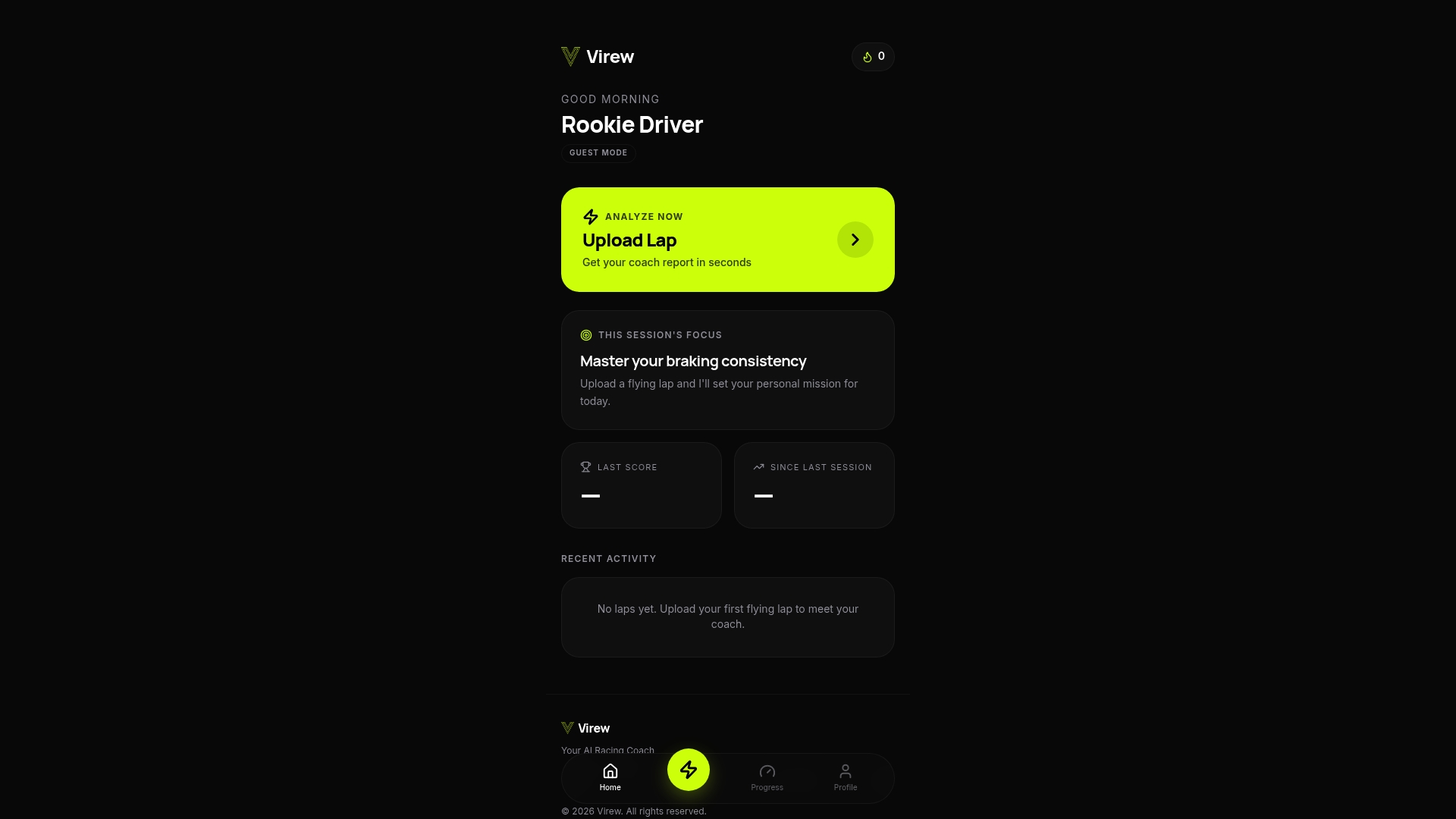
What Virew actually does for readers working on the techniques in this guide:
- Analyzes your own uploaded laps from PlayStation, Xbox, or PC, rather than giving generic tips.
- Gives feedback tied to session type, since a Race stint and a Qualifying lap need different priorities.
- Treats dry and wet conditions separately, so the coaching matches the grip you actually had.
- Tracks your progress over time, so you can see whether last week's exit-speed drill actually moved the needle.
If you want a coached route into better overtaking, start with how Virew's AI lap analysis works to see what a coaching report looks like, or head straight to the lap analysis tool to upload your own footage and find out where your next overtake is really being won or lost.
Sources
For more on the mechanics behind this guide, the 2026 Overtake Mode explainer covers the energy and deployment rules in detail, while race strategy analysis from the 2026 season shows how tire deltas translate into real passes. Sim-racing coaching resources on racecraft fundamentals and making overtakes stick informed the technique sections above.
- Boost, overtake mode, active aero & recharge: the key 2026 terms explained
- Less flap, more zap: F1's 2026 overtake mode
- Sim Racing Overtaking Guide: Pass and Make It Stick
FAQ
What is the best way to overtake in F1 26?
The highest-percentage approach is setting up the pass a corner earlier by carrying a strong exit into the straight, then choosing between an inside move, an outside move, or a switchback based on how the defender positions their car. Divebombing without that setup succeeds far less often than a patient, planned move.
What are the different types of overtaking maneuvers?
The main categories are inside out-braking passes, outside commitment moves, switchbacks or cutbacks that punish an over-committed defender, and late-braking moves that only work with real pace and space advantage. Each fits a different situation depending on the defender's line and the track's width at that corner.
Who is responsible when contact happens during an overtake?
In sim racing league etiquette, the attacker is generally expected to be significantly alongside before turn-in for a move to be considered legitimate, while the defender is expected to leave racing room once that overlap exists. Guidance on safe passing points to the same principle used on public roads: only commit to a move with a clear view and enough space to complete it, which is a useful standard for judging who was at fault.
How does Overtake Mode affect overtaking in F1 26?
Overtake Mode gives the attacking car access to up to 350 kilowatts of electrical deployment, while the defending car's own deployment starts fading past roughly 290 kilometers per hour and reaches zero by around 355 kilometers per hour. That means managing your battery state of charge and picking the right straight to use it on matters as much as raw pace.
How should overtaking technique change in wet conditions?
Wet overtaking needs earlier braking markers, more overlap before commitment, and extra caution around spray that reduces visibility of the apex and exit. Fresh wet tires can create brief pace windows that are worth targeting for a pass, since race analysis from wet sessions has shown several seconds a lap of extra pace for a handful of laps.