
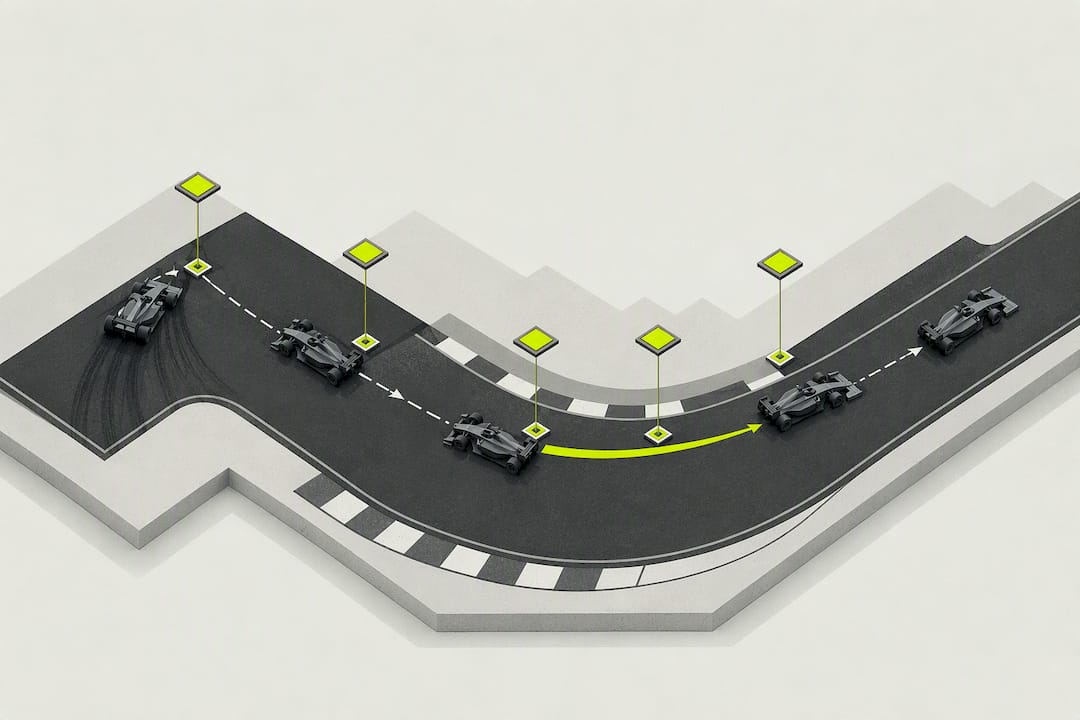
When your rear steps out in F1 26, steer into the skid and keep your inputs smooth. Don't stamp the brakes or jerk the wheel; both actions load the front tires unevenly and turn a manageable slide into a spin. Ease the throttle rather than lifting completely, since throttle handling depends on whether power or lift-off caused the slide in the first place.
TL;DR:
- Oversteer in F1 26 is caused mainly by applying too much throttle early or abrupt weight shifts off the rear axle, leading to rotation rather than just sliding.
- Correcting oversteer involves smooth countersteering, easing the throttle appropriately, and unwinding the steering gradually once grip returns, avoiding aggressive inputs.
- Telemetry channels like rear wheel slip, yaw rate, steering angle, and throttle trace help distinguish power oversteer from lift-off oversteer, guiding precise corrections.
- Setup adjustments such as slightly forward brake bias, softer differentials, higher rear tyre pressures, or increased rear downforce can reduce oversteer tendencies without costing lap time.
- Practicing controlled slides, throttle application, and trail-braking drills, combined with AI lap analysis, accelerates mastering reliable oversteer recovery.
Table of Contents
- What Does Oversteer Feel Like in F1 26?
- What Causes Oversteer in F1 26?
- How Do You Correct Oversteer on a Dry Track?
- How Should You Correct Oversteer in Wet Conditions?
- How Do You Avoid Overcorrecting and the Pendulum Effect?
- What Setup Changes Reduce Oversteer Risk in F1 26?
- What Drills Build Reliable Oversteer Recovery?
- How Can Telemetry and AI Coaching Speed Up the Process?
- Author Perspective: Mastering Oversteer Correction for Faster Laps
- Try Virew for Lap-Specific Oversteer Coaching
- Sources
- FAQ
What Does Oversteer Feel Like in F1 26?
Oversteer shows up as rotation, not just sliding. The rear of the car swings wider than your steering input suggests, and the nose points further into the corner than you intended. If you're on a controller, you'll feel the car "snap" rather than drift; on a wheel, you'll feel the self-aligning torque fight you as you add opposite lock.
Watch for these signs while driving and in your telemetry after the lap:
- Visual cue: the rear end swings out faster than the front turns in, especially visible on corner exit.
- Steering feedback: you need noticeably more countersteer than usual to hold the line, or the wheel shakes under correction.
- Telemetry signature: a spike in yaw rate paired with a sudden jump in steering angle, often within a tenth of a second.
- Rear slip data: wheel speed sensors show the rear tires spinning faster than the fronts, or losing speed unevenly through a slide.
Context matters as much as the symptom itself. Oversteer on corner entry under braking behaves differently from oversteer on exit under power, and reading the telemetry against the corner phase is how you separate one from the other. Auto Express notes that the rear tires exceeding grip before the fronts is the underlying mechanic in almost every case, but where in the corner it happens tells you why.
What Causes Oversteer in F1 26?
Nearly every oversteer moment in F1 26 traces back to one of two mechanisms, according to Auto Express: too much power too early, or an abrupt shift in weight off the rear axle. Knowing which one you're dealing with changes your entire correction.
- Power oversteer: you get on the throttle too aggressively coming out of a slow corner (think Turn 3 at Suzuka or the final chicane at Monza), the rear tires spin up before they hook, and the car rotates around the rear axle.
- Lift-off oversteer: you release the throttle sharply mid-corner or trail-brake too aggressively into the apex, the weight shifts forward off the rear tires, and the rear loses grip without any throttle input at all.
- Brake-induced oversteer: heavy braking with a front bias that's too aggressive, or braking too late and too hard while still turning, unsettles the rear before you've even reached the apex.
- Setup and tyre contributors: low rear tyre pressure, overheated rear tyres, too much rear downforce relative to the front, or a differential setting that locks too easily on entry all raise your oversteer risk before you touch the pedals.
Your throttle trace and steering angle graph tell you which one you're fighting. A wheelspin spike right as the throttle trace climbs points to power oversteer. A yaw spike that appears the moment your throttle trace drops to zero, with no wheelspin at all, is lift-off oversteer. Continental's driving guide points out that oversteer is inherently harder to manage than understeer because the car is actively rotating, which is exactly why misreading the cause costs you the correction window.
How Do You Correct Oversteer on a Dry Track?
Dry-track correction is a sequence, not a single reaction. Rushing any one step is usually what turns a slide into a spin.
- Look where you want the car to go, not at the wall. Your hands follow your eyes almost automatically, and drivers who fixate on the barrier tend to steer toward it.
- Apply countersteer immediately, but only enough to match the slide. On a wheel, this usually means 15 to 30 degrees of opposite lock depending on the corner and speed; on a controller, a firm but not maxed-out stick input in the opposite direction. Overcorrecting here is the single biggest mistake new sim racers make.
- Adjust throttle based on the cause. If it's power oversteer, ease off slightly rather than lifting fully; a complete lift can shift weight forward and add a second, lift-off oversteer moment on top of the first. If it's lift-off oversteer, hold the throttle steady rather than adding more.
- Wait for the rear to hook back up before unwinding. You'll feel the wheel lighten or see your yaw rate drop toward zero in telemetry. That's your cue.
- Unwind the steering smoothly, not all at once. Snapping the wheel straight the instant grip returns is what causes the pendulum effect, where the car whips the opposite direction into a second slide.
BFGoodrich's guidance is blunt about the biggest error here: slamming the brakes mid-slide destabilizes the rear further and almost always turns a correctable moment into a spin.
Pro Tip: Practice this in Time Trial on a low-grip track like Imola's Rivazza corners with traction control off. The lower grip ceiling exaggerates the slide, giving you more reaction time to feel the countersteer and unwind sequence than you'd get on a high-grip track like the Red Bull Ring.
How Should You Correct Oversteer in Wet Conditions?
Wet-weather oversteer demands a slower, gentler version of the same sequence, not a different one. Grip returns more slowly on a wet track, and the margin for error shrinks accordingly.
- Countersteer earlier but less aggressively. The lower grip ceiling means the rear breaks away with less warning, but it also means large steering corrections overshoot easily.
- Treat throttle re-application as a two-stage process. Bring the throttle back in small increments rather than steadying at one level; wet tarmac grip changes lap to lap and even corner to corner as the racing line dries or puddles shift.
- Accept a slower exit speed rather than fighting for the lap time. A recovered slide that costs you three tenths beats a spin that costs you fifteen seconds and a fresh set of tyres from the pit lane.
- Manage tyre temperature through the recovery. A slide scrubs heat into the outer edge of the tyre unevenly; repeated slides in the same corner degrade your intermediate or wet tyres faster than clean laps would.
In wet Qualifying sessions especially, trading half a second for a clean, controlled recovery protects your tyres and your track position far better than a heroic save that leaves you sideways at the apex on your next lap.
How Do You Avoid Overcorrecting and the Pendulum Effect?
The pendulum effect is what happens when you apply too much countersteer, the rear tires suddenly regain grip, and all that stored steering angle whips the car violently the other way. Race & Track Driving's coaching material identifies over-correction, not the original slide, as the most common cause of a full spin among developing drivers.
The fix is training yourself to unwind the moment grip returns, not a beat later.
- Watch for the wheel lightening in your hands (or the stick input feeling less resistant on a controller) as your first cue that grip has returned.
- Watch your yaw rate decaying toward zero in post-session telemetry to confirm you're reading the cue correctly in real time.
- Practice small, incremental unwinds rather than one large correction followed by one large release.
Pro Tip: Run a session in F1 26's Time Trial mode with the wheel's force feedback turned up higher than your normal setting. The exaggerated feedback makes the "grip returning" moment far more obvious, training your hands to react faster once you dial the setting back to normal.
What Setup Changes Reduce Oversteer Risk in F1 26?
A few setup levers lower your oversteer tendency without meaningfully costing you lap time, provided you don't overcorrect the balance the other way.
- Move brake bias slightly forward. A front-biased brake setup keeps the rear more stable under braking, which directly reduces brake-induced oversteer on entry.
- Soften the differential's on-throttle lock. A diff that locks too aggressively on power transfers load unevenly to the rear tyres, feeding power oversteer on exit.
- Raise rear tyre pressures slightly if you're seeing overheating. Overheated rear tyres lose grip margin fast, and tyre temperature management is one of the most overlooked oversteer contributors in longer race stints.
- Add a touch more rear downforce if your track allows it. More rear wing stabilizes the car at speed, though it costs you top speed on straights, so this is a track-by-track tradeoff.
- Build a smoother throttle ramp on exit. Rolling the throttle on over half a second instead of stabbing it is often worth more than any setup change, since it addresses the cause directly instead of just the symptom.
Adapting to the 2026 car generation matters here too, since throttle sensitivity and rear grip characteristics shift year to year; see our guide to driving the 2026 cars for specifics.
What Drills Build Reliable Oversteer Recovery?
Recovery becomes instinct through repetition, not through reading about it. Structure your practice sessions in three phases and track specific telemetry markers between sessions to confirm you're actually improving.
- Controlled slide drill (10 to 15 minutes). Pick a low-speed corner with a wide run-off, like Turn 1 at Bahrain, and deliberately induce a mild slide with throttle. Run 8 to 10 laps focusing only on the countersteer and unwind sequence, not lap time.
- Power-on exit drill (10 to 15 minutes). Choose a medium-speed exit corner and gradually increase your throttle application percentage lap overlap, backing off the moment you feel the rear step out. The goal is finding your current grip limit, not exceeding it.
- Trail-braking consistency drill (10 minutes). Practice releasing the brake at a consistent, gradual rate into corner entry to reduce the abrupt weight transfer that causes lift-off oversteer.
- Cooldown and review (5 minutes). Pull your telemetry and compare peak yaw rate and throttle trace smoothness against your last session.
According to Race & Track Driving's training progression, you should only increase throttle targets in the power-on drill once you're recovering consistently at your current level, not before. Track two numbers across sessions: peak yaw rate during slides (lower is better) and how smooth your throttle ramp looks on exit. Improvement in both is the clearest sign your reflexes are actually changing, not just your luck on a given lap.
How Can Telemetry and AI Coaching Speed Up the Process?
Reading your own telemetry tells you what happened. It rarely tells you what to do differently next time, which is the gap AI-assisted lap analysis is built to close.
The channels that matter most for oversteer diagnosis are rear wheel slip, yaw rate, steering angle, throttle trace, and brake pressure, layered together on the same timeline. Auto Express confirms these traces are what separates power oversteer from lift-off oversteer at a glance, but spotting the pattern across dozens of corners on a full lap is tedious to do by hand.
- Upload laps from the same session type and similar tyre conditions so comparisons are meaningful rather than skewed by fresh versus worn rubber.
- Include a few consecutive laps rather than a single outlier, since one clean lap and one mistake buried together tell a more honest story.
- Note whether the session was Time Trial, Qualifying, or a Race stint, since throttle and braking priorities shift between them.
Virew's coaching follows the Drive → Analyze → Improve → Repeat cycle: you upload the lap, the AI maps your throttle, braking, and steering traces to a likely cause, and it prescribes drills matched to what actually happened on your lap rather than generic advice. Our lap analysis guide walks through exactly what to upload for the clearest read.
| What to track | Why it matters | Target trend over sessions |
|---|---|---|
| Peak yaw rate during slides | Shows how violent your oversteer moments are | Should decrease as recovery improves |
| Throttle trace smoothness on exit | Flags stabs versus rolled-on power | Should become progressively smoother |
| Rear wheel slip frequency | Indicates how often you're exceeding rear grip | Should drop as setup and technique improve |
| Steering angle recovery time | Measures how fast you unwind after correcting | Should shorten without overshooting |
Author Perspective: Mastering Oversteer Correction for Faster Laps
The drivers who improve fastest aren't the ones pulling off spectacular saves. They're the ones who almost never need to, because their throttle and steering inputs stay smooth enough that the slide barely develops in the first place. A heroic recovery still costs time; a prevented slide costs nothing.
Small gains compound here. Shaving a tenth of a second off your reaction time on the unwind, repeated across twenty corners a lap, is a bigger improvement than any single setup change. Track your telemetry targets honestly and the consistency follows.
— Virew
Try Virew for Lap-Specific Oversteer Coaching
Generic driving tips tell you to "steer into the skid." Virew tells you which corner on your actual lap the slide started, whether it was power or lift-off, and what drill fixes it. Upload a handful of laps and you get targeted feedback on throttle, braking, steering, and racing line instead of advice that assumes every driver's problem looks the same.
The Free plan gives you a limited number of lap analyses each month, enough to diagnose your most persistent oversteer corners and get a first round of drills. If you're logging laps regularly and want unlimited analysis history plus deeper coaching detail, the Pro plan unlocks that. Either way, the fastest next step is uploading a lap where you know you lost the rear and letting the analysis tell you exactly why through our lap analysis tool.
Sources
- How to control understeer and oversteer skids in your car | Auto Express
- Understeer vs oversteer: A guide for drivers | Continental Tires
- Correcting Oversteer - Race & Track Driving
FAQ
What Is the Most Common Cause of Oversteer?
Excessive power applied too early on corner exit is one of the two dominant causes, alongside abrupt lift-off or overly aggressive trail braking mid-corner. Both cause the rear tires to lose grip before the front, according to Auto Express.
Is It Easier to Correct Understeer or Oversteer?
Understeer is generally easier to manage because the front simply pushes wide, giving you more reaction time. Oversteer is harder to correct since the car is actively rotating and the correction window is much shorter, as Continental explains.
How Do You Recover From Oversteering in F1 26?
Steer into the skid with smooth, measured countersteer, ease the throttle rather than lifting completely, and never brake hard mid-slide. Unwind the steering as soon as grip returns to avoid the pendulum effect described by Race & Track Driving.
Can Virew Help Me Fix a Specific Oversteer Problem?
Yes. Uploading laps to Virew's lap analysis tool shows you exactly which corners triggered oversteer, whether power or lift-off caused it, and which drills to run to fix that specific pattern.
What Setup Change Fixes Snap Oversteer on Corner Exit?
Softening the differential's on-throttle lock and smoothing your throttle ramp usually addresses exit snap directly, since aggressive lock and stabbed throttle both overload the rear tyres unevenly. A slightly forward brake bias also helps if the issue starts on entry rather than exit.