
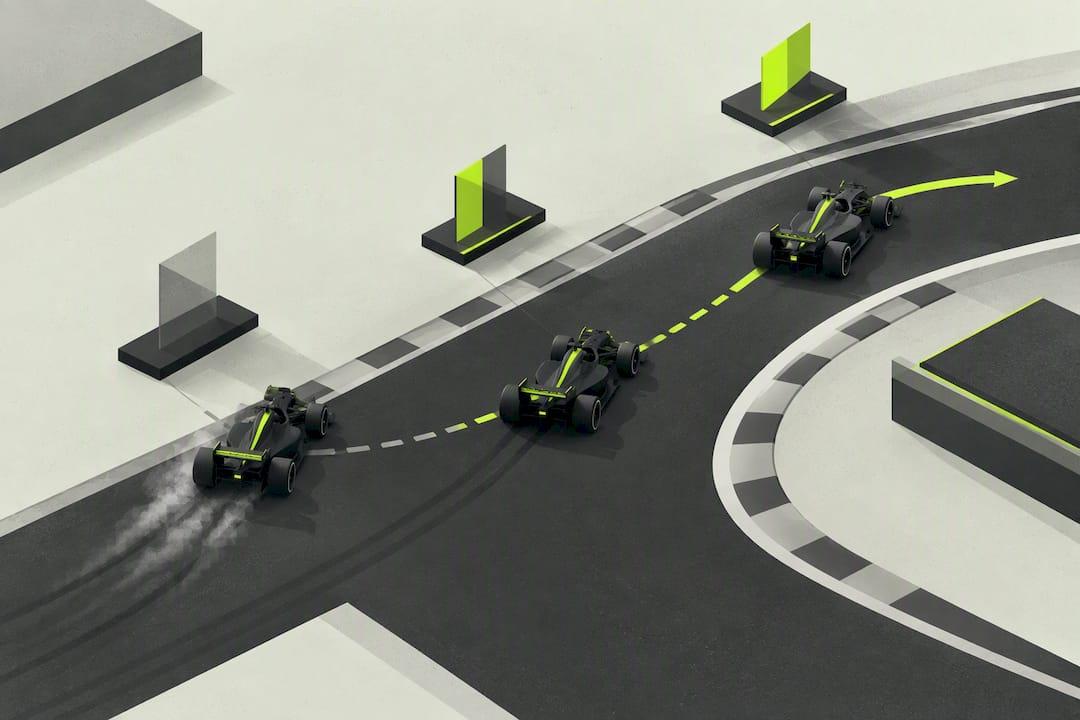
The fix for oversteer in F1 26 is the same three moves every time: steer into the slide so the front wheels point where you want the car to go, then modulate the throttle instead of stabbing it. Ease off for a power slide, roll back on gently for a lift-off slide. Never slam the brakes mid slide. That single input adds forward weight transfer and unloads the rear tires further, which is how a save turns into a spin.
TL;DR:
- Correcting oversteer requires steering into the slide, smooth throttle modulation, and avoiding mid-slide braking to prevent worsening the spin.
- Early signs of oversteer include rear tire temp increases, excessive rear rotation after lift-off, or steering needing more lock than expected.
- Fine-tuning setup with rear downforce, anti-roll bars, and brake bias can significantly reduce the tendency to oversteer, especially on high-load circuits.
- Practicing controlled slides, timing countersteer correctly, and reviewing uploaded laps with coaching help build recovery skills and consistency.
- Tracking your actual oversteer corrections and inputs through lap analysis tools allows targeted improvement and fewer spins during races.
Table of Contents
- What Causes Oversteer and How Do You Spot It Early?
- Step-by-Step: How Do You Recover From an Oversteer Slide?
- How Much Countersteer and Throttle Do You Actually Need?
- Which F1 26 Setup Changes Reduce Oversteer?
- What Drills Actually Build Oversteer Recovery Skill?
- How Uploading Laps Helps You Fix Oversteer Faster
- Why Consistency Beats the Spectacular Save
- Get Feedback on Your Own Oversteer Moments
- Sources
- FAQ
What Causes Oversteer and How Do You Spot It Early?
Oversteer happens when the rear tires lose grip before the front ones, so the back of the car rotates faster than the steering angle calls for. The SAE J670 and ISO 8855 standards define this through the understeer gradient: when that gradient goes negative, the car is oversteering, and the same chassis can flip between understeer and oversteer depending on speed and lateral load. In F1 26 terms, that means the same car can feel planted through Silverstone's Copse and then snap loose at Suzuka's 130R if tire temps, fuel load, or setup shift the balance.
Recognizing it early buys you the half second that separates a correction from a spin. Watch for these signs on track and in your inputs:
- The rear of the car steps out visually before your steering correction lands, often with a sudden yaw you feel through the pad or wheel rim.
- Your steering input suddenly needs more lock than the corner radius should require.
- The rear tire temperature readout climbs faster than the fronts, a sign the rear is working harder than it should.
- The car rotates more than expected right after you lift off the throttle or apply trail braking.
The trigger matters as much as the symptom. Lift-off oversteer shows up as a sudden rotation the instant you come off the throttle, usually mid corner. Power-on oversteer hits on corner exit when you get back to the throttle too early or too hard, especially in lower gears where torque overwhelms rear grip. Brake-induced oversteer appears under heavy trail braking, often paired with a hint of rear lock. Rear-wheel-drive-only behavior isn't a factor in F1 26 since every car is a rear-driven single-seater, but drivetrain torque delivery and differential settings still shape which of these three you'll fight most on a given circuit.
Step-by-Step: How Do You Recover From an Oversteer Slide?
Once the rear steps out, the sequence matters more than the speed of your reaction. Rushing the wrong input costs more time than a slightly late but correct one.
- Steer into the slide. Point the front wheels in the direction the rear is sliding toward, not back toward your original line. Steering into the skid and easing the throttle smoothly is the foundation of every oversteer recovery, on track or in the sim.
- Look where you want the car to go, not at the barrier. Your hands tend to follow your eyes, so fixating on the wall you're sliding toward makes it more likely you'll steer there.
- Diagnose the cause in real time and match your throttle to it. If you lifted and the rear snapped, reapplying throttle gently pulls the nose back in line. If you got greedy on exit throttle, easing off restores grip instead.
- Stay off the brakes. Braking mid slide shifts weight forward, lightens the rear axle further, and accelerates the spin rather than stopping it.
- Hold the countersteer until grip returns, then unwind gradually. Maintaining opposite lock until the rear tires regain grip prevents the classic pendulum effect where an early correction sends the car sliding the other way.
Pro Tip: Practice narrating your diagnosis out loud during Time Trial laps: "lift oversteer, feeding throttle" or "power oversteer, easing off." Saying it forces you to actually classify the slide instead of reacting on pure instinct, and that habit shows up as fewer spins once it becomes automatic.
If the slide was brake-induced, release brake pressure smoothly rather than snapping off the pedal. A sudden release can shock the rear suspension and provoke a second, sharper slide right after the first one settles.
How Much Countersteer and Throttle Do You Actually Need?
The hardest part of oversteer correction isn't knowing to countersteer, it's knowing how much and for how long. Too little opposite lock and the rear keeps rotating past your correction. Too much, held too long, and you get the pendulum snap back the other way once grip returns.
A few working guidelines that translate well to F1 26's steering feel:
- Apply opposite lock in proportion to the yaw rate you feel, not a fixed number of degrees. A gentle power slide out of Barcelona's Turn 10 needs a small correction; a snap oversteer moment under trail braking into Eau Rouge needs a bigger, faster one.
- Time the correction to the onset of rotation, not the peak. Waiting until the car is already sideways forces a bigger, more violent input that's harder to control.
- For lift-off oversteer, feed throttle back in as you countersteer. The two inputs work together to settle the rear.
- For power-on oversteer, come off the throttle just enough to let the rear tires regain grip, then reapply smoothly once the slide stops growing. A full lift can transfer weight forward and unsettle the car further mid-correction.
- Downshifting mid slide rarely helps and often hurts, since the extra engine braking can add to an already unstable rear end.
Deliberately inducing small, controlled slides in a low-risk corner and reviewing the replay afterward is the fastest way to calibrate this feel. Two numbers are worth tracking every session: your average opposite-lock angle during instability, and how many corrections it takes before the car is straight again. Drivers who tighten both numbers over repeated sessions consistently cut their spin rate in Time Trial without sacrificing entry speed, because they're applying just enough lock instead of overcorrecting out of panic.
Which F1 26 Setup Changes Reduce Oversteer?
Technique only gets you so far if the car is fighting you from the setup sheet. Adjusting rear downforce, softening the rear anti-roll bar, and shifting brake bias forward are the three levers most F1 26 drivers reach for first, and each comes with a trade-off worth understanding before you touch a slider.
- Add rear wing or shift aero balance rearward. More rear downforce settles the car through fast corners at the cost of straight-line speed on tracks like Monza or Baku's long back straight.
- Soften the rear anti-roll bar. A softer rear ARB lets the outside rear tire load more progressively, reducing the snap that causes sudden power-on oversteer, though it can add a touch of mid-corner roll.
- Move brake bias forward. Shifting bias toward the front axle cuts the risk of rear lock under heavy braking into hairpins like Turn 1 at the Red Bull Ring, which is one of the most common triggers for brake-induced oversteer.
- Watch rear tire pressures and camber. Hotter rear tires and aggressive negative camber both increase the odds of snap oversteer once the rear axle starts working hard, especially in long, high-load corners.
- Match the setup to the session. Race setups generally lean toward stability since a spin costs positions and tire life, while Qualifying and Time Trial setups often accept a twitchier rear in exchange for faster rotation through low-speed corners.
None of these changes are free. A car dialed for maximum stability in a race stint will usually rotate slower into hairpins during a qualifying lap, so the right setup depends entirely on what session you're driving.
What Drills Actually Build Oversteer Recovery Skill?
Reading about opposite lock and actually applying it under pressure are two different skills. These three drills, run in order, build the muscle memory that carries into race conditions.
- Controlled oversteer induction. Pick a medium-speed corner with runoff, like Turn 9 at Bahrain, and deliberately provoke a small power slide on exit. Focus on hitting a consistent, small steering correction rather than a big dramatic save.
- Countersteer timing windows. Repeat low-speed slides in a corner like Monaco's hairpin and time how long you hold opposite lock before unwinding. The goal is shortening that window session over session without triggering a pendulum snap.
- Throttle modulation under changing grip. Run the same corner sequence on a heavy fuel load, then again on low fuel with softer compounds, and note how much less throttle margin you have before the rear lets go.
Pro Tip: Structure a 30 minute session as a warmup lap, ten minutes on Drill 1, ten minutes on Drill 2, then five validation laps at race pace. Compare your steering angle traces and lap time before and after the drill block. That before and after delta is the clearest sign the practice is actually sticking.
How Uploading Laps Helps You Fix Oversteer Faster
Feeling a slide and understanding exactly what caused it are different problems, and most drivers guess more often than they'd like to admit. Virew's lap analysis reviews your uploaded F1 26 laps after the session and highlights the corners where your steering and throttle inputs line up with an oversteer moment, turning a vague memory of "the rear stepped out at Turn 8" into a specific, repeatable pattern.
The coaching feedback focuses on details that are hard to judge from the seat alone:
- How much opposite lock you're applying on average during unstable moments, and whether that figure is trending down across sessions.
- A throttle smoothness score that flags jerky reapplication after a slide instead of a controlled, progressive input.
- Consistency across laps, so you can see whether a fix you made in one corner is holding up lap after lap.
- Coaching notes that shift focus depending on session type, since a Time Trial lap gets analyzed for outright pace while a Race upload gets reviewed for tire wear and incident avoidance across a stint.
Worth being clear about: Virew reviews the lap data you upload after you've driven it. It doesn't capture live telemetry mid-session or watch your inputs in real time, so the workflow is drive, upload, then review the coaching report before your next run.
Why Consistency Beats the Spectacular Save
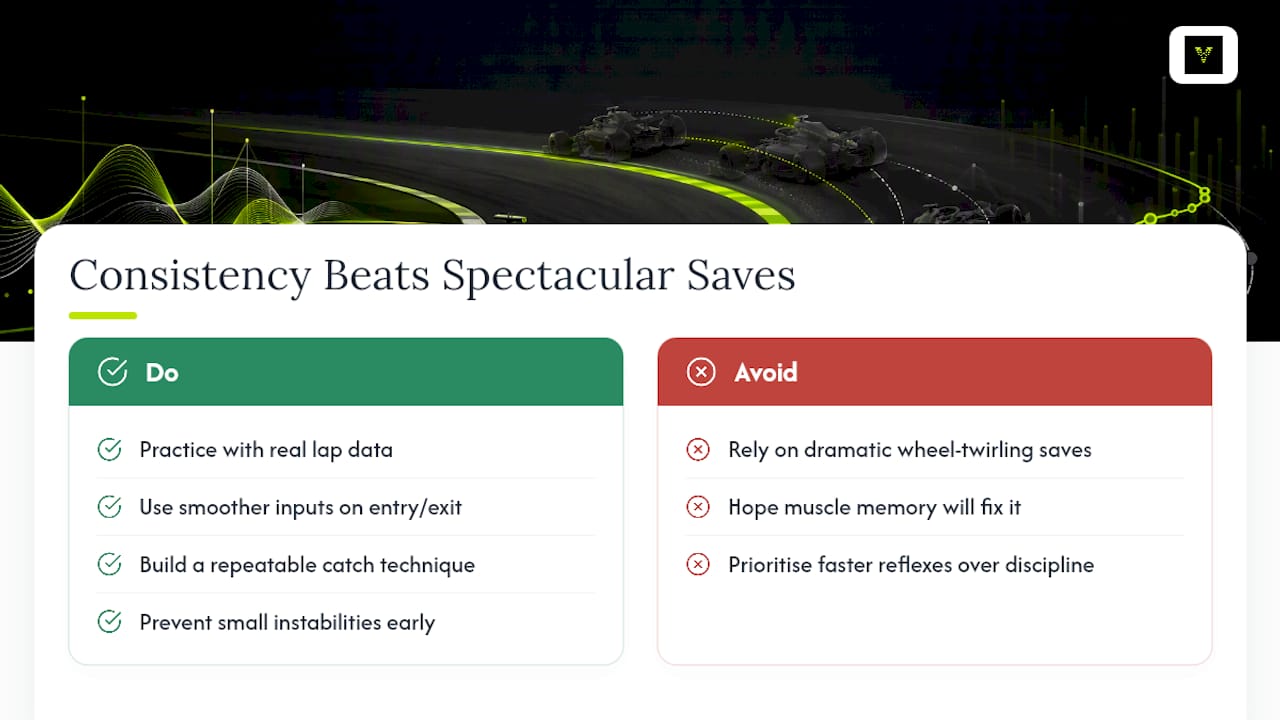
A dramatic, wheel-twirling recovery from a near spin looks great in a clip, but it rarely wins races. What actually moves your average finishing position is cutting the number of times you get into that situation at all. Controlled oversteer has its place, especially for rotating a car through a tight hairpin on a qualifying lap, but it only pays off when it's paired with the discipline to catch it the same way every single time.
Most drivers I'd bet lose more time to small, repeated moments of instability across a race stint than to the one big spin everyone remembers. Fixing that isn't about faster reflexes. It's about smoother inputs on corner entry and exit, so the rear never gets unsettled enough to need a save in the first place. Measured practice against real lap data closes that gap far faster than hoping muscle memory improves on its own.
— Virew
Get Feedback on Your Own Oversteer Moments
Reading about opposite lock is one thing. Seeing exactly which corner your rear stepped out in, and how much correction you actually applied, is another. Virew reviews your uploaded F1 26 laps and points to the specific braking zones and exits where your inputs line up with instability, rather than handing you generic setup tips that ignore how you actually drive.
If oversteer keeps costing you time at the same two or three corners, upload a lap and see the coaching report built around your own inputs. New accounts start with a free analysis credit, and the Pro plan unlocks unlimited laps once you're ready to go deeper. Start with one lap from your worst corner and work from there.
Sources
For the underlying vehicle dynamics behind oversteer, the SAE and ISO definitions summarized on Wikipedia are worth a read. For general handling context beyond the sim, Continental's guide to understeer versus oversteer covers how tires and drivetrain layout shape the balance.
- Understeer & Oversteer Correction
- Oversteer Explained: Causes, Correction & Control
- Correcting oversteer - Race & Track Driving
- True impact of driving styles on F1 2026 top drivers
FAQ
What Is the Most Common Cause of Oversteer?
Sudden weight transfer off the rear axle is the most common trigger, whether from lifting off the throttle mid corner, getting back to power too early, or braking hard enough to unsettle the rear under trail braking. In F1 26, power-on oversteer on corner exit and brake-induced oversteer into heavy stops are the two you'll fight most often.
Is It Easier to Correct Understeer or Oversteer?
Understeer is generally easier to manage because easing off the throttle or unwinding some steering lock usually restores front grip without much risk of a spin. Oversteer demands a faster, more precise response since the car is already rotating, and a poorly timed correction can send it the other way.
How Do You Recover From Oversteering?
Steer into the direction the rear is sliding, look where you want the car to go, and match your throttle to the cause: ease off for a power slide, feed it back in gently for a lift-off slide. Avoid braking mid slide, since it shifts weight forward and can make the rear snap around faster.
Does More Oversteer or Understeer Suit Faster Lap Times?
Most quick drivers prefer a car with a hint of oversteer on corner entry because it helps rotate the nose into tighter corners, as long as it stays controlled rather than snapping loose. A setup that's too prone to oversteer costs more time through spins and corrections than it gains in rotation, so the balance point depends on the driver and the circuit.
Can Virew Tell Me Exactly Where I'm Losing Time to Oversteer?
Yes. Uploading a lap to Virew's F1 26 lap analysis flags the corners where your steering and throttle inputs match an oversteer pattern, along with metrics like average opposite-lock angle and throttle smoothness so you can track whether your corrections are improving.