
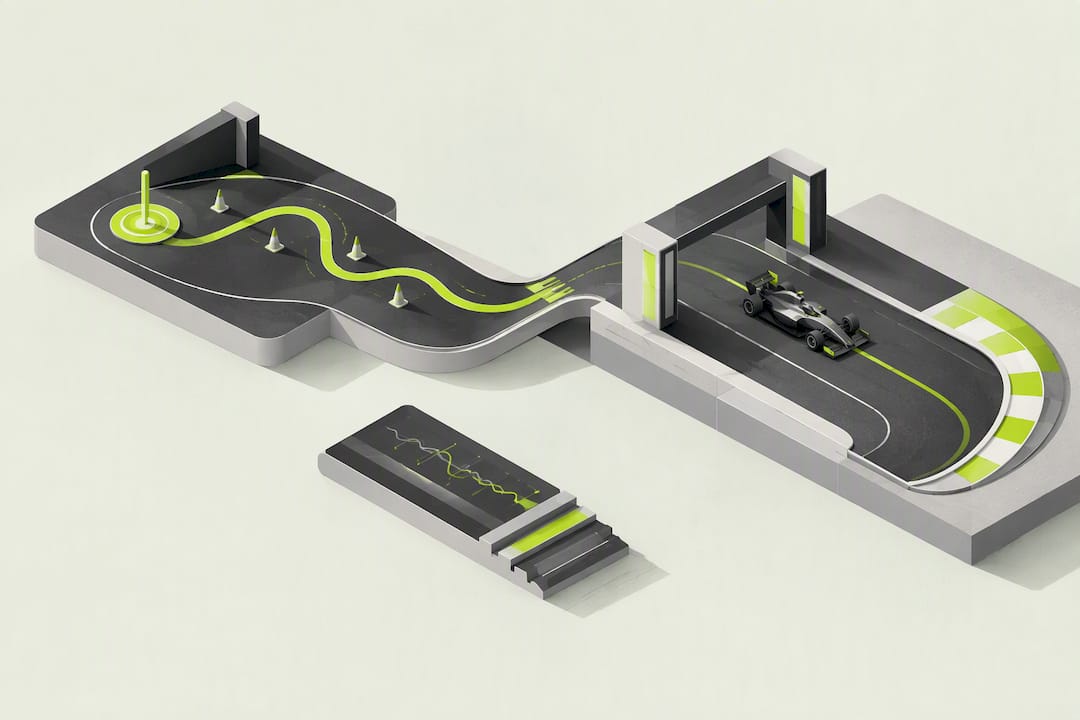
Maintenance throttle is the small, steady throttle you hold mid-corner to keep the chassis settled and preserve traction. You apply it once the car has finished braking and taken its set, holding a light, constant input through the apex rather than adding or lifting. The payoff is a calmer car, a consistent contact patch, and a cleaner exit that sets up real acceleration instead of a fight to catch the rear.
TL;DR:
- Maintaining a steady, light throttle during mid-corner stabilizes the chassis by preventing abrupt load transfers that can unsettle the car.
- The optimal moment to hold maintenance throttle is after the car has stabilized, with consistent steering pressure and no suspension movement.
- Proper gear selection and slow, deliberate throttle application help maximize the window for effective maintenance throttle and reduce slip risk.
- Most throttle errors come from abrupt or reactive adjustments; planning throttle inputs and practicing small, smooth changes improve consistency.
- Virew’s lap analysis tool identifies where your throttle timing varies between laps, enabling targeted coaching to improve stability and exit speed.
Table of Contents
- Why a Steady Throttle Keeps the Car Settled Through a Corner
- When to Apply Maintenance Throttle During a Corner
- How to Set and Hold Maintenance Throttle Step by Step
- Common Throttle Mistakes and How to Recover
- Practice Drills to Build the Skill in F1 26
- How Virew Turns Throttle Timing Into Coaching Missions
- What Changed When I Stopped Fighting the Throttle
- Try Virew to Find Your Throttle Timing Losses
- Sources
- FAQ
Why a Steady Throttle Keeps the Car Settled Through a Corner
A car under trail braking or coasting into a corner is decelerating, which shifts weight onto the front axle and unloads the rear. A light, constant throttle counters that deceleration just enough to stop the chassis from pitching forward further, which is why throttle control affects motorcycle cornering in exactly the same way it affects an F1 car mid-corner: it keeps the suspension in a settled middle position instead of fully compressed or fully extended. That middle position matters because it is where the contact patch stays most consistent, and a consistent contact patch is what lets you carry rotation speed without triggering a slide.
The effect gets stronger in lower gears, where a small throttle movement produces a bigger change in drive torque at the rear axle. That is one reason gear choice for a corner is not just about exit speed, it is about how forgiving the throttle feels while you are holding it.
You will feel the chassis settle in a few concrete ways:
- The steering load through your hands or wheel evens out instead of loading and unloading.
- The rear stops squatting and rising and instead holds a steady ride height.
- Small mid-corner bumps stop upsetting the car's line.
Small throttle inputs prevent the abrupt load transfer that destabilizes a chassis mid-corner, according to core throttle skills guidance, which treats the throttle as a suspension tool rather than just an acceleration input.
When to Apply Maintenance Throttle During a Corner
Cornering breaks down into three distinct throttle phases, and mixing them up is where most lap time gets lost. According to guidance on cornering technique and throttle phases, the sequence runs like this:
- Entry: brakes are doing the speed reduction, throttle stays off or neutral so weight stays committed to the front for turn-in grip.
- Mid-corner: once the car has taken its set and lean or rotation is stable, hold a light, steady maintenance throttle to keep the chassis settled through the apex.
- Exit: roll the throttle on progressively as the car unwinds and straightens, synced with the reduction in lateral load so the extra grip goes into acceleration rather than a slide.
The cue to start holding maintenance throttle is a settled car: steering pressure has stopped changing, the line feels locked in, and the suspension has stopped moving. In wet or low-grip conditions, that window opens later and the roll-on itself has to be smoother and more gradual, since there is less traction budget to spend on any sudden input.
How to Set and Hold Maintenance Throttle Step by Step
Get your speed right before you turn in. Trying to fix an entry that was too fast by lifting the throttle mid-corner just destabilizes the car further, so all your speed adjustment should happen on the brakes, before you commit to the corner.
Pick a gear that suits the corner radius. A gear that is too low makes the throttle oversensitive for a tight, technical corner, while a gear that is too tall can leave you short of drive on exit. For long, fast corners a taller gear gives you a wider, more forgiving throttle window to hold steady.
Once you are turned in and the car feels settled, add throttle in a small amount and hold it flat. There is no fixed number here, since the right amount depends on the corner and the car's balance at that moment. What you are chasing is a feel: enough throttle that the rear stays loaded and the front stays light, not so much that the car starts to push wide.
- Start lighter than you think you need to, since it is easier to add than to recover from too much.
- Hold the input as level as possible rather than pulsing or feathering it.
- Watch for the car standing up or the rear stepping out, and respond with a small, smooth reduction rather than lifting off entirely.
- Keep your steering corrections small so you are not fighting the throttle with the wheel at the same time.
Pro Tip: Practice saying the throttle amount out loud as you drive, "light, hold, hold, roll," so your inputs match your mental model instead of drifting on feel alone.
Coordinate your steering and throttle as one system rather than two separate jobs. If you are still adding lock while trying to increase throttle, you are asking the tires to do two jobs on the same traction budget, which is exactly when the car starts sliding wide or the rear lets go.
Common Throttle Mistakes and How to Recover
Most throttle problems in F1 26 come down to abruptness rather than the wrong amount. According to research on throttle control in turns, planning throttle changes before the corner and favoring small adjustments over reactive corrections is the core of clean cornering.
- Chopping the throttle mid-corner shifts weight forward suddenly and can snap the rear loose or trigger a spin; the fix is to ease off gradually instead of lifting outright.
- Over-rolling the throttle too early overloads the rear before the car has unwound, which sends it wide; the recovery is a small reduction and a wait for more lean to come off before adding drive back.
- Blipping or pulsing the throttle mid-corner destabilizes the chassis repeatedly instead of once, so hold a level input even if it feels conservative.
- Trying to fix the line with throttle rarely works, since adding throttle mid-corner tends to open the radius rather than tighten it. The correction belongs on the wheel and the brake, not the throttle.
If the rear starts to slide, ease the throttle rather than snapping it shut. If the front starts to wash out, reduce lean angle rather than reaching for the throttle at all. Staying smooth and looking through the corner rather than at the point of the slide gives you the best chance of catching it before it becomes a spin.
Practice Drills to Build the Skill in F1 26
Skill here comes from repetition on a narrow task, not from lapping full circuits at random. Build it in stages.
- Straight-line smoothing: on a long straight, practice rolling the throttle on and off in small, even steps until the input feels deliberate rather than reflexive.
- Low-speed arc holds: pick a slow corner such as the final hairpin at a track like Monaco and practice holding one steady throttle value through the entire apex before touching the throttle again.
- Linked-corner holds: move to a sequence of two or three corners and practice holding maintenance throttle through each apex without adjusting between them.
- F1 26 Time Trial segment drills: isolate a single corner or short sector, then repeat it, holding a consistent throttle band through the mid-corner phase and measuring how your exit speed varies lap to lap.
Increase difficulty by shortening the window where you allow yourself to adjust, or by moving from a slow corner to a faster, higher-load one. Track your progress by exit speed consistency and by how many corrective steering inputs you need, since fewer corrections usually means the throttle held cleaner.
Pro Tip: Run the same corner ten times in a row before judging your consistency; one good lap tells you nothing about whether the technique has actually become a habit.

This kind of segment repetition is the same principle behind the Drive, Analyze, Improve, Repeat loop covered in how to get faster in F1 26, which breaks lap improvement into the same kind of narrow, repeatable practice cycles.
How Virew Turns Throttle Timing Into Coaching Missions
Throttle timing mistakes are hard to self-diagnose from the cockpit view alone, since a corner that felt fine can still hide an early roll-on or a chopped mid-corner input. Virew's lap analysis breaks a lap into segments and looks specifically at how throttle behaves through entry, mid-corner and exit for each one.
- It flags corners where throttle timing is inconsistent between laps, which usually points to the maintenance-throttle window being applied too early or too late.
- It highlights hold zones where a rolling adjustment replaces a steady input, matching the chopping and over-rolling mistakes covered above.
- It adapts its feedback to session type and to dry or wet conditions, since the timing window for maintenance throttle shifts with grip level.
A driver can use a Free lap credit to test one or two corners where the exit feels inconsistent, then move to Pro for ongoing coaching missions that track the same corners lap after lap as detailed in how Virew's AI analysis works.
What Changed When I Stopped Fighting the Throttle
The biggest shift in cornering stability rarely comes from a new setup or a different line, it comes from leaving the throttle alone once it is set. Early on, the instinct is to chase every small slide with a lift or a stab, which almost always makes the slide worse instead of catching it. What actually helped was slowing down the whole process: enter the corner, settle the car, hold, then roll on, without touching the throttle in between. Deliberate repetition beats rushing the process every time, and the exit speed gains follow once the habit sticks.
— Virew
Try Virew to Find Your Throttle Timing Losses
Reading about maintenance throttle gets you the theory, but seeing exactly where your own laps break down is a different problem, and that is what Virew's lap analysis is built to solve. Upload a lap and Virew checks throttle timing through entry, mid-corner and exit for the corners where you are actually losing time, then turns that into coaching missions you can repeat.
- Time Trial drivers get segment-level feedback on exactly which corners have inconsistent roll-on.
- Rookies get plain-language explanations of what to change rather than a raw number.
- Consistency-focused racers can track the same corner over multiple sessions to see if the fix is sticking.
Start with a Free lap analysis to test a corner or two, then explore how Virew maps throttle timing to coaching missions if you want ongoing feedback across a full session.
Sources
- How does throttle control affect motorcycle cornering? (Riderwize)
- Hints & tips: cornering (MoreBikes)
FAQ
What happens if throttle timing is off in a corner?
A throttle applied too abruptly or too early destabilizes the chassis, which can cause the rear to slide or the car to run wide instead of holding its line. Smooth, well-timed maintenance throttle keeps the suspension and contact patch settled through the corner.
When should I start holding maintenance throttle in a corner?
Start once the car has finished its braking and the line feels settled, which usually means steering pressure and suspension movement have both stabilized. Holding it too early, before the car has taken its set, tends to unsettle the car rather than help it.
Where in the corner does maintenance throttle apply?
It applies during the mid-corner phase, between the end of entry braking and the start of exit acceleration, according to the three-phase cornering model. Entry stays off-throttle, mid-corner holds steady, and exit rolls on progressively.
What is the purpose of maintenance throttle?
Its purpose is to keep the chassis settled and the contact patch consistent through the apex, rather than to add speed. It sets up a cleaner, more predictable exit where real acceleration can begin.
Can Virew help me fix inconsistent throttle timing in F1 26?
Virew's lap analysis flags corners where throttle timing varies between laps and turns that into repeatable coaching missions. Free lap credits let you test specific corners before moving to Pro for ongoing tracking.