
Lift-and-coast means briefly lifting off the throttle before a braking zone so aerodynamic drag and tyre scrub do the slowing instead of the brakes, cutting fuel burn and topping up battery charge in the process. For F1 26 sim racers, it is one of the few techniques that pays off in Time Trial, qualifying prep, and full race distance alike, especially now that 2026-spec power units lean harder on manual energy harvesting.
TL;DR:
- Proper lift-and-coast timing typically costs around 0.05 to 0.1 seconds per lap, with longer coasts potentially adding 0.2 to 0.3 seconds if overused.
- The technique is most effective when lift points are consistent and carefully calibrated, avoiding erratic lifting that can add time or invite overtakes.
- In dry conditions, lift distances of about 15 to 20 meters are optimal, but in wet conditions, they should generally be shortened to avoid excessive deceleration.
- Practicing with telemetry tools and structured drills helps drivers find the optimal balance between fuel savings and minimal lap time impact.
- Using lift-and-coast proactively early in a stint enhances fuel efficiency, energy recovery, and tyre preservation, whereas reactive or late-stage use risks losing positions.
Table of Contents
- What Is Lift and Coast, Exactly?
- How Does Lift and Coast Actually Work?
- Why Do Teams and Sim Racers Use It?
- When Does Lift and Coast Cost You Lap Time?
- How to Practice Lift and Coast using in F1 26
- A Quick Checklist to Test Your Lift-and-Coast on Track
- Lift and Coast vs Other Fuel and Energy Techniques
- How Lift and Coast Evolved Into a Core F1 Strategy
- Famous Cases Where Lift and Coast Decided the Race
- Does Lift and Coast Change How the Car Feels?
- Why This Skill Is Worth the Practice Time
- Master Lift and Coast Faster With Virew's Lap Analysis
- Sources
- FAQ
What Is Lift and Coast, Exactly?
Lift-and-coast is not the same as coasting into a corner out of laziness or bad timing. It's a deliberate, repeatable window: you release the throttle a set distance before your normal braking point, let the car shed speed naturally, then rejoin your usual braking trace at the exact point you'd have hit the brakes anyway. Engineers describe it as a calibrated deceleration window, not a shortcut to slow driving.
The confusion matters because sloppy lift-and-coast (lifting too early, too late, or inconsistently) costs more lap time than it saves in fuel or energy. Done right, it's invisible on a lap chart except for the numbers on your fuel and battery readouts.
How Does Lift and Coast Actually Work?
The physics is simple once you see it on a telemetry trace. At around 300 km/h, aerodynamic drag alone can decelerate a car by roughly 0.9g, before you've touched the brake pedal at all. Add tyre scrub and engine drag, and a 50-meter lift can shed a meaningful chunk of speed with the throttle simply closed. During that coast phase, fuel flow drops to almost nothing, compared with full throttle burning at maximum rate, and that gap is where the savings come from.
Here's what's happening mechanically during a well-executed lift-and-coast in F1 26:
- Lift timing: you release throttle a short distance before your normal brake point, depending on corner speed and gearing.
- Coast distance: the car decelerates under drag alone until it reaches the speed where your regular braking trace would begin.
- Fuel behavior: fuel flow falls to practically zero during the coast window, unlike a gentle-throttle approach that still burns fuel continuously.
- Energy harvest: lifting off early gives the MGU more time to recover energy, which matters directly for boost availability under the 2026 power unit rules.
- Rejoin point: you brake exactly where you normally would, so lap time on the braking phase itself stays unchanged.
Pro Tip: Watch your throttle trace and speed trace together with in F1 26's telemetry overlay. A clean lift-and-coast shows a sharp throttle drop followed by a smooth, straight-line speed decay, not a jagged one that suggests you're still on and off the throttle.
Why Do Teams and Sim Racers Use It?
Fuel and energy management aren't afterthoughts; in F1 26, they're strategic levers. Lift-and-coast lets you start a race stint with less fuel on board, and every kilogram you don't carry is lap time you don't lose to extra mass. Spread across a full race distance, small, repeated fuel savings from a dozen or more laps of controlled coasting add up to real strategic flexibility, whether that means running a lighter car from the start or avoiding a late-race fuel-saving crisis where you're forced to lift far more aggressively than planned.
Under 2026 regulations, the payoff extends beyond fuel. Battery state of charge (SOC) is now a tighter resource, and manual lift-off regen remains a driver-controlled lever for topping it up between deployment zones. Real-world teams have used this exact tactic for over a decade, and it's often the most time-efficient way to save fuel compared with just easing off overall throttle percentage.
Practical reasons drivers and sim racers reach for lift-and-coast include:
- Protecting SOC through a middle stint so boost is guaranteed on the following straight.
- Managing brake temperatures on tracks with heavy, repeated braking zones.
- Reducing tyre scrub under braking, which helps stint-long tyre wear.
- Banking a fuel margin early so a late safety car or strategy call doesn't force a panic-lift finish.
When Does Lift and Coast Cost You Lap Time?
Lift-and-coast is a tool, not a default setting, and using it badly is worse than not using it at all. A short, well-timed coast of 15 to 20 meters typically costs somewhere in the range of 0.05 to 0.1 seconds per lap. Push the coast distance out further to save more fuel or energy, and that penalty can climb toward 0.2 to 0.3 seconds, which is real time over a full race distance.
The bigger risk is racecraft, not just lap time. If you lift early and a car behind you stays on full power, you hand over a straight-line advantage right into your braking zone, which is exactly how easy overtakes happen. Common driver mistakes include:
- Lifting at an inconsistent point lap after lap, which shifts your braking marker and invites lock-ups.
- Failing to rejoin the original braking trace, either braking too early (losing more time) or too late (risking a corner overshoot).
- Coasting through a defensive lap when a trailing car is within DRS range.
- Using lift-and-coast in qualifying, where a single flat-out lap usually matters more than fuel saved across a session you won't repeat.
How to Practice Lift and Coast using in F1 26
Getting this technique consistent takes structured reps, not random experimentation mid-race. Two drills work well for building the feel.
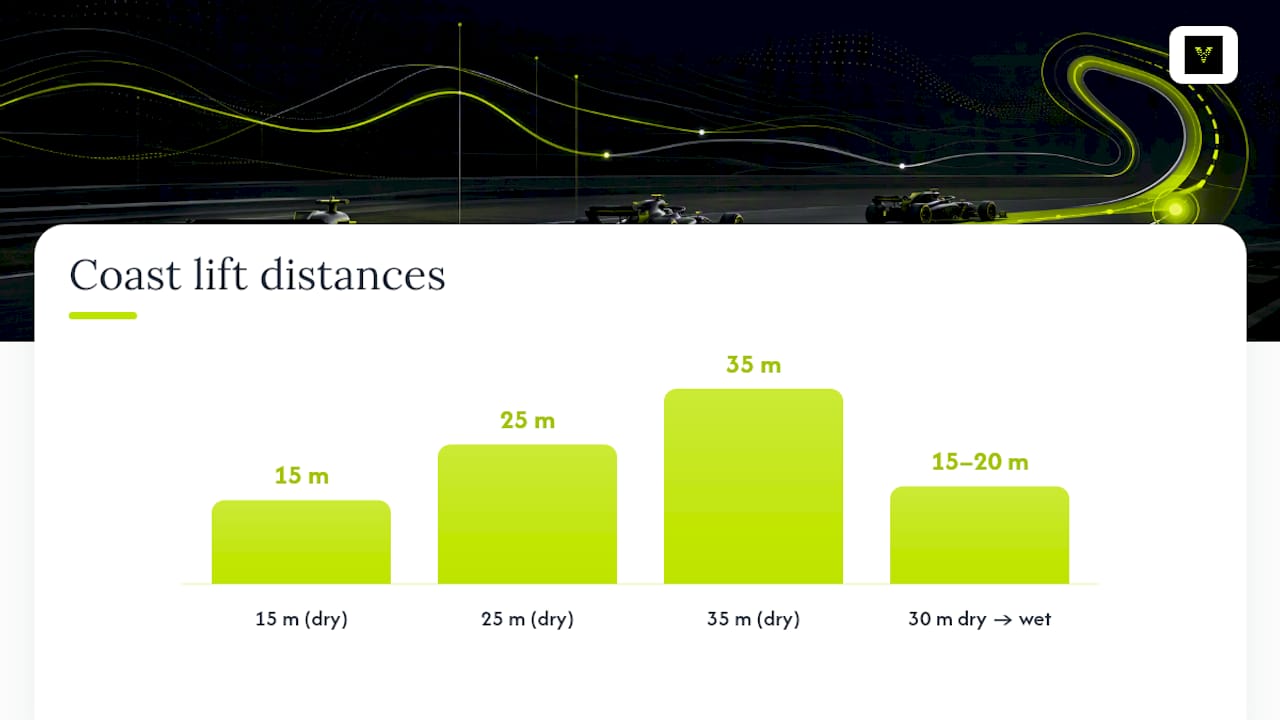
- Coast-distance ladder. Pick one long straight into a heavy braking zone, ideally somewhere like the run into Turn 1 at a high-speed track. Run five laps at a fixed 15-meter lift point, note your lap delta and SOC change, then increase to 25 meters for another five laps, and again at 35 meters. This shows exactly where the fuel-to-lap-time tradeoff stops being worth it for that specific corner.
- Overlay comparison. Compare your throttle trace against a faster reference lap of your own. Wasted throttle right before a braking zone, where a coast would have been more efficient, shows up clearly as a gap between the two traces where your throttle stays open longer than it needs to.
Structure each session the same way: a short warm-up lap, five measured runs at a fixed lift point, then a review before adjusting in 10 to 20 meter increments. Jumping straight to big changes makes it impossible to isolate what actually worked.
Track these four numbers every run: coast distance, SOC delta across the lap, total lap delta versus your reference, and throttle-trace smoothness (a jagged trace usually means you're still modulating instead of committing to a clean lift). This is exactly the kind of pattern Virew's lap analysis is built to surface automatically, overlaying your throttle trace against a faster reference and flagging where you're lifting too early or too late without you having to eyeball five separate telemetry graphs.
Wet conditions change the math. Grip is lower, so tyre and aero drag decelerate the car faster relative to speed, which means your coast distances should generally shrink rather than grow. A 30-meter dry lift point might only need to be 15 to 20 meters in the wet before you're already slower than you want heading into the braking zone.
A Quick Checklist to Test Your Lift-and-Coast on Track
Before changing anything mid-stint, run this sequence in a practice session or a low-stakes Time Trial run:
- Set your baseline. Pick a reference lap, turn on telemetry overlays, and note your starting SOC before the run.
- Start small. Lift 20 to 30 meters before your normal braking point, log five laps, and record both lap delta and SOC change against your baseline.
- Adjust gradually. Move the lift point in 10-meter steps, watching for braking-marker drift, and stop increasing coast distance the moment a car behind is close enough to punish it.
- Lock in the result. Compare overlays from each run and save whichever lift point gave the best fuel-or-energy gain for the smallest lap-time cost as your reference for that track.
Lift and Coast vs Other Fuel and Energy Techniques
Lift-and-coast isn't the only way to manage fuel and energy, in F1 26, but it tends to be the most efficient one when you measure cost per gram saved. The alternative most drivers try first is simply easing off throttle percentage through a whole section, rather than lifting fully and coasting. That approach still burns fuel continuously, just at a reduced rate, so it saves less per corner than a full lift-and-coast and the driver still has to think about it under acceleration too.
Reducing engine mixture or fuel mode settings is a separate lever entirely, one that's set for a whole stint rather than corner by corner, and it trades outright power for fuel economy across the board rather than in a targeted window. It's a blunter tool. Energy harvest through braking, meanwhile, happens whether you lift-and-coast or not, since regenerative braking captures energy any time you're slowing under brake pressure. What lift-and-coast adds on top is extra harvest time before the brakes are even applied, which is why it interacts so directly with battery state of charge under 2026 rules.
The practical takeaway: fuel mode changes handle broad, stint-long savings, throttle easing is the weakest and least precise option, and lift-and-coast remains the calculated efficiency strategy that costs the least lap time per unit of fuel or energy saved, which is exactly why it keeps showing up as the go-to tactic corner by corner.
How Lift and Coast Evolved Into a Core F1 Strategy
Lift-and-coast rose to prominence after refueling was banned from Formula 1, which meant cars had to carry their entire fuel load from the start. Before that, teams could simply refuel mid-race, so managing fuel corner by corner mattered far less. Once refueling disappeared, every kilogram of fuel carried at the start became a direct lap-time cost, and lift-and-coast became one of the cleanest ways to start lighter without sacrificing outright pace everywhere on track.
The technique picked up fresh relevance heading into 2026, as new power unit regulations put far greater emphasis on electrical harvesting. Reporting on the new rules suggests drivers and teams expect more lift-and-coast and downshifting as a direct result of how the new engines behave, even though some regulation tweaks aim to reduce how much of it is needed specifically in qualifying sessions.
For F1 26, that historical arc matters because the game's power unit modeling reflects this same shift. Automated harvesting behavior handles part of the workload, but manual lift-off still matters whenever SOC drops low or a driver wants guaranteed boost on the next straight. The skill that started as a real-world fuel-saving workaround is now baked into how the 2026-spec cars are meant to be driven, in-game and on track alike.
Famous Cases Where Lift and Coast Decided the Race
Lift-and-coast has occasionally spilled into public view when teams push it harder than usual. Reporting on the Canadian Grand Prix documented drivers being told to lift and coast more aggressively than normal to protect fuel margins, a moment that sparked genuine debate over whether fuel-saving instructions were undermining the spectacle of racing at full pace.
That tension is worth understanding for sim racers because it shows the two faces of the technique. Used proactively, early in a stint, lift-and-coast is nearly invisible, a few tenths banked here and there with no drama. Used reactively, late in a race because a driver is suddenly short on fuel, it becomes a visible, lap-by-lap compromise that can cost positions if a competitor timed their own fuel-saving better.
The lesson translates directly to F1 26 race strategy: plan your lift-and-coast usage early and consistently across a stint rather than discovering with five laps to go that you need to lift 40 meters early just to make the fuel target. A driver who banks small, steady savings from lap one rarely faces the kind of late-race scramble that shows up in race commentary as a fuel crisis. Consistency beats a desperate correction, every time.
Does Lift and Coast Change How the Car Feels?
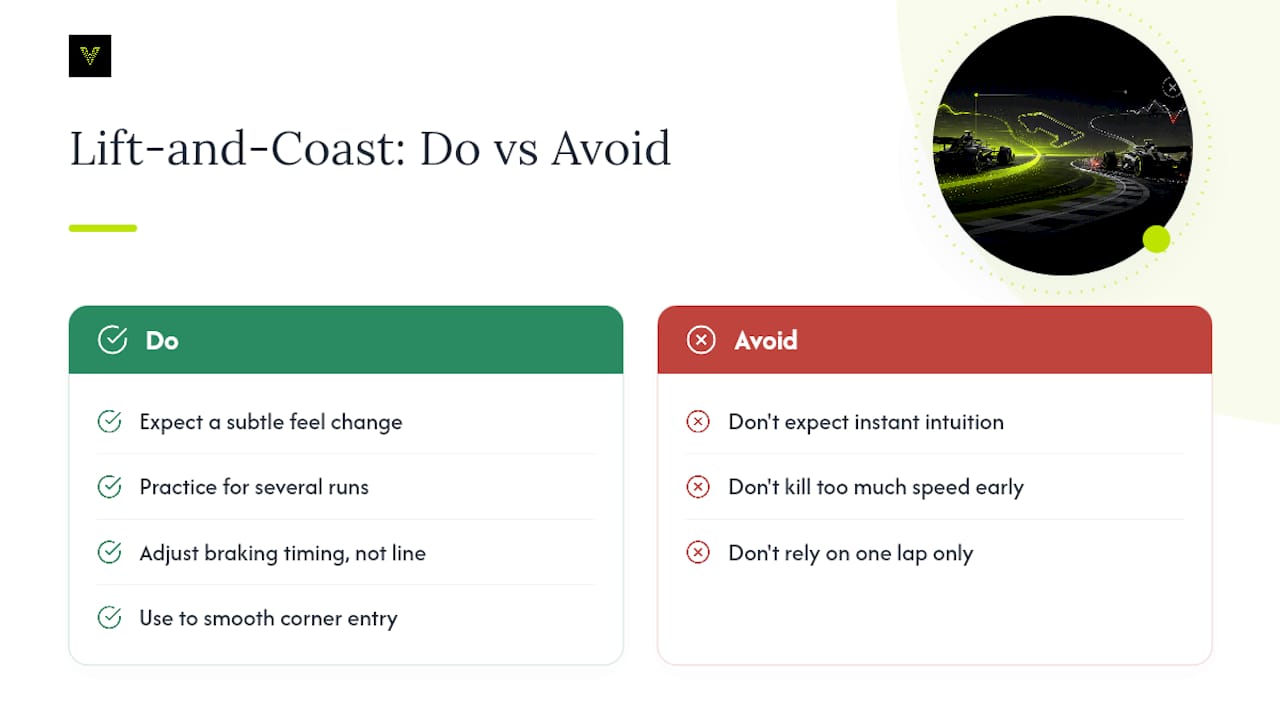
Yes, and it's a subtler shift than most drivers expect the first time they try it seriously. Lifting off early changes weight transfer before you've even touched the brake pedal, since the car settles slightly under drag deceleration rather than snapping forward under sudden brake pressure. Some drivers find this actually helps corner entry stability, because the car arrives at the braking zone already partially settled rather than fighting a hard transition from full throttle to hard braking in one motion.
Driver commentary around the 2026 cars backs this up. Several drivers reportedly found lift-and-coast felt odd at first but became intuitive after a few runs once they adjusted their sense of timing. That adjustment period is the part sim racers underestimate. Your muscle memory for a braking point is built around a specific speed and throttle state, and lift-and-coast shifts both of those variables slightly, which is exactly why your first few attempts often feel like you're braking too early even when you're not.
The upside once it clicks: better predictability under braking, since you're no longer transitioning from maximum throttle load to maximum brake load in one abrupt motion. The downside if you get it wrong: a car that feels vague on entry because you've killed too much speed too early, forcing you to carry the corner at a lower speed than the car is capable of. Getting the balance right is less about raw skill and more about repetition on a specific corner until the feel becomes automatic.
Why This Skill Is Worth the Practice Time
Most sim racers chase lap time through braking points and throttle application, and both matter enormously. But lift-and-coast is one of the few skills that pays off in three places at once: fuel strategy, energy management, and tyre life, without demanding a faster car or better reflexes.
The gains are small individually, a tenth here, a gram of fuel there, but they compound across a stint or a league season in a way raw pace alone doesn't. Guessing at lift points from memory is how most drivers plateau. Pairing deliberate drills with telemetry that actually shows your throttle trace against a faster lap is how you stop guessing and start improving on purpose.
— Virew
Master Lift and Coast Faster With Virew's Lap Analysis
Spotting a mistimed lift-and-coast on your own telemetry screen takes practice most drivers don't have time for. Advanced AI lap analysis tools can read your lap footage and indicate directly where you're lifting too early, too late, or losing battery charge you didn't need to, instead of leaving you to squint at overlapping graphs.
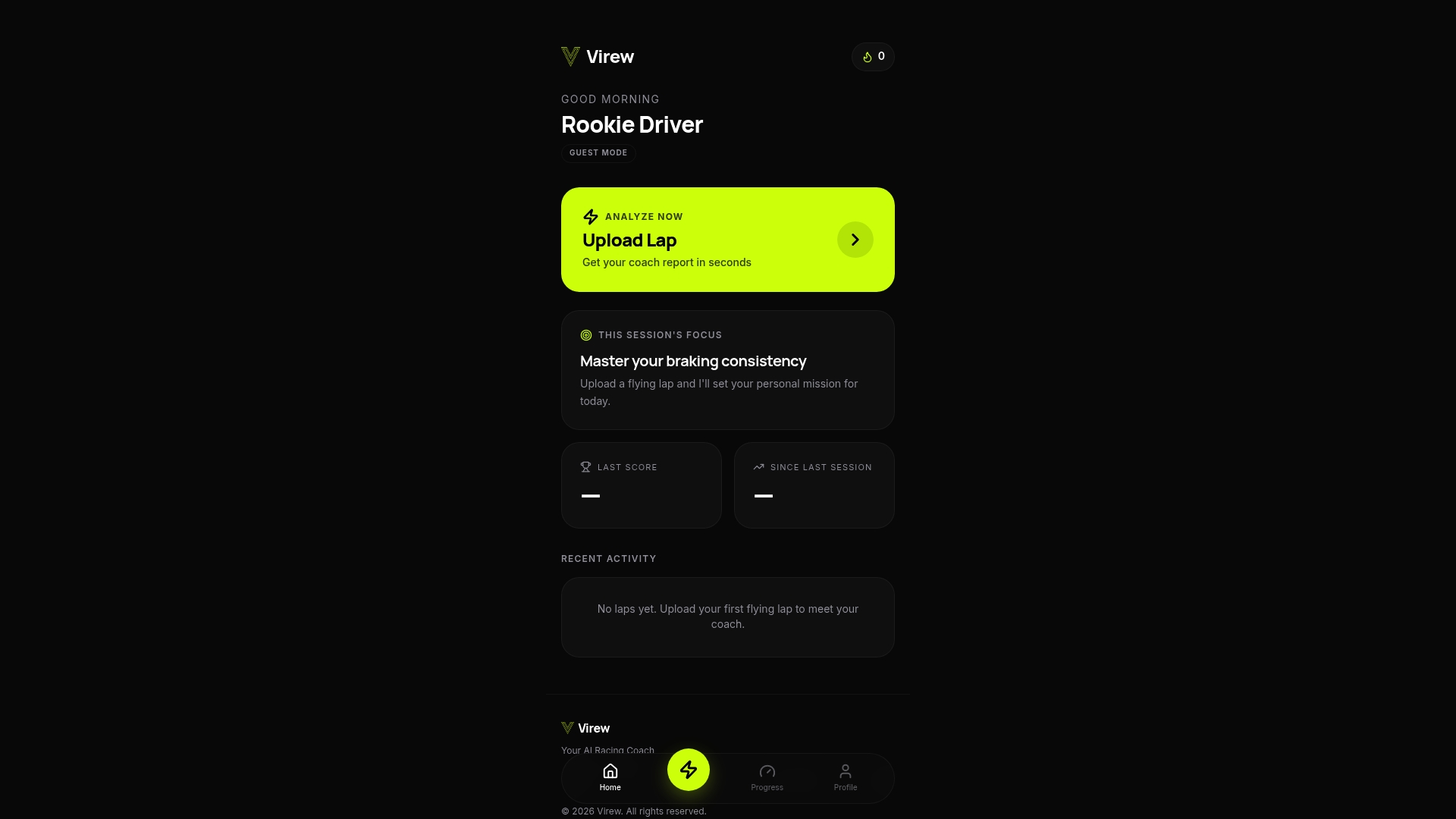
Upload a lap from PlayStation, Xbox, or PC, and Virew builds a throttle and brake overlay against a faster reference, tracks your SOC trend across the stint, and generates a targeted practice mission if your lift point is drifting lap to lap. It's built specifically for for F1 26's power unit behavior, so the feedback matches what you're actually driving, not a generic sim racing checklist. If you're adjusting to the 2026 cars specifically, the guide to driving the 2026 cars covers the wider handling changes alongside energy management.
Run one lap analysis on your next session and see exactly where your lift-and-coast is costing you time, or start with the how-to-get-faster guide if you want a broader look at where your pace is going first.
Sources
- Explained: the new key terms for Formula 1's new-for-2026 rules — Formula 1
- What exactly is 'lift and coast'? Mercedes explain — Motorsport Week
- Drivers reveal downshifting and lift-and-coast demands of new F1 engines — PlanetF1
- F1 2026 Regulations: What is lift and coast? — GPFans
FAQ
What Is Lift and Coast in F1?
Lift-and-coast means releasing the throttle before a braking zone so aerodynamic drag and tyre scrub slow the car naturally, saving fuel and helping energy recovery before the brakes are even applied.
How Much Lap Time Does Lift and Coast Cost?
A short, well-timed coast usually costs around 0.05 to 0.1 seconds per lap, while longer coasts used to save more fuel or energy can cost 0.2 to 0.3 seconds.
Why Is Lift and Coast More Relevant in F1 26 for 2026?
The 2026 power unit rules put greater emphasis on electrical harvesting, and manual lift-off remains a direct way for drivers to top up battery charge and guarantee boost availability on the next straight.
Can Virew Help Me Practice Lift and Coast?
Yes. Virew's lap analysis overlays your throttle trace against a faster reference lap and tracks your battery state of charge, so you can see exactly where your lift point needs adjusting.
Should I Use Lift and Coast While Defending a Position?
Generally no. Coasting while a car behind you is at full throttle hands over a straight-line advantage right into the braking zone, which is one of the easiest ways to get overtaken.