

Lift and coast means releasing the throttle early and letting the car slow naturally under aero drag and engine braking before you reach the braking zone. In F1 26, it saves fuel, protects your brakes and skid block, and under 2026 power unit rules, it charges the MGU-K battery for later use. Learn to apply it selectively and you gain strategic flexibility that flat-out driving simply cannot offer.
TL;DR:
- Lift and coast typically costs between 0.05 and 0.30 seconds per lap, depending on timing and how early the driver lifts.
- Using lift and coast reduces fuel consumption, brake temperatures, tyre wear, and helps harvest electrical energy more efficiently under 2026 rules.
- It is most beneficial during race stints with high fuel loads, heavy braking zones, or when managing battery power for overtakes late in a lap.
- Practicing this technique involves incremental lift points, fuel tracking, and consistent rejoining at the correct entry speed without telemetry tools.
- Poor application, such as lifting too early, too often, or during wheel-to-wheel battles, can easily negate its benefits and slow lap times.
Table of Contents
- What Lift and Coast Actually Does to Your Car
- Why Sim Racers Should Bother With Lift and Coast at All
- When You Should Actually Use It: Race, Qualifying, and Track Layout
- How to Practice Lift and Coast in F1 26 Without Telemetry
- Common Mistakes That Waste Your Lift and Coast Practice
- Coaching Priorities for Learning Lift and Coast
- Why Learning This Feels Wrong at First but Pays Off
- Structured Practice Plans for Mastering Race Technique
- Sources
- FAQ
What Lift and Coast Actually Does to Your Car
The mechanics are simple even if the timing feels foreign at first. You lift off the throttle before your usual braking marker, the car sheds speed through aerodynamic drag and engine braking, and you rejoin your normal braking trace at a lower entry speed than if you'd stayed flat out. During that coast phase, the MGU-K switches into generator mode and pulls kinetic energy back into the battery instead of you burning it off entirely through the brakes.
A few things happen simultaneously during the coast window:
- Fuel flow drops to near zero since the throttle is closed
- Brake temperatures fall because you're carrying less speed into the corner
- The MGU-K harvests energy that would otherwise be wasted as heat
- Tyre and skid-block wear both ease slightly under the reduced load
The trade-off is measurable. Lift and coast typically costs between roughly 0.05 and 0.30 seconds per lap depending on how early and how hard you lift. That sounds small, but multiply it by a full race distance and you start to see why teams treat the timing of every lift as a genuine strategic decision.
Why Sim Racers Should Bother With Lift and Coast at All
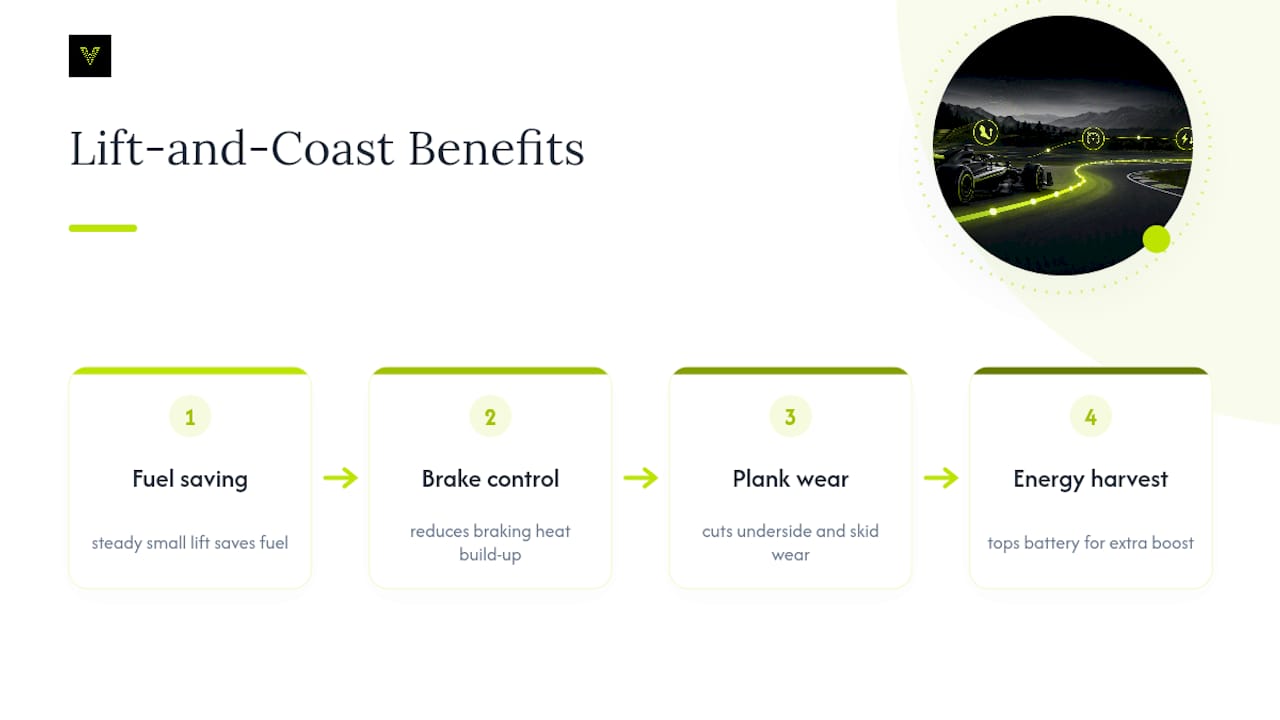
Fuel saving gets the most attention, but it's only one of four real reasons this technique matters in F1 26. Run your fuel load too aggressively and you'll be forced to lift far more than planned in the closing laps, which costs more time than a small, consistent lift applied from lap one.
Brake management is the second driver. Lifting earlier reduces the speed you carry into the braking zone, which means less kinetic energy converted to heat at the rotors. Over a long stint that keeps brake temperatures in a safer window and helps you retain consistent pedal feel late in a race, rather than dealing with fade when you need stopping power most. Engineers have long pointed to lift and coast as the most efficient way to trim fuel consumption without sacrificing lap time compared to other methods, like short-shifting or running a leaner engine map throughout.
Plank and skid-block wear is the quieter benefit. Heavy braking loads and bottoming out at high speed accelerate wear on the car's underside, and a well-timed lift reduces that load exactly where it matters.
Then there's energy harvest, which matters more in F1 26 than in previous seasons. 2026 power units draw roughly half their power from electrical systems, so every coast phase that tops up your battery translates directly into more available boost on the next straight. That's a genuine performance trade, not just fuel conservation.
When You Should Actually Use It: Race, Qualifying, and Track Layout
Not every lap or every corner calls for lifting early, and knowing when to apply it separates drivers who manage a race from drivers who just survive one.
- Race sessions with a fuel target. If your fuel-per-lap number is running hot against your remaining distance, lift and coast at one or two specific corners is usually cheaper than a late splash-and-dash detour.
- Long stints where brake temperature climbs. Circuits with heavy, repeated braking zones benefit from planned lifts to keep pedal feel consistent into the final laps.
- Battery management laps. When you need extra MGU-K deployment for an overtake later in the lap, a light lift earlier in the sequence can top up the reserve just enough.
- Qualifying, rarely. Teams generally avoid lifting on a qualifying lap since every hundredth counts, though under 2026 rules with heavier electrical demand, some circuits may still require a small lift to protect deployment for the final sector.
Circuits with long straights and few heavy braking zones, think Monza or Baku, tend to reward lift and coast more than tight, stop-start layouts like Monaco, simply because there's more coasting distance available without disrupting your rhythm.
How to Practice Lift and Coast in F1 26 Without Telemetry
You don't need an overlay or a data logger to learn this. You need consistent visual references and a willingness to run the same corner ten times in a row.
- Drill one: incremental lift points. Pick a single corner with a visible braking board, like the 100m marker at the end of a long straight. Lift five meters earlier than your normal braking point for three consecutive laps, then check your lap time against your baseline. Move the lift point back gradually until the time loss stops feeling worthwhile.
- Drill two: fuel-gauge tracking. Run a five-lap stint using your in-game fuel readout, noting consumption per lap with no lifting, then repeat the same stint with a light lift at one corner. The difference in your fuel-per-lap number tells you exactly what that lift is worth over a race distance.
- Drill three: braking-trace recovery. After lifting, use a fixed visual reference, a run-off marking, a curb edge, or a sponsor board, to rejoin your normal braking point at a consistent entry speed. Check your minimum corner speed on the in-game HUD to confirm you're not carrying extra speed into the apex, which would erase the point of lifting at all.
Adjust these drills for wet conditions separately. In the rain, aero drag drops and grip is unpredictable, so your coast distance needs to be longer and your rejoin point earlier to account for reduced braking confidence on a wet racing line.
Structure your sessions by mode: use Time Trial to isolate the lift-point drill without race pressure, use Qualifying practice to confirm you can still post a clean lap without lifting at all, and use Race mode to test fuel-target drills across a realistic stint length.
Pro Tip: Run your lift-and-coast drill on the same three or four corners every session instead of switching tracks constantly. Repetition on familiar braking zones is what turns a conscious lift into muscle memory.
Common Mistakes That Waste Your Lift and Coast Practice
The biggest mistake is lifting too early and too often out of caution rather than calculation. If you're losing more than three tenths on a single corner, you're likely lifting well before the point of diminishing returns and giving away time you don't need to.
- Lifting too far before the corner and coasting longer than the fuel or brake benefit justifies
- Failing to rejoin your normal braking trace, which causes a slow, mushy entry instead of a clean one
- Lifting during wheel-to-wheel battles, where losing momentum invites a move from behind
- Never checking whether a specific lift actually pays off through lap-time comparison and exit speed
Fix each one the same way: compare your lifted lap against a flat-out baseline, watch your exit speed on the HUD, and cut any lift that costs more than it saves.
Coaching Priorities for Learning Lift and Coast
Good coaching for this technique focuses on outcomes you can actually see on screen, not abstract theory. Three numbers matter more than anything else:
- Lap-time delta between your lifted lap and your baseline lap
- Exit speed consistency at the corner where you're practicing the lift
- Fuel-per-lap trend across a full stint, tracked from the in-game display
Allocate practice time deliberately. A rough split of two-thirds flat-out laps to one-third lift-and-coast drills keeps your baseline pace sharp while still building the habit. You don't need telemetry overlays to run this kind of session, just consistent visual markers and a notebook or memory for your lap times from one run to the next.
Why Learning This Feels Wrong at First but Pays Off
Lifting off the throttle on purpose goes against every racing instinct you have. It feels like giving up time you could be attacking for.
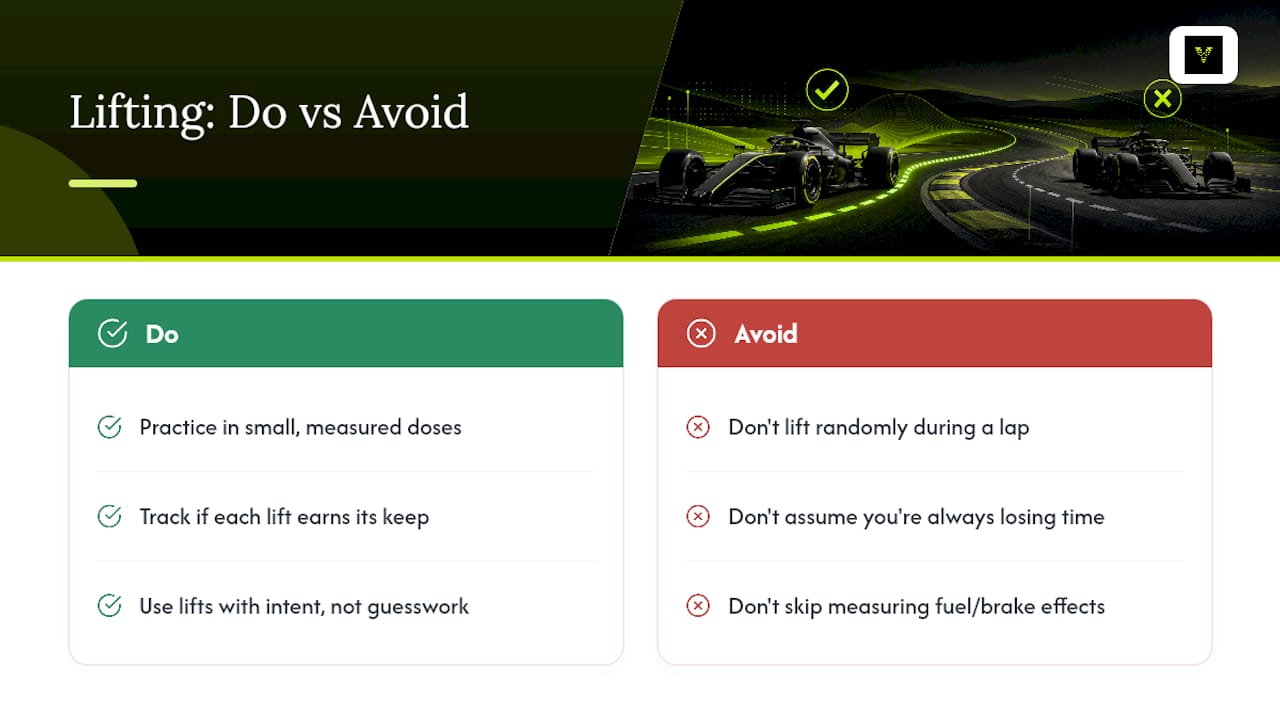
The payoff shows up over a race distance, not a single lap, through saved fuel, cooler brakes, and a charged battery when you need the boost most. Practice it in small, measured doses and track whether each lift earns its keep. Used with intent instead of guesswork, it becomes a strategic tool rather than a compromise.
— Virew
Structured Practice Plans for Mastering Race Technique
Learning lift and coast through trial and error works, but it's slow when you're guessing which corners actually matter for your fuel target or battery deployment. Virew is built for F1 26 drivers who want their practice time to point somewhere specific: upload your race footage and get plain-language coaching on where you're losing time and which habits are worth fixing first.
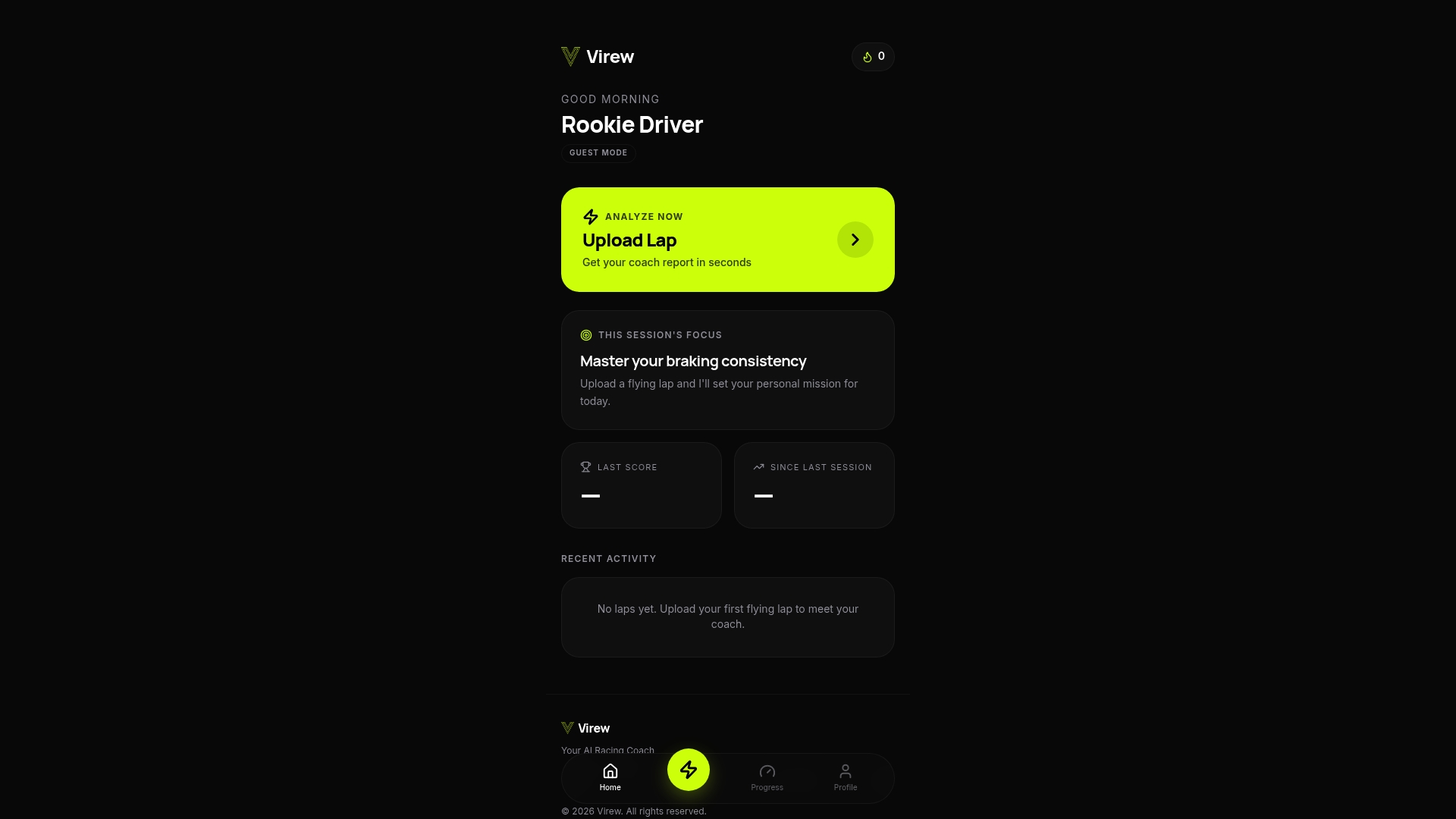
A structured plan beats random repetition, especially for a technique like this where the gains are marginal but cumulative. Coaching reports can break down braking, corner entry, and consistency to help you understand whether your lift-and-coast attempts are beneficial or detrimental to lap time. Start with the Free plan to see how your current sessions stack up, then decide if the Pro tier's unlimited analysis fits your training routine.
Sources
- What is lift and coast in F1? - RacingNews365
- What is lift and coast in F1? - F1Chronicle
- What exactly is 'lift and coast'? Mercedes explain - Motorsport Week
FAQ
What Is Lift and Coast in F1 26?
Lift and coast is releasing the throttle before your usual braking point, letting aero drag and engine braking slow the car naturally instead of burning fuel or overheating the brakes under full power. In F1 26, it also feeds the MGU-K generator mode, which supports the heavier electrical demands of 2026 power units.
How Much Lap Time Does Lift and Coast Cost?
A typical lift costs between roughly 0.05 and 0.30 seconds per lap, depending on how early you lift and how much speed you shed. Light, well-placed lifts cost far less than long, cautious coasting phases.
Should I Use Lift and Coast in Qualifying?
Generally no, since a qualifying lap rewards maximum commitment everywhere on track. Under 2026 rules some circuits with heavy electrical demand may still call for a small lift to protect energy deployment for the final sector.
Can I Practice Lift and Coast Without Telemetry Tools?
Yes. Use fixed visual markers like braking boards or curb edges to set your lift point, track your fuel-per-lap number from the in-game display, and compare lap times across repeated runs to see what each lift actually costs and saves.
Does Virew Help With Lift and Coast Technique?
Virew reviews your uploaded F1 26 laps and gives plain-language coaching on braking, corner entry, and consistency, which helps you judge whether a lift-and-coast habit is actually paying off. Pricing details for the Free and Pro plans are available on the Virew site.