
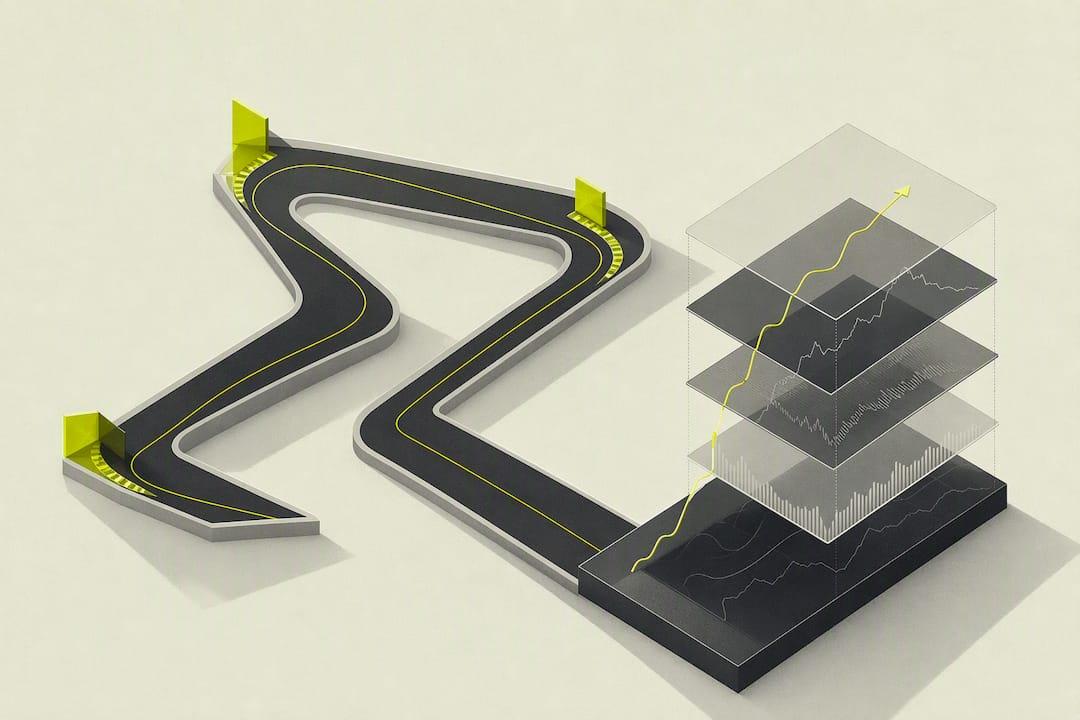
Racing rhythm is the repeatable cadence of braking, turn-in, apex, and throttle that turns one clean corner into a whole clean lap. You build it by drilling fixed braking markers until five consecutive laps land within a small margin of each other, not by chasing a single perfect lap. Start tonight in Time Trial: pick one corner, pick one brake marker, and run a five-in-a-row set. Then check the result with lap analysis to confirm what actually changed.
TL;DR:
- Consistent lap times in F1 26 depend on mastering repeatable input sequences, not just achieving a single fast lap.
- Focus on building fixed brake markers, smooth steering arcs, and progressive throttle application to develop reliable racing rhythm.
- Practice should be structured around drills like five-in-a-row sets, with clear separation of variables and regular telemetry analysis.
- Race, qualifying, and time trial modes each require tailored rhythm approaches, emphasizing durability, peak performance, or baseline consistency.
- Adjust wet-weather driving techniques and setup choices carefully, as grip conditions and aerodynamic settings significantly alter optimal rhythm.
Table of Contents
- What Does Racing Rhythm Mean in F1 26?
- Core Principles: Brake Shape, Steering Cadence, and Throttle Timing
- Should Rhythm Practice Differ Between Time Trial, Qualifying, and Race?
- Practical Drills and a 4-Week Plan to Build Rhythm
- How Do You Use Telemetry to Spot Repeated Time Losses?
- Why Wet Driving Needs a Completely Different Rhythm
- How Do Gear Shifts and Setup Choices Fit Into Rhythm?
- How Do You Stay Consistent Under Pressure?
- How Does Track Layout Change Racing Rhythm?
- What Mistakes Do Beginners Make Learning Racing Rhythm?
- Rhythm improves fastest through a tight loop: drive a set, analyze what the data actually shows, change one thing, repeat. AI coaching can help by flagging the exact corner and input shape behind a recurring loss, instead of leaving you to guess between sessions. Gains are typically marginal per session, but can compound once your five-in-a-row spread starts consistently shrinking week over week.
- Try Virew to Turn Lap Data Into a Faster Rhythm
- Authoritative Reading and Telemetry Tools to Consult Next
- Sources
- FAQ
What Does Racing Rhythm Mean in F1 26?
Racing rhythm is the sequence your hands and feet repeat every time you approach a corner in F1 26: brake to a fixed point, release pressure as you turn in, hold a line to the apex, then feed throttle back in as the wheel unwinds. When that sequence stays identical lap after lap, your times stay identical too. When it wobbles, so does your lap time, even if you never touch a wall.
This matters more in F1 26 than in most racing games because the physics model rewards mechanical sympathy over aggression. A driver who repeats a slightly slower lap consistently will beat a driver whose best lap is faster but not repeatable, because race time is the sum of every lap, not your best one. That single idea should reframe how you practice. You are not hunting a purple sector. You are hunting a input sequence you can reproduce ten times in a row without thinking about it.
Core input shapes worth naming
Three shapes make up rhythm, and each has a distinct feel once you know what to look for:
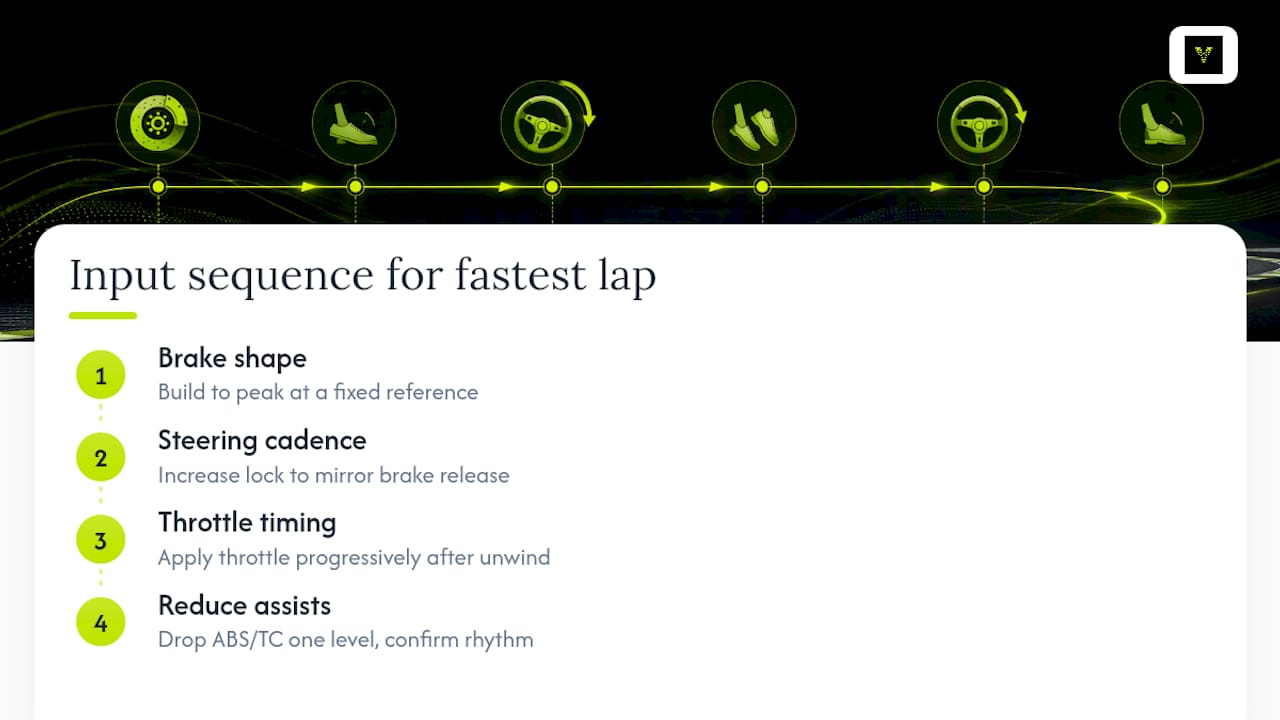
- Brake shape: a sharp rise to peak pressure, held briefly, then a controlled taper into the corner.
- Steering cadence: one smooth arc to the apex, not a series of small corrections.
- Throttle timing: a delayed, progressive squeeze that starts only once the wheel is unwinding.
None of these are exotic. They're the same three motions you already make. The goal of learning racing rhythm is making them identical, corner after corner, session after session.
Core Principles: Brake Shape, Steering Cadence, and Throttle Timing
Every fast, consistent lap in F1 26 comes down to three input shapes working together, and getting the sequence wrong is the single biggest reason drivers plateau below their potential pace.
Brake in a straight line and build to peak pressure at a fixed reference, whether that's a board, a painted line, or a distinctive piece of track furniture. Trail braking then means releasing that pressure gradually as you turn in, rather than snapping off the brake and coasting. This technique improves rotation and preserves corner speed when the release is smooth rather than abrupt, according to guidance from Racinggames.
Steering input should mirror brake release almost exactly. If you're still trailing brake pressure while cranking in a lot of lock, you're asking the front tyres to do two jobs at once, and that's where mid-corner understeer or snap oversteer creeps in. The fix is matching the rate of steering increase to the rate of brake decrease, so the car rotates on a single, predictable arc instead of needing correction.
Throttle timing closes the loop. Hold off full throttle until the wheel is mostly unwound, then apply it progressively rather than mashing the pedal the instant you clip the apex. Progressive application preserves rear grip and actually gets you to full throttle sooner in real terms, because you're not asking the tyres to accelerate and rotate at the same time.
Here's the part that surprises newer players: smoothness beats the "on the edge" feel every time in F1 26's physics model. Deliberate, mechanically sympathetic inputs consistently outperform aggressive ones, because the tyre model punishes sudden weight transfer far more than it rewards bravery.
While you're building this feel, reduce ABS and traction control progressively rather than all at once. Full assists mask poor marker discipline. Drop one assist level, confirm your rhythm holds, then drop the next.
Should Rhythm Practice Differ Between Time Trial, Qualifying, and Race?
Yes, and this is where a lot of practice time gets wasted. Each session type rewards a different flavor of rhythm, and drilling the wrong one won't transfer.
Time Trial is where you build baseline rhythm because it strips out fuel load, tyre wear, and traffic, letting you focus purely on marker-based, repeatable inputs. It's the ideal starting point for focused practice precisely because nothing else is competing for your attention. Measure success with five-in-a-row consistency and sector-by-sector deltas, not just your personal best.
Qualifying flips the priority. You get one representative lap, sometimes two, so peak performance matters more than raw repeatability. Warm your tyres and brakes deliberately on the out-lap, time your ERS deployment for the sectors where it earns the most lap time, and accept a slightly higher-risk line if it buys tenths.
Race rhythm is about durability. You need a cadence you can hold for 20 laps or more while managing tyre wear and ERS harvest, so aim for a consistent sector-time window rather than any single peak lap.
What to record for each:
- Time Trial: lap-to-lap delta across five consecutive laps, plus sector time spread.
- Qualifying: exit speed onto the following straight, ERS deployment timing.
- Race: tyre delta lap-on-lap and sector consistency across a full stint.
Practical Drills and a 4-Week Plan to Build Rhythm
Rhythm isn't learned by driving more laps randomly. It's learned by drilling one variable at a time until it's automatic, then adding the next.
- Fixed-marker braking runs. Pick one corner, pick one visual reference, and brake to that exact point for ten laps straight. Ignore the rest of the lap.
- Five-in-a-row consistency sets. Once your marker feels stable, run five consecutive laps and check whether they land within a small margin of each other. This is the standard sim-racing coaches lean on to enforce repeatable rhythm instead of chasing one hero lap.
- Steering-only laps. Drive a full lap focusing only on smooth, single-arc steering inputs, letting braking and throttle sit on autopilot in your mind.
- Exit-only laps. Focus exclusively on throttle timing out of each corner, checking whether you're waiting for the wheel to unwind before committing.
- Controlled assist reduction. Drop one assist level, re-run your five-in-a-row set, and confirm your times hold before dropping another.
Structure each session the same way: five warm-up laps to build tyre temperature and feel, a focused drill block of 15 to 20 minutes on one variable, then verification laps to confirm the change actually stuck.
Over four weeks, your consistency window should shrink. Week one might see five-in-a-row spreads of a moderate margin. By week four, aim for spreads under two tenths on familiar corners. Change only one variable per session. If you adjust your brake marker and your steering timing on the same run, you won't know which change caused which result.
Pro Tip: Keep a simple notebook or spreadsheet of your five-in-a-row spread per corner each week, tracking consistency progress. Watching that number shrink is more motivating than any single lap time, and it tells you exactly which corners still need work.
How Do You Use Telemetry to Spot Repeated Time Losses?
Feel alone will lie to you eventually. Telemetry tells you the truth about what your hands actually did, not what you think they did.
The traces that matter most are speed, throttle position, brake pressure shape, steering angle, and gear selection. Overlay two laps and look for where the lines diverge, because that divergence point is exactly where the time loss happens. The most useful comparison isn't your best lap against a rival's ghost, it's your best consistent lap against your own median lap, since that reveals the micro-errors you repeat without noticing.
One classic pattern telemetry exposes is "hockey-sticking," where a driver brakes too early, coasts at reduced pressure, then has to brake again closer to the corner. On a brake trace, this shows up as a jagged double hump instead of one clean taper. You'd never catch this from the cockpit view. You'd just feel like the corner "wasn't quite right."
Telemetry tools like Garage 61 and MoTeC become genuinely useful once you can read a delta overlay, and platforms like Virew's F1 26 lap analysis turn those raw traces into plain-language coaching that flags the recurring error and suggests the specific drill to fix it.
The verification workflow that actually works:
- Implement exactly one tweak (a later brake point, a smoother release, whatever the data flagged).
- Run a fresh five-in-a-row set.
- Compare the new overlay against your baseline to confirm the change moved the needle.
Direct-force feedback wheels and load-cell brake pedals don't replace this discipline, but they do speed up how quickly your muscle memory locks in a consistent brake pressure shape, which shortens the whole learning curve.
Why Wet Driving Needs a Completely Different Rhythm
Treat wet running as a separate skill, not a wetter version of your dry rhythm. The car's grip window narrows dramatically, and the inputs that work in the dry will spin you in the wet.
- Brake earlier and taper more gently. Peak pressure that worked on a dry brake marker will lock a wheel or trigger ABS intervention on a wet one.
- Widen your trail-brake release. The transition from braking to turn-in needs to be gentler, since the tyre has less lateral grip to spare mid-transition.
- Narrow your throttle window. Full commitment to throttle needs to wait longer after the apex, and the application itself should be even more progressive than in the dry.
- Slow down ERS deployment. Sudden power delivery on a wet exit is one of the fastest ways to light up the rear tyres.
Master your dry baseline first, then move to wet Time Trial sessions with entirely new fixed markers, since your dry braking points will be wrong in the wet. Tyre choice and warm-up time shift your rhythm priorities too. A cold intermediate tyre needs a noticeably gentler input rhythm for the first two or three laps than one that's fully up to temperature.
How Do Gear Shifts and Setup Choices Fit Into Rhythm?
Rhythm isn't just pedal and wheel work. Your gearing and setup either support your cadence or fight it every single corner.
Downshifting late or missing a gear during trail braking disrupts your brake release shape, because the engine braking effect changes mid-corner exactly when you're trying to keep inputs smooth. If you're using manual or semi-automatic shifting, time downshifts to happen before peak brake pressure, not during the trail-off phase, so the car's balance stays predictable.
Setup choices shape what rhythm is even possible. A higher brake bias toward the front sharpens initial bite but can make trail braking twitchier, since more of your braking force sits on tyres that are also trying to steer. A slightly rearward bias often makes the trail-brake taper feel more linear, which is easier to repeat consistently. Differential settings matter too: a more open diff on entry helps rotation during trail braking but can cost stability on throttle application, so the setting you pick should match which half of the corner you're struggling to make consistent.
Downforce levels change your braking markers directly. More rear wing means later braking is possible into high-speed corners, which means your fixed markers from a lower-downforce setup won't apply once you change the car's aero balance. If you're adapting to the current car generation's handling model, expect to reset several brake markers rather than assuming your old reference points still hold.
How Do You Stay Consistent Under Pressure?
Rhythm that falls apart the moment a rival appears in your mirrors isn't rhythm yet. It's a lap you can only drive when nothing's at stake.
The physical side is simpler than most drivers assume: relax your grip on the wheel and your feet on the pedals. Tension translates directly into jerky inputs, since a white-knuckle grip makes small steering corrections harder to execute smoothly. Between stints or restarts, consciously shake out your hands and reset your seating position exactly as you had it during your best practice laps.
Mentally, the fix is narrowing your focus to the same reference points you drilled alone. When a rival appears alongside you, your brain wants to react to them instead of your brake marker. Fight that by mentally naming your marker just before you reach it, the same way you did during your five-in-a-row sets. This sounds almost too simple, but it works because it keeps your attention on the input, not the outcome.
Breathing matters more than it sounds like it should. Holding your breath through a tense braking zone tightens your whole upper body, which stiffens your inputs exactly when you need them loose. Exhale through the brake zone, the same way you would through a heavy lift, and your hands stay looser on the wheel.
The broader principle: pressure doesn't create new mistakes, it just amplifies the small inconsistencies that were already there. That's another reason the drilling phase matters so much before you ever take rhythm into wheel-to-wheel racing.
How Does Track Layout Change Racing Rhythm?
Every circuit demands a different rhythm, and assuming one cadence works everywhere is a common way drivers stall out below their potential.
Long, high-speed corners like Silverstone's Copse or Suzuka's 130R reward a rhythm built around minimal steering correction and a very gradual brake release, since the car is carrying huge lateral load and any abrupt input unsettles it badly. Your throttle application here can start earlier relative to the apex than in a slow corner, because the car is already stable at speed.
Tight, low-speed corners like Monaco's hairpin or Baku's castle section demand the opposite: a shorter, sharper brake shape, a quick steering input to a tight apex, and a throttle application that waits longer before committing, since there's far less margin for error at low speed with high steering angle.
Chicanes and corner sequences, like Spa's Bus Stop or Monza's second chicane, need rhythm that treats the whole sequence as one continuous input pattern rather than two separate corners. Braking too hard for the first element leaves you unable to carry speed into the second, so your marker for element one has to account for what element two needs.
Elevation changes complicate braking markers further. Downhill braking zones, like the run into Eau Rouge's approach or the drop into Turn 8 at Istanbul-style layouts, need earlier brake points because the car carries more speed than the visual reference suggests. Build separate mental markers for uphill and downhill braking zones rather than assuming one distance works for both.
What Mistakes Do Beginners Make Learning Racing Rhythm?
The most common mistake is chasing a single perfect lap instead of a repeatable one. A driver who nails one incredible lap and then can't reproduce it hasn't actually learned anything, because the input sequence wasn't stable enough to repeat.
A close second: braking, then coasting, then braking again, the hockey-stick pattern telemetry exposes so clearly. This usually comes from indecision about the brake marker itself. The fix isn't more bravery, it's picking one fixed reference and committing to it for ten laps before judging the result.
Overcorrecting the wheel mid-corner is another frequent issue, usually caused by turning in too aggressively relative to brake release. Drivers feel the car understeer, add more lock, and the car snaps the other way. The actual fix is slowing down the steering input, not adding more of it.
Many beginners also try to fix everything at once, changing brake point, steering timing, and throttle application in the same session. That makes it impossible to know which change helped. Isolate one variable, confirm it with a five-in-a-row set, then move to the next.
Finally, leaving all assists on too long delays rhythm development, because ABS and traction control hide the exact feedback you need to build a real brake marker feel. Drop assists gradually as your inputs smooth, rather than all at once or not at all.
Rhythm improves fastest through a tight loop: drive a set, analyze what the data actually shows, change one thing, repeat. AI coaching can help by flagging the exact corner and input shape behind a recurring loss, instead of leaving you to guess between sessions. Gains are typically marginal per session, but can compound once your five-in-a-row spread starts consistently shrinking week over week.
Try Virew to Turn Lap Data Into a Faster Rhythm
Virew is built for exactly the loop this guide describes: upload a lap, get a coaching breakdown of your brake shape, steering cadence, and throttle timing, then know precisely which corner is costing you time instead of guessing.
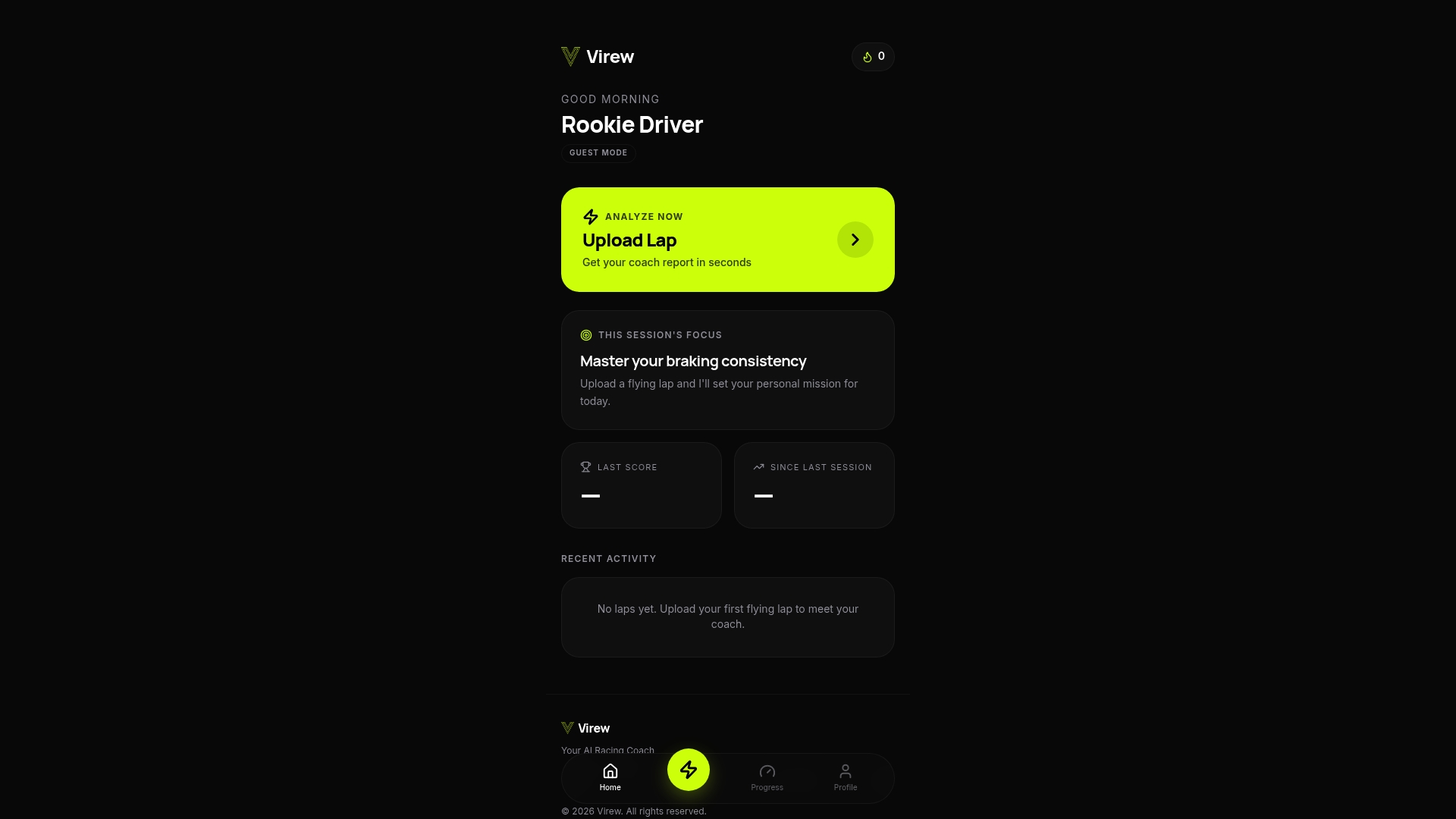
The workflow is simple. Upload a lap from Time Trial, Qualifying, or a Race stint, and Virew's lap analysis flags recurring input errors, sector deltas, and exit speed losses the way a coach would if they were watching your telemetry over your shoulder. Run the drill it suggests, then upload a fresh five-in-a-row set to confirm the fix actually held. That verification step is where most solo practice falls short, because it's hard to judge your own consistency without a data reference sitting next to your memory of how the lap felt.
Start with the F1 26 lap-time improvement guide to see the full coaching workflow, then upload your next session and let the analysis tell you which corner to drill first.
Authoritative Reading and Telemetry Tools to Consult Next
- Sim Racing Manual's guide to consistency for reference-point discipline and telemetry reading.
- Racinggames for trail-braking mechanics.
- Telemetry platforms like Garage 61 and MoTeC for raw data overlays once you can read a delta trace.
Sources
- Consistency: why it matters and how to build it | Sim Racing Manual
- Racinggames
- Simracingsetup
- How to Improve Lap Times in Sim Racing (What Actually Works)
FAQ
What Is Racing Rhythm in F1 26?
Racing rhythm is the repeatable sequence of braking, turn-in, apex, and throttle application that produces consistent lap times, built by drilling fixed brake markers rather than chasing single fast laps.
How Long Does It Take to Learn a New Racing Rhythm?
Most drivers see their five-in-a-row consistency spread shrink noticeably within a four-week practice plan, moving from roughly half-second gaps between laps to under two tenths on familiar corners.
Should I Practice Rhythm in Time Trial or Race Mode?
Start in Time Trial, since it removes fuel load, tyre wear, and traffic so you can focus purely on marker-based, repeatable inputs before applying that rhythm to race conditions.
What Is the Five-in-a-Row Drill?
It's a practice standard where you complete five consecutive laps within roughly two tenths of each other, used to enforce repeatable input shapes instead of rewarding one lucky hero lap.
How Does Virew Help With Learning Racing Rhythm?
Virew analyzes uploaded F1 26 laps to flag recurring braking, steering, and throttle errors, then recommends specific drills so you can verify improvement with a fresh five-in-a-row set rather than guessing from feel alone.
Should I Use the Same Rhythm in Wet and Dry Conditions?
No. Wet conditions need earlier braking, a gentler trail-brake release, and a narrower throttle window, since the grip window narrows significantly compared to dry running.