
Racing rhythm in F1 26 is the timed sequence of brake, turn-in, apex, and throttle that produces smooth, repeatable sector speeds instead of one great lap surrounded by scruffy ones. Start with a simple test: pick a corner you know well and run three laps braking at the exact same reference point each time. If your minimum speed through that corner swings by more than a tenth or two between laps, your rhythm is the problem, not your car setup. Telemetry, and tools like Virew, can then show you exactly which input in that sequence is breaking down.
TL;DR:
- Consistent racing rhythm requires precise control of brake, turn-in, apex, and throttle sequences, with small speed variations indicating technique issues.
- Focused drills like straight-line braking, reduced brake pressure, and sector chaining improve rhythm faster than long, unfocused laps.
- Telemetry analysis highlights inconsistencies in braking point, minimum speed, and throttle delay, directing targeted improvements in your driving.
- Different circuits demand tailored rhythm practices, emphasizing late brake release at Monza, continuous corner chaining at Silverstone, and early throttle at Suzuka.
- Short, structured practice sessions with targeted drills and telemetry review produce more reliable, repeatable laps than casual, long sessions.
Table of Contents
- What Does Learning Racing Rhythm Actually Mean in F1 26?
- How Do You Train Braking Rhythm and Trail Braking?
- How Do You Use Telemetry to Spot Repeated Time Losses?
- What Should Your Time Trial, Qualifying, and Race Rhythm Sessions Look Like?
- Where Should You Focus Rhythm Practice at Monza, Silverstone, Spa, and Suzuka?
- How Do You Build a Rhythm Training Plan That Actually Sticks?
- Turn Rhythm Data Into Faster, More Repeatable Laps
- Sources
- FAQ
What Does Learning Racing Rhythm Actually Mean in F1 26?
Racing rhythm is a sequence, not a feeling. It runs brake onset, then a progressive release as you trail into the corner, then turn-in, then the apex, then a throttle ramp that builds through exit. Every corner on every lap should follow that same shape, corner after corner, lap after lap. When drivers say a lap "felt good," what they usually mean is that sequence repeated cleanly six or eight times in a row without a stumble.
Load transfer is what makes the sequence work or fall apart. Braking shifts weight onto the front tires, which is exactly when they have the most grip available for turning in. Release the brake too abruptly and that grip disappears before you've used it. Release too gradually and you carry speed past the point where the front tires can rotate the car, which shows up as understeer at the apex. The grip budget at any instant is shared between braking, turning, and accelerating. Rhythm is really just the skill of spending that budget in the right order.
Downforce changes the math further. F1 26's cars generate serious aerodynamic load at speed, which means high-speed corners reward a firmer, later brake release than low-speed corners where mechanical grip dominates. A rhythm that works through Silverstone's Copse won't transfer directly to a tight second-gear hairpin, because the grip source has shifted from aero to mechanical.
The most reliable formula-style technique layers a small, distinct steering increase right at the apex, timed while brake pressure is nearly gone, which rotates the car without breaking rear grip according to coaching drills built around F4 to F1 driving technique. Four mistakes wreck this sequence most often:
- Over-slowing the entry, which kills exit speed even when the apex looked tidy
- Adding a late steering "kick" instead of committing to one clean turn-in
- Re-steering after the apex because the first input was tentative
- Getting on throttle before the front tires have finished their work, which triggers mid-corner push
Pro Tip: Before blaming your driving, check your wheel rotation and force feedback. A rotation setting that doesn't match the car's actual steering ratio makes every apex "kick" feel inconsistent even when your inputs are identical, according to wheel calibration guidance.
How Do You Train Braking Rhythm and Trail Braking?
Four drills build rhythm faster than laps of unfocused running, and each one isolates a single variable so you know exactly what changed.
- Zero-steering braking drill. Brake in a straight line before the corner with zero steering input, release smoothly, then turn in only once you're off the brake. Compare your brake trace lap over lap. This drill demonstrably changes minimum corner speed and rotation once you overlay the traces, based on drills used in formula-style sim coaching, and it isolates whether your entry speed or your steering timing is the actual problem.
- Softer-trail drill. Run the same corner but reduce brake pressure during release by roughly a third compared to your normal habit. If the car rotates more freely with less pressure, you've been over-slowing the entry and masking it with extra steering lock.
- Entry-exit match. Fix your entry speed at one number for three consecutive laps and only adjust your exit throttle timing. Isolating one variable while you practice the other is what actually accelerates learning, more than trying to fix everything on every corner at once.
- Sector-chaining drill. String two or three connected corners together and focus purely on carrying continuity from one exit into the next entry, rather than treating each corner as a separate event.
Run four to six focused laps per drill, not twenty. Short, telemetry-compared runs beat long unfocused stints for learning speed, a finding that holds across race pace training methods as much as pure rhythm work. Stop a drill once your trace overlay stops changing between laps. That's your signal you've either fixed the issue or hit the limit of what that drill alone can teach you.
Pro Tip: Run the zero-steering drill on a corner you already think you're good at. Most drivers find at least one habitual steering correction they never noticed until the trace showed it happening the same way, lap after lap.
How Do You Use Telemetry to Spot Repeated Time Losses?
Raw telemetry gives you five signals worth reading: brake pressure, throttle curve, steering angle, speed trace, and gear selection, with ERS deployment as a sixth for exit-heavy corners. Each tells you something different. Brake pressure shows how aggressively and how smoothly you're shedding speed. Throttle curve shows whether you're feeding power in progressively or stabbing at it. Steering angle reveals the "kicks" and re-corrections that a driver rarely feels in the moment but that show up clearly on a graph.
Reading corner-marked overlays that flag braking point, minimum speed, and throttle-on timing is often enough to catch a problem without digging into raw traces at all, according to telemetry-based lap improvement guidance. Overlay three or four laps of the same corner and look for three specific mismatches:
- Braking point spread. If your brake marker lands in a different spot each lap, rhythm hasn't been learned yet, it's still being guessed at.
- Minimum speed gaps. A one or two kilometer-per-hour swing at the apex across laps points to inconsistent trail braking, not raw pace.
- Throttle-on delay. A lap that's slower on exit almost always shows throttle applied a fraction of a second later than your best lap, even when the driver insists they "got on it early."
This is precisely where automated lap analysis earns its keep. Reading five overlapping traces across a full lap by eye is tedious, and most drivers only catch the obvious mistakes while missing the smaller, repeated ones. Virew analyzes uploaded F1 26 gameplay laps and identifies the exact corners and input sequences where time is lost, then delivers targeted tips on that specific sequence, whether it's a delayed brake release or a throttle application that's consistently late by a few frames. It doesn't replace reading your own traces. It shortens the search by pointing straight at the corners where your rhythm keeps breaking down.
Work the fix order in this sequence: braking point variance first, minimum speed second, exit throttle timing third. Fixing throttle timing before your braking point is consistent just moves the inconsistency somewhere else in the corner.
What Should Your Time Trial, Qualifying, and Race Rhythm Sessions Look Like?
Each session type demands a different flavor of rhythm, and treating them identically wastes practice time.
- Time Trial template. Run two warm-up laps to settle tire temperature, then three matched-brake-point laps focused on one corner or sector. Upload the set and review the overlay immediately, while the laps are still fresh in memory. Time Trial remains the best environment for isolating pure execution since there's no traffic or strategy noise to distort what you're measuring.
- Qualifying checklist. Rhythm under pressure depends on preparation before the lap starts: correct tire warm-up through the out-lap, ERS charge timed for the lap's biggest deployment zone, and a mental cue for your first braking reference so nerves don't rush turn one.
- Race practice. Rehearse what coaching frameworks label M3, repeatable race pace, rather than qualifying-mode maximum effort, using drills for tire and ERS management across a longer stint, drawn from structured race pace practice.
- Track progress with two numbers. Sector delta average across a stint, and lap-to-lap standard deviation. A shrinking standard deviation is proof rhythm is improving even before your best lap time drops.
Where Should You Focus Rhythm Practice at Monza, Silverstone, Spa, and Suzuka?
Each circuit rewards a slightly different rhythm emphasis.
- Monza: protect top speed with a late, controlled brake release into Turn 1 and through the Ascari chicane; consistency of braking point matters more here than outright braking force.
- Silverstone: chain Maggotts through Becketts as one continuous rhythm exercise rather than three separate corners, and resist adding steering after the apex through that sequence.
- Spa: practice long, progressive braking rhythm into heavy-load corners like Pouhon, matching your exit speed to the compression that follows immediately after.
- Suzuka: the S-curves demand precise turn-in timing above all else, with smooth, early throttle ramps out of each linked corner rather than one big stab at the final apex.
How Do You Build a Rhythm Training Plan That Actually Sticks?
A short, structured week beats scattered practice every time. Days one and two: baseline laps on one track to identify where rhythm breaks down most. Days three through five: targeted drills on those specific corners, uploading each session for review. Days six and seven: implement the changes, then repeat the baseline test to measure sector variance, minimum corner speeds, and lap-to-lap delta against where you started.
— Virew
Turn Rhythm Data Into Faster, More Repeatable Laps
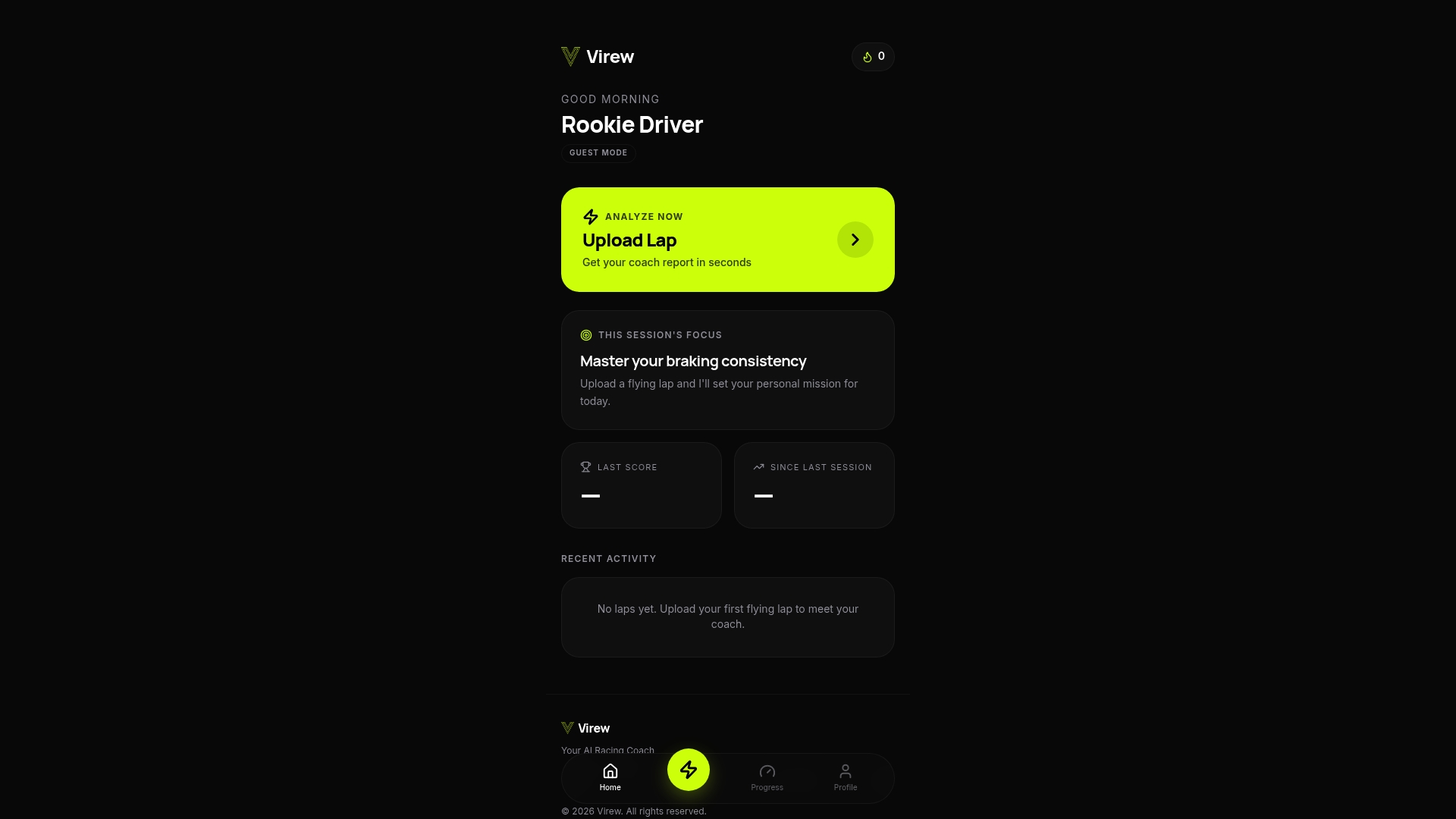
Spotting a rhythm problem by eye across five overlapping telemetry traces takes practice most drivers never get around to building. Virew shortcuts that process: upload your F1 26 gameplay laps and it analyzes the footage to identify the exact corners and input sequences where you're losing time, then hands you targeted tips on what to change in that specific sequence, whether it's a braking point that drifts lap to lap or a throttle application landing a few frames late.
Time Trial and competitive drivers chasing marginal gains get the most out of this, since small rhythm inconsistencies are exactly what separates a good lap from a repeatable one. Some AI racing coaching services offer free lap analysis credits for new accounts, providing initial insights into which corners might be costing you time. Upload your next session and see the F1 26 lap analysis break down where your rhythm is actually breaking down.
Sources
- F1 26 Wheel Settings Guide for Every Platform - SimStaff
- How To Improve Your Lap Time With F1 26 Telemetry - Sim Racing Setups
FAQ
What Is Racing Rhythm in F1 26?
Racing rhythm is the repeatable sequence of brake onset, trail release, turn-in, apex, and throttle ramp that produces consistent sector speeds lap after lap.
What's the Fastest Way to Start Learning Racing Rhythm?
Run a three-lap Time Trial drill braking at the same reference point every time, then compare the brake and throttle traces to see where the sequence breaks down.
How Many Laps Should Each Rhythm Drill Take?
Four to six focused laps per drill is enough; short, telemetry-compared runs teach rhythm faster than long unfocused stints.
Does Wheel Setup Affect Racing Rhythm?
Yes. Incorrect wheel rotation or force feedback calibration distorts how consistently you can feel the car, which makes every apex input harder to repeat, according to F1 26 wheel setup guidance.
How Does Virew Help With Rhythm Training?
Virew analyzes your uploaded F1 26 gameplay laps and identifies the exact corners and input sequences where you're losing time, then provides targeted tips for that specific braking point, apex, or throttle application.