
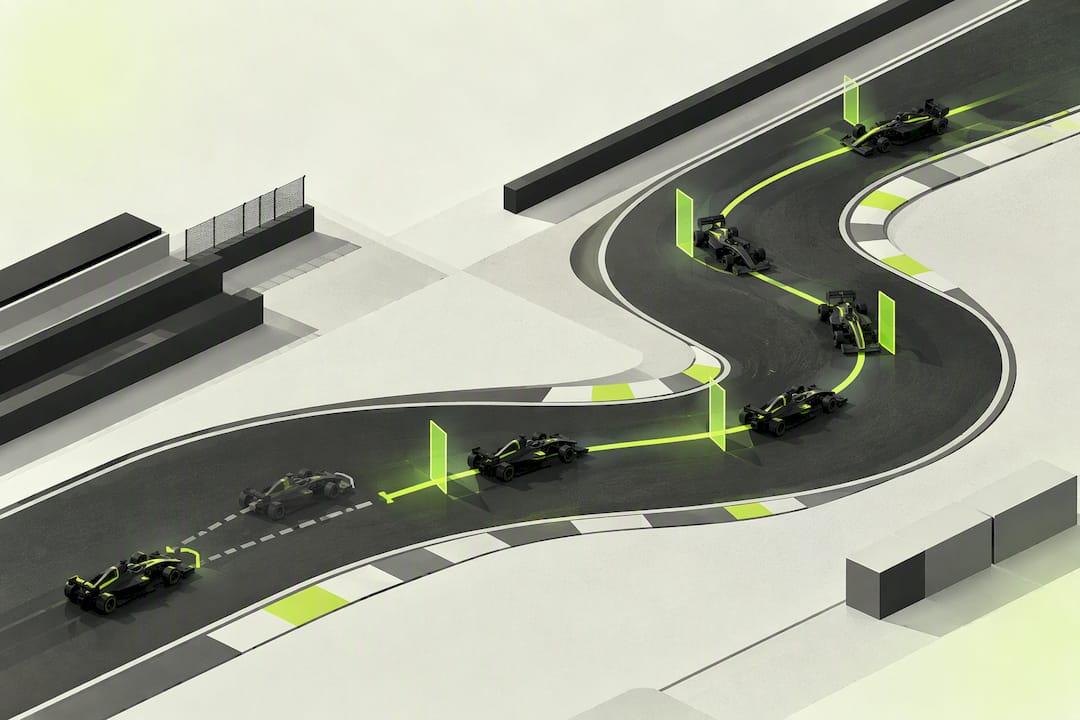
Commit to the entry and protect aerodynamic load through the middle of the corner. That single habit, more than any braking marker or setup tweak, wins the most time through fast sweepers like Suzuka's Esses or Silverstone's Maggotts and Becketts. High-speed corners scale downforce with speed, so lifting or stabbing the brake mid-corner kills the very grip you need. Certain racing analysis tools consistently flag hesitant entries as the top time-loser in these sections.
TL;DR:
- Maintaining commitment on entry and small, steady inputs through fast sweeper corners is crucial for maximizing speed and minimizing hesitation.
- High-speed corners rely heavily on aerodynamics, so preserving downforce and managing tire heat across long, sustained sections improves overall lap times.
- Proper seat and control positioning help maintain precise, smooth corrections necessary for rhythm-building in sequences like Suzuka's Esses or Silverstone's Maggotts.
- Using lap analysis tools to identify specific faults such as hesitant entry or mid-corner throttle lifts enables targeted practice that yields measurable improvements.
Table of Contents
- What Makes a Corner "High-Speed" in F1 26
- Turn-In, Steering Cadence, and Throttle Through Fast Sweepers
- Car Setup Choices That Improve High-Speed Corner Confidence
- Practice Drills for Time Trial, Qualifying, and Race Sessions
- Common Mistakes and Quick Fixes
- How Virew's Lap Analysis Maps to High-Speed Corner Improvement
- Managing Tyre Temperature Through Long High-Speed Sections
- The Physics Behind High-Speed Cornering
- Driver Positioning and Seating Stability in Fast Corners
- A Coach's Take on Building Fast-Corner Confidence
- Turn Your High-Speed Corner Practice Into Measurable Gains
- Sources
- FAQ
What Makes a Corner "High-Speed" in F1 26
A high-speed corner is any turn taken above roughly 200 km/h where aerodynamic downforce, not mechanical grip, does most of the work holding the car to the track. A modern F1 car can generate over 6,000 pounds of downforce at 240 kph, more than three times its own weight. That changes everything about how you drive it.
Slow corners reward mechanical grip, weight transfer, and a clean rotation. Fast corners reward stability and small inputs, because any sudden steering or throttle movement disturbs the airflow that's keeping you planted.
- Suzuka's S-curves and 130R force continuous direction changes at 200 to 260 km/h with almost no room to breathe.
- Silverstone's Maggotts and Becketts complex demands the same rhythm, just at a different rate.
- Monza's Parabolica is slower entry but still aero-loaded through the middle, punishing any twitch on turn-in.
Drivers rely on feel more than fixed braking markers here, because the grip window shifts constantly with speed and load.
Turn-In, Steering Cadence, and Throttle Through Fast Sweepers
Your inputs through a high-speed corner need to look almost nothing like your inputs through a hairpin. Small, early, continuous. That's the whole formula, but getting there takes deliberate practice.
- Commit on turn-in. Pick your entry speed before you get there, then hold it. Testing the front tires with a slow, exploratory turn-in at 220 km/h is how you end up understeering wide at the exit.
- Keep steering inputs small and constant. In multi-apex sequences like the Esses, you're never fully unwinding the wheel. Think of it as a continuous wave rather than a series of separate turns.
- Roll the throttle on early and smoothly. A long, steady application preserves rear grip. A sharp stab unsettles the car right when it has the least mechanical grip to spare.
- Use trail braking sparingly. It still has a place on corners with a genuine late apex or a downhill entry, but dragging the brake through a flat-out sweeper just destabilizes the rear when you need it settled.
- Review the replay for three tells. Watch for speed variance through the corner, repeated small steering corrections, and any mid-corner throttle lift. All three point to hesitation, not lack of pace.
Jolyon Palmer has noted that drivers gauge grip through seat-of-pants feel and build consistency through repetition rather than memorized markers. That's the mindset to bring into every high-speed practice lap.
Pro Tip: Instead of chasing entry speed, focus a whole session purely on exit speed out of one corner. Log your speed at the exit kerb, not your speed at turn-in. You'll find the fastest lines almost always trade a little entry pace for a cleaner, faster exit.
Car Setup Choices That Improve High-Speed Corner Confidence
Setup work for fast corners is mostly about trust. A car that moves around under you gets driven cautiously, and caution costs more time than a slightly conservative wing angle ever will.
- Differential: A slightly open on-throttle diff smooths power delivery through long sweepers and cuts down on sudden rear snap when you get back on the throttle, according to Suzuka-specific F1 26 setup guidance.
- Suspension: Softer front suspension helps the car absorb kerbs without upsetting the front end, while a slightly stiffer rear keeps the platform stable under load.
- Brake bias and gearing: Shift brake bias slightly forward for corners with a longer, faster entry, and check your gearing doesn't leave you bouncing off the limiter mid sweeper.
- Tyre pressures: Sustained high-speed sections build heat fast, so monitor pressures closely across a stint rather than setting them once and forgetting them.
Practice Drills for Time Trial, Qualifying, and Race Sessions
Each session type asks something different of you through a fast corner, so your practice should look different too.
- Time Trial commitment drill: Run two or three laps focused only on one corner. Try removing your usual visual reference point and instead target a consistent mid-corner speed on each lap.
- Qualifying simulation drill: Trim the car slightly more aggressively than your race setup, load a single tank of low fuel, and run one aggressive lap after a proper warmup lap to build heat into the tires.
- Race stint drill: Alternate a hard push lap with a conservation lap over a ten-lap stint, tracking whether your exit speed through the fast corners stays consistent as the tires age.
- S-curve rhythm drill: Isolate a multi-apex sequence like Suzuka's Esses and run it repeatedly, focusing purely on steering cadence and the timing of your throttle roll.
- Structure the block: Warm up for two laps, run a focused ten to fifteen minute block on one drill, then cool down with a relaxed lap and mentally note what felt inconsistent.
Common Mistakes and Quick Fixes
Most lost time in fast corners traces back to one of a few habits, and each one shows up clearly on replay.
- Hesitation on entry looks like a slow, tentative turn-in followed by a late correction. The fix is repetition: run committed entry reps until the speed feels normal, not scary.
- Understeer usually comes from too little front wing or too much throttle applied too early. Add a touch of front downforce or delay the throttle application slightly.
- Oversteer on throttle comes from an abrupt power application unsettling the rear. Smooth out the roll-on and resist the urge to counter-steer aggressively, which often overcorrects.
- Tyre overheating shows up as a gradual loss of rear grip late in a stint. Back off marginally through the fastest sections rather than fighting the car with more input.
When a sector feels consistently off, run through this order: entry speed, steering smoothness, throttle timing, tire temperature. One of those four is almost always the culprit.
How Virew's Lap Analysis Maps to High-Speed Corner Improvement
Virew's lap analysis is built to catch exactly the faults described above, because it reviews the actual lap you drove rather than handing you a generic tip sheet.
- It flags entry speed relative to the corner type, so you can see whether hesitation or overcommitment is costing you time.
- It tracks throttle ramp rate, which is the clearest signal of whether you're rolling on smoothly or chopping the pedal.
- It picks up repeated steering corrections through multi-apex sequences, the same tell you'd look for manually in a replay.
- It adapts its coaching missions to session type, so a Time Trial upload gets different focus areas than a Race stint upload.
The practical loop looks like this: upload a Time Trial lap, review the flagged weaknesses, run two or three of the targeted drills above, then re-upload to measure whether entry speed or exit consistency actually improved. Short, evidence-driven cycles beat vague "just drive more" practice every time, and you can start that loop through Virew's guide on getting faster in F1 26.
Managing Tyre Temperature Through Long High-Speed Sections
Sustained high-speed corners build tire temperature steadily rather than in sharp spikes, which is exactly what makes them dangerous over a long stint. A car under continuous aero load through a fast sequence keeps working the tire surface, and that heat compounds lap after lap if your inputs stay aggressive.
The fix isn't to slow down dramatically. It's to smooth out the margins. A slightly earlier, gentler throttle roll through a sequence like Silverstone's Maggotts and Becketts generates less scrub than a late, aggressive application, and that difference adds up over fifteen or twenty laps.
In Race sessions, treat tire management as a rolling decision rather than a one-time setup choice. If you notice the rear stepping out slightly earlier in a corner than it did five laps ago, that's your temperature warning. Ease off the commitment by a small margin rather than waiting until the tire lets go completely. In Qualifying, this matters less because you're only asking for one or two hot laps, but even then, an out-lap that's too aggressive through fast corners can leave you starting your flying lap on tires that are already past their peak window.
Pressures matter here too. Running pressures too low lets the tire flex more under the sustained lateral load of a fast corner, which generates extra heat on top of what the corner itself produces. Checking your pressure trend across a stint, rather than setting it once at the start, is a small habit that pays off specifically in tracks with long high-speed sections.
The Physics Behind High-Speed Cornering
Lateral G-force is what actually threatens to spit you off the track in a fast corner, and it climbs fast as speed increases. At 250 km/h through a sweeper, the car's mass is being pulled sideways with enough force that only the combination of tire grip and downforce keeps you on your intended line.
Weight transfer works differently here than in a slow corner. In a hairpin, you feel a clear, almost jolting shift of weight onto the outside tires as you turn in. In a fast sweeper, that transfer happens more gradually and continuously, because you're holding a sustained cornering load rather than making one sharp direction change. This is part of why smooth, small steering inputs matter so much: an abrupt input in a high-load corner creates a sudden, disruptive weight shift precisely when the car has the least spare grip to absorb it.
Downforce is what keeps this whole system stable. As speed rises, downforce rises with it, effectively increasing the car's usable grip beyond what its tires and suspension alone could provide. That's why a fast corner taken at high speed can sometimes feel more planted than the same corner taken slightly slower. Below a certain speed threshold, you lose enough downforce that the car starts to feel loose, which is part of why committing to the correct entry speed matters more in fast corners than in almost any other part of the track.

Driver Positioning and Seating Stability in Fast Corners
Where you sit relative to the wheel and pedals affects how precisely you can execute the small, continuous inputs that fast corners demand. A seating position that forces you to reach for the wheel, or that has your hands too high or low relative to a natural resting point, makes it harder to hold the tiny, consistent steering corrections a sequence like Suzuka's Esses requires.
If you're on a wheel and pedal setup, check that your seating distance lets you keep a slight bend in your elbows at a neutral wheel position. Too straight an arm reduces your ability to make fine adjustments smoothly, which shows up as jerkier inputs exactly where you need the opposite. If you're playing on a controller, the equivalent adjustment is grip pressure and thumb position on the stick, since a death grip translates into overcorrected, twitchy steering through multi-apex corners.

Camera position matters here too, more than in slower corners. A camera angle that's too low or too zoomed in can make it harder to read the flow of a long sweeper, because you lose the peripheral sense of the track's curvature that helps you judge cadence. Many drivers find a slightly higher, wider view improves their sense of rhythm through sequences like Maggotts and Becketts, precisely because it makes the corner's shape easier to read at a glance rather than reacting late to what's directly ahead.
A Coach's Take on Building Fast-Corner Confidence
Confidence in a fast corner isn't built by one heroic lap. It's built in small, measurable steps: commit a little further each rep, log the result, repeat. Chasing a vague "feel" wastes sessions. Chasing a specific, timed target through one corner builds real trust faster.
— Virew
Turn Your High-Speed Corner Practice Into Measurable Gains
Everything above works better when you can see exactly which corner, which input, is costing you time instead of guessing from feel alone. Virew reviews the actual lap you drove in F1 26 and turns it into a plain-language coaching report, flagging things like a hesitant entry into 130R or an early throttle lift through the Esses instead of handing you a generic setup sheet.
Start by uploading a Time Trial lap through a high-speed section you're struggling with, request a cornering-focused report, and run the top two drills it surfaces before your next session. Free and Pro plans are both explained on the Virew analysis pipeline page, so you can see exactly what each tier unlocks before you commit a lap.
Sources
- Suzuka: Key Corners, Sectors and What Makes It Unique | F1 Chronicle
- F1 26 Japan Setup | The Best Suzuka Car Setups F1 2026 Season Pack
FAQ
What Is a High-Speed Corner in F1 26?
A high-speed corner is a turn taken above roughly 200 km/h where aerodynamic downforce, rather than mechanical grip, provides most of the car's cornering ability. Suzuka's S-curves and Silverstone's Maggotts and Becketts are classic examples.
What Is the Most Famous High-Speed Corner Sequence?
Suzuka's Esses and 130R are among the most recognized high-speed sequences, requiring constant loading and unloading of lateral force through multiple direction changes at 200 to 260 km/h. Their layout rewards rhythm and commitment over isolated braking or turn-in points.
Which Corner Produces the Highest Lateral G-Force?
Long, fast sweepers taken at sustained high speed generate the highest lateral G-forces, since G-force climbs with both speed and the tightness of the direction change. Corners like 130R combine both factors, which is why they demand such a smooth, committed driving style.
What Speed Should You Carry Through a Corner?
There's no single target speed. The right entry speed depends on the corner's radius, the car's aero setup, and tire condition at that point in the stint. The more reliable approach is consistency: find a speed you can repeat lap after lap without correcting mid-corner, then build from there using focused drills or a tool like Virew's lap analysis to confirm where you actually have room to push.