
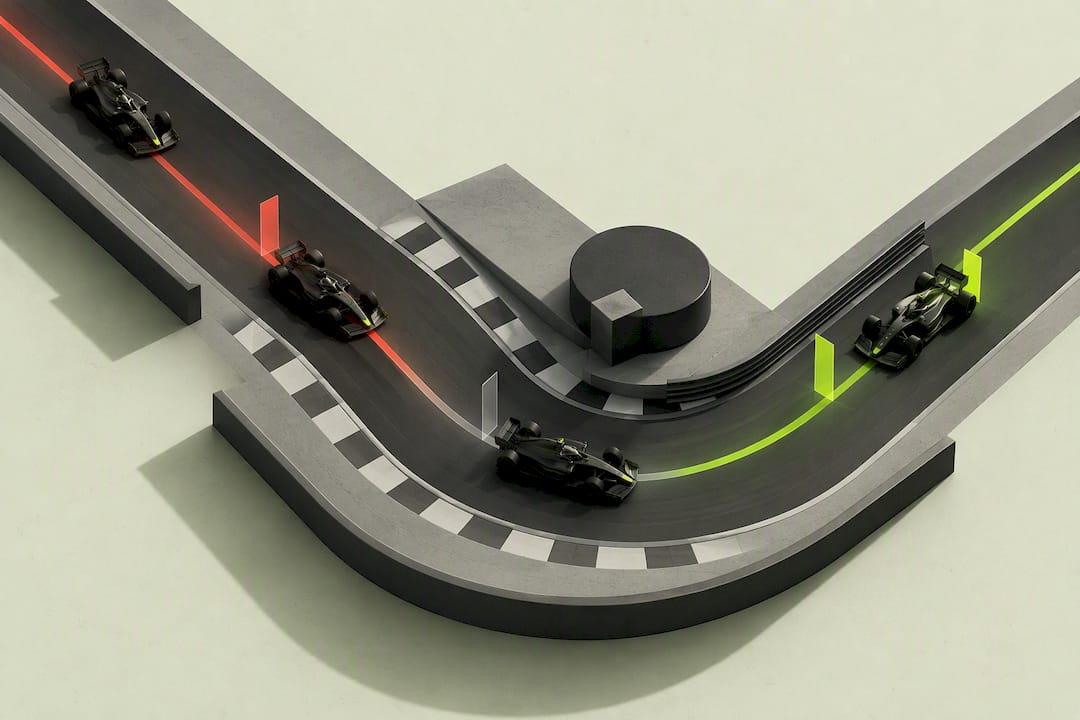
The fastest way through a hairpin in F1 26 is brake hard in a straight line, turn in late while trailing off the brake pedal to rotate the car, then squeeze the throttle early and progressively before the apex so you're already accelerating on exit. Everything else, setup tweaks, session tuning, drills, exists to make that one sequence repeatable. Get the sequence right and lap time follows.
TL;DR:
- Most time lost at hairpins results from rushing the brake, turn-in, or throttle phases rather than line choice or setup alone.
- Fine-tuning brake bias and differential settings one at a time helps identify immediate improvements in exit speed and stability.
- Tailoring technique for constant-radius versus decreasing-radius hairpins requires different approaches to rotation and braking points.
- Using telemetry and AI analysis tools can pinpoint the exact input mistake, streamlining practice and reducing guesswork.
- Consistent, smooth execution of the four-phase sequence and mental visualization before laps significantly improves repeatability and lap times.
Table of Contents
- What Is the Hairpin Technique in F1 26?
- Setup Changes That Change How a Hairpin Feels
- How Should You Adjust Hairpin Technique by Session?
- Common Hairpin Mistakes and Quick Fixes
- Drills and Telemetry That Lock In the Improvement
- How AI Lap Analysis Turns Hairpin Data Into a Practice Plan
- Not All Hairpins Are Built the Same
- Managing Weight Transfer Through a Hairpin
- Visualizing the Corner Before You Drive It
- Does Hairpin Technique Change by Drivetrain?
- A Coach's Take on Prioritizing Hairpin Gains
- Get Prioritized Hairpin Coaching From Your Own Laps
- Sources
- FAQ
What Is the Hairpin Technique in F1 26?
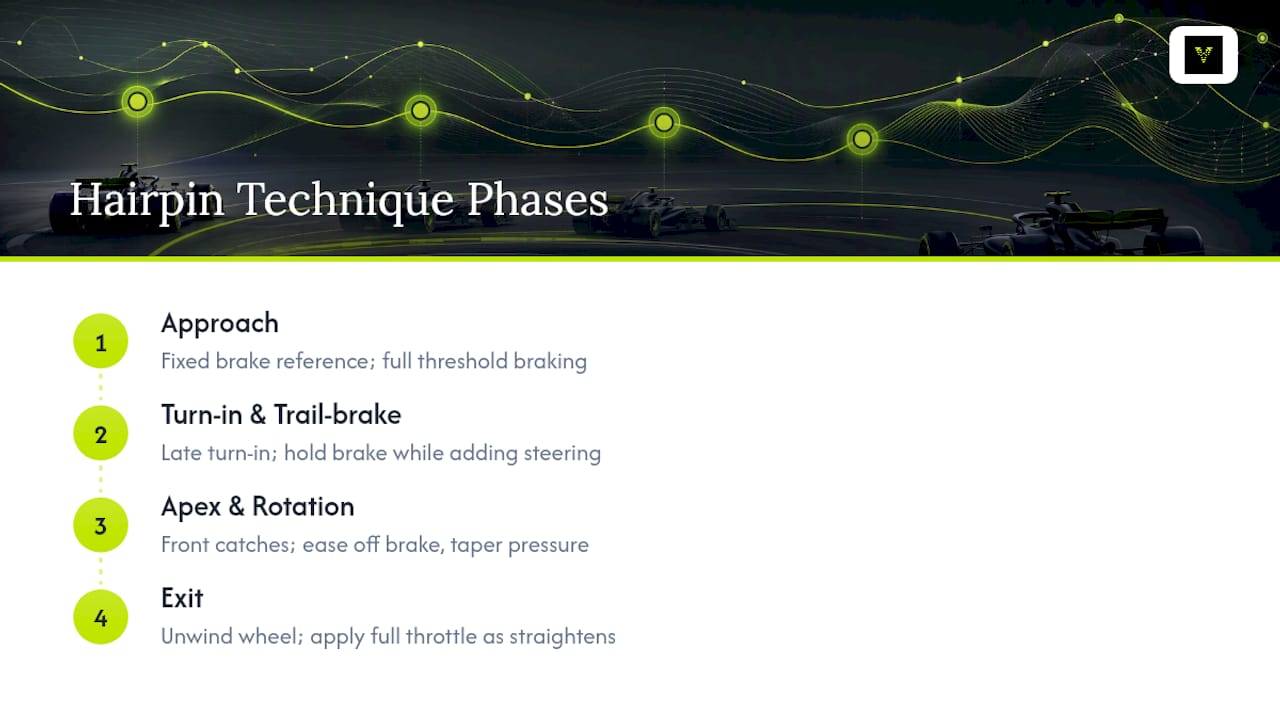
The hairpin technique breaks into four distinct phases, and most drivers lose time because they treat it as one continuous motion instead of four separate jobs. Each phase has its own input priority, and rushing one phase wrecks the next.
1. Approach. Pick a fixed braking reference, a board, a curb edge, a paint stripe, and hit full threshold brake pressure while the car is still straight. Braking in a straight line matters more at hairpins than almost anywhere else on the circuit, because any lateral load on the tires while you're at maximum brake pressure eats into your stopping distance and destabilizes the platform before you've even started turning.
2. Turn-in and trail-brake. This is where hairpins are won or lost. Turn in later than feels natural, then keep meaningful brake pressure on as you add steering angle. The trail braking technique guidebook puts very tight hairpins at 0.70 to 0.80 brake pressure through the first half of the corner, with medium-radius hairpins closer to 0.50 to 0.70. That overlap between brake and steering is what rotates the car instead of letting it push wide.
3. Apex and rotation. You'll feel the front end "catch" and the rear start to rotate around the apex. That's your cue to start easing off the brake, not stamping on throttle. A detailed trail braking guide describes this as a smooth, decreasing pressure curve rather than an on/off switch, and getting that taper wrong is the single biggest source of mid-corner snap at hairpins.
4. Exit. Unwind the steering wheel as you apply throttle, and time full throttle to land right as the wheel straightens. Exit speed, not apex speed, is what actually shows up on your speed trap.
Setup Changes That Change How a Hairpin Feels
Your car setup either supports this technique or fights it. A few levers matter more than the rest at tight hairpins specifically.
- Steering lock. Some hairpins, most notably Monaco's Fairmont Hairpin, need nearly 20 degrees of lock compared to the roughly 14 degrees typical elsewhere on the Monaco circuit. If you're running out of steering angle before you've finished rotating, that's a setup or sensitivity problem, not a driving error.
- Brake bias. Shifting bias slightly forward helps the front tires bite on turn-in, which supports the trail-brake phase. Push it too far forward and you overload the fronts, causing understeer right when you need rotation most.
- Differential. A tighter diff on entry helps stability under trail-brake, but a looser setting on power helps the car rotate out of tight hairpins without fighting your steering input on exit.
- Downforce, ride height, tire pressures. More front downforce aids turn-in bite, but costs you top speed on the next straight. Softer tire pressures add mechanical grip for slow corners at the expense of high-speed stability.
Pro Tip: Change one setup variable at a time, run five consecutive laps through the same hairpin, and only judge exit speed. Changing brake bias and differential together in the same session makes it impossible to know which change actually helped.
How Should You Adjust Hairpin Technique by Session?
The core mechanics stay the same across Time Trial, Qualifying, and Race, but how aggressively you push each phase changes with the stakes.
- Time Trial. This is where you find the limit. Push the late apex as late as it'll go, extend the trail-brake window right to the edge of lockup, and accept that your setup might be too aggressive for a full race distance. You're hunting for the single fastest lap, not a repeatable one.
- Qualifying. Same aggression, slightly more margin. You usually get limited runs, so a spin at the hairpin costs you the whole lap. Back the trail-brake pressure down maybe 5 to 10 percent from your Time Trial number to keep a safety cushion.
- Race. Exit stability wins races, not apex speed. Bring the throttle in more gently to avoid wheelspin that chews through tire life, and be aware that 2026 power unit changes make low-speed throttle response more sensitive than in previous seasons. A clean, unspectacular hairpin exit lap after lap beats one heroic lap followed by three ragged ones.
Common Hairpin Mistakes and Quick Fixes
Most hairpin time loss traces back to one of four habits, and each has a specific, testable fix.
- Throttle too early. If you're seeing wheelspin on exit, you're asking for grip the tires don't have yet. Delay your throttle application by a few tenths and start with a softer initial ramp instead of a stab.
- Apex too early. Turning in and hitting the apex early feels fast but kills your exit line, forcing you to lift or add a correction. Shift to a later, more medium apex and hold the trail-brake a fraction longer.
- Abrupt turn-in causing snap oversteer. A sharp steering input paired with a sudden brake release destabilizes the rear. Smooth out both the wheel input and your brake-release curve so they taper together, not separately.
- Wrong brake bias or differential for the corner. If the rear steps out under trail-brake, nudge bias forward in small increments. If the car won't rotate at all, loosen the differential slightly rather than forcing more steering angle.
Pro Tip: If you're not sure which mistake is costing you time, replay your last hairpin lap in slow motion and watch your hands, not the track. Most drivers can't feel the exact moment they add throttle, but they can see it.
Drills and Telemetry That Lock In the Improvement
Isolating the hairpin from the rest of the lap is the fastest way to fix it, because you stop compensating for other corners without realizing it.
- Single-corner repeat. Run 10 consecutive laps focused only on one hairpin: approach, turn-in, trail-brake, exit. Ignore the rest of the track entirely.
- Three-attempt bracket. Try three trail-brake end pressures, say 0.60, 0.70, and 0.80, and compare exit speed and consistency across each, a method outlined in tips for tackling tight turns and hairpins.
- Telemetry to check. Look at your brake pressure ramp, steering angle at the apex, throttle ramp shape, and exit speed delta lap to lap.
A realistic target is five laps landing within 0.3 to 0.5 seconds of each other through the same hairpin, with a steadier exit speed window and a brake trace that slopes down smoothly instead of stepping off in chunks, the kind of trace pattern coaching guides point to as the sign of a mastered corner.
How AI Lap Analysis Turns Hairpin Data Into a Practice Plan
Reviewing your own telemetry manually works, but it's slow, and it's easy to miss the one input that's actually costing you time. Virew inspects the brake trace, turn-in point, steering angle at apex, and throttle timing for the session type you uploaded, then flags the specific phase where you're losing time.
If a lap shows a 0.4 second exit loss at a given hairpin, Virew doesn't just report the number. It points to the likely cause, early throttle or a too-early apex, and builds a short practice plan around fixing that one thing. That's the Drive → Analyze → Improve → Repeat loop in practice: instead of guessing which of four possible mistakes cost you time, you get a shortlist.
Not All Hairpins Are Built the Same
Treating every hairpin with the same technique is a mistake, because the corner geometry changes what your car needs mid-corner.
Constant-radius hairpins, where the curve stays roughly the same tightness throughout, reward a single, steady rotation. You commit to one line, hold it, and the car should track predictably from turn-in to exit without much correction. Turn 3 at Barcelona has this character: pick your line, trust the mid-corner grip, and stay smooth.
Decreasing-radius hairpins tighten as you go deeper into the corner, which is where a lot of drivers get caught out. If you carry the same speed you'd use on a constant-radius hairpin, the corner keeps closing on you and you either run wide on exit or need a second, corrective steering input mid-corner. The fix is counterintuitive: brake slightly harder on entry than the corner seems to demand, because you need more speed scrubbed off before the tightest point arrives, not after.
Extreme, low-speed hairpins like Monaco's Fairmont Hairpin are almost their own category. The geometry is so tight that normal steering lock isn't enough, which is why that corner needs nearly 20 degrees of lock against a typical 14, according to F1Chronicle's breakdown of the corner. If your car won't rotate enough even with a clean trail-brake, check your steering lock and sensitivity settings before assuming it's a driving error.
Knowing which type you're facing changes your entry speed and your commitment to the line well before you touch the brake pedal.
Managing Weight Transfer Through a Hairpin
Weight transfer is the physical mechanism behind every phase of the hairpin technique, and understanding it explains why the sequence works the way it does.
Hard straight-line braking shifts weight onto the front tires, which is exactly what you want, because it loads up the contact patch that's about to do the steering. This is why braking before you turn matters so much: brake and steer at the same time and you split that weight transfer between deceleration and rotation, and neither job gets done well.
As you turn in and trail off the brake, weight starts shifting back toward the rear axle. That transfer is what lets the rear tires regain grip for the throttle phase to come. Release the brake too fast and that transfer happens abruptly, which is often the real cause of snap oversteer that drivers blame on "too much steering." Release it too slowly and the front stays overloaded, causing understeer right at the apex.
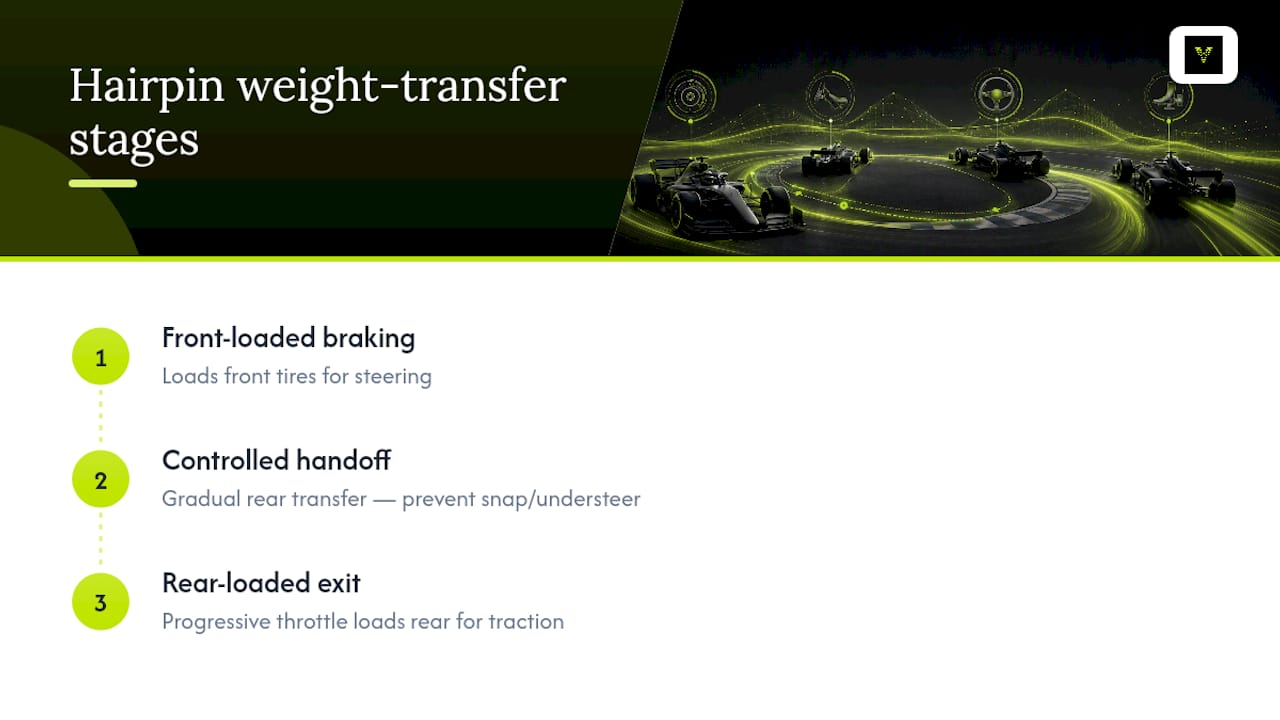
On exit, applying throttle shifts weight rearward again, loading the rear tires for traction just as you need it most. This is why early, progressive throttle beats a late stab: a gradual application lets weight transfer to the rear tires in step with the extra grip they're generating, instead of asking for traction before the load has arrived. Getting the timing of these three transfers right, front-loaded braking, a controlled mid-corner handoff, and rear-loaded exit, is what separates a hairpin that flows from one that fights you.
Visualizing the Corner Before You Drive It
Hairpins punish hesitation more than almost any other corner type, because there's so little time between turn-in and the decision to add throttle. Building a mental rehearsal of the corner before you drive it reduces that hesitation.
Before a session, picture the approach: where your brake marker sits, how hard you press, and where the late turn-in point is relative to the corner. Run through the trail-brake taper in your head, the gradual release as steering increases, and picture the exact moment you'd feel the car start to rotate. This isn't vague positive thinking; it's rehearsing a specific sequence of inputs so your hands react faster when you're actually on track.
A lot of drivers who plateau at a hairpin are reacting to the corner instead of anticipating it. They brake, then decide where to turn in. They turn in, then decide when to add throttle. Each decision point costs a fraction of a second, and at a tight hairpin those fractions add up to real lap time. Visualizing the phases in order, before you're under pressure to execute them, moves those decisions earlier so the actual driving becomes closer to muscle memory than a live judgment call.
This matters most in qualifying, where you get one clean lap and no room to feel your way into the corner. Spend thirty seconds before your qualifying run mentally driving your key hairpins in order, brake point, turn-in, rotation, exit, and you'll find your inputs come earlier and smoother than if you go in cold.
Does Hairpin Technique Change by Drivetrain?
F1 26 cars are all rear-wheel drive, but the way different power units and aero packages deliver traction at low speed still changes how a hairpin exit behaves, and it's worth understanding the general principle even if you're only driving F1 cars.
Cars with more rear-biased weight distribution and strong low-speed torque delivery, which describes most current F1 26 cars, want a progressive, patient throttle application on exit. Ask for full power too early and the rear tires break loose because there's more torque than the contact patch can handle at that steering angle. This is precisely why the 2026 technical changes affecting low-speed throttle response matter so much at hairpins specifically: more sensitive low-speed power delivery means the margin for an early throttle mistake is smaller than it used to be.
If you're used to front-wheel drive road cars or other sim titles with different drivetrain layouts, the instinct to get on the power early to "pull" the car out of the corner works against you here. Rear-wheel drive F1 cars need the front tires unloaded and the steering unwinding before the rear can take full throttle without breaking traction. All-wheel-drive systems in other titles mask some of that risk by sharing torque across four tires, which is part of why technique that works in a rally sim can actively hurt your hairpin exits in F1 26. The rule for these cars is simple: steering out, then power in, not power in to help you steer out.
A Coach's Take on Prioritizing Hairpin Gains
Chasing the latest possible apex looks fast on a replay and usually isn't. Exit speed and repeatability win more time across a full lap than a heroic-looking entry, and that's the trade-off worth internalizing before you touch a single setup slider.
When testing changes, isolate one variable, brake bias, trail-brake pressure, or differential, and hold everything else steady. Combine changes and you'll never know which one actually helped. Use Time Trial to hunt for your braking markers and rotation limits, since it's the lowest-risk environment to push right to the edge. Then validate whatever you find in race trim, with race fuel and worn tires, because a setup that rotates beautifully on a qualifying lap can turn nasty by lap 20.
— Virew
Get Prioritized Hairpin Coaching From Your Own Laps
Virew is built around a simple idea: your fastest hairpin fix comes from your own data, not generic advice. Upload a lap from F1 26 on PlayStation, Xbox, or PC, and the free plan gives you a limited number of analyses each month with actionable cues on exactly where a hairpin cost you time.
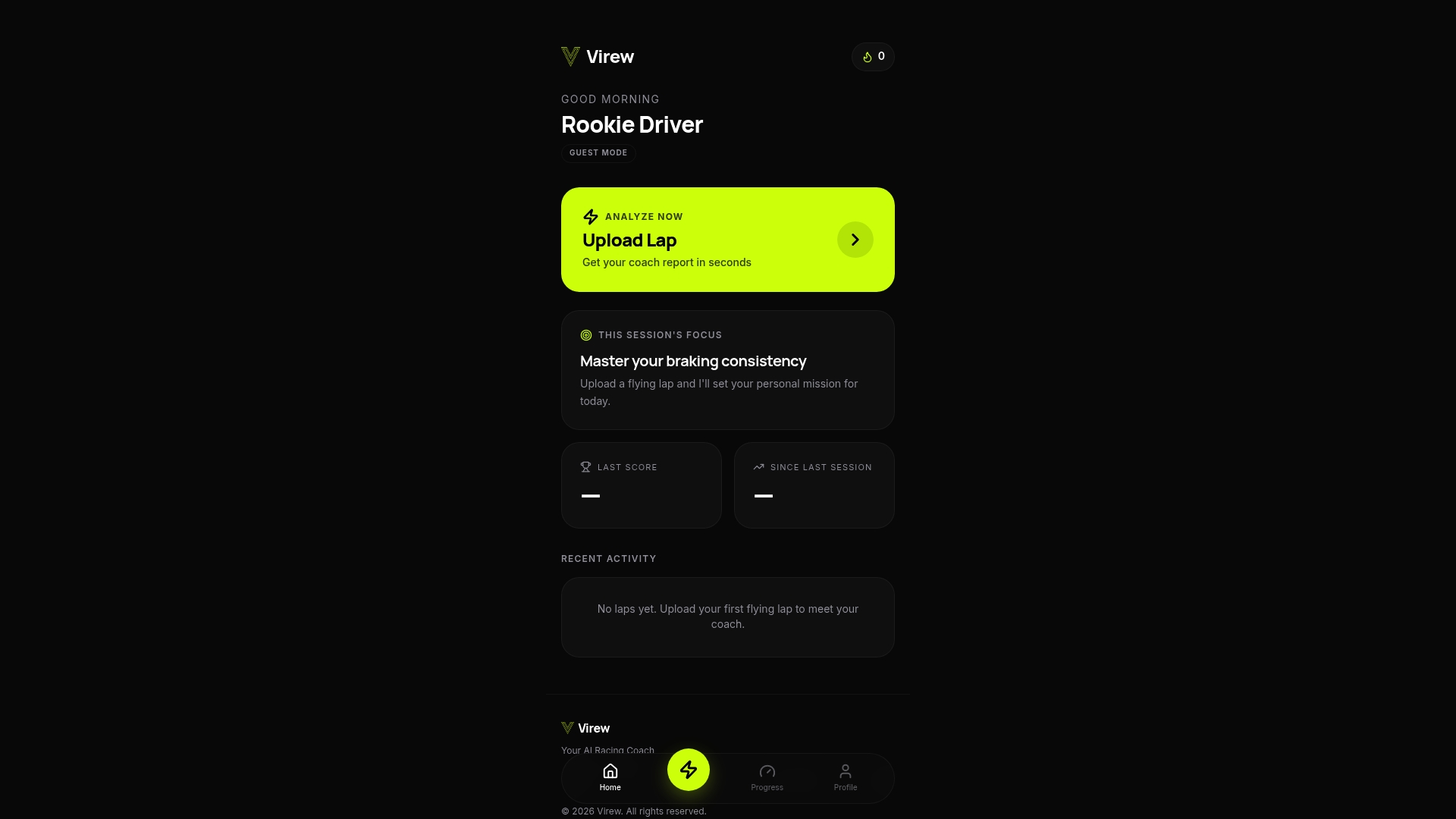
If hairpins are a recurring weak point across your sessions, a paid subscription unlocks unlimited lap analyses, full history, and guided daily missions so you can track whether your trail-brake adjustments are actually sticking week over week, not just on one good lap. The process is straightforward: upload a lap, review the prioritized coaching cues Virew flags for that hairpin, then run the specific drills it suggests before your next session. Check out the lap analysis page to see exactly what gets reported, or read how to use Virew for a walkthrough of your first upload.
Sources
- iracing adaptive coach — trail braking technique guidebook
- Mastering Trail Braking: The Ultimate Sim Racing Guide | SRP®
- What is the slowest corner in F1? | F1Chronicle
FAQ
What Brake Pressure Should I Use for a Hairpin in F1 26?
Very tight hairpins generally need 0.70 to 0.80 brake pressure through the first half of the corner, while medium-radius hairpins sit closer to 0.50 to 0.70. Treat these as starting points and adjust based on your car's brake bias and tire wear.
Why Do I Keep Getting Wheelspin Exiting Hairpins?
Wheelspin almost always means you're applying throttle before the front tires have unloaded and the rear tires have regained grip. Delay your throttle application slightly and start with a softer ramp instead of an immediate full input.
Should I Use the Same Apex for Every Hairpin?
No. Constant-radius hairpins reward a steady, single line, but decreasing-radius hairpins need extra entry speed scrubbed off early since the corner keeps tightening. Extreme low-speed hairpins like Monaco's Fairmont often need more steering lock than your default setup provides.
How Can I Tell Which Part of a Hairpin Is Costing Me Time?
Reviewing your own brake, steering, and throttle traces manually works, but it's easy to miss the specific input causing a loss. Uploading the lap to Virew flags the exact phase, whether it's an early throttle input or a too-early apex, and builds a short practice plan around that one fix.
Does Virew Cost Anything to Use?
Virew offers a Free plan with a limited number of monthly lap analyses, and a Pro plan for unlimited analyses and full history. Current pricing details for both are available on the Virew site.