
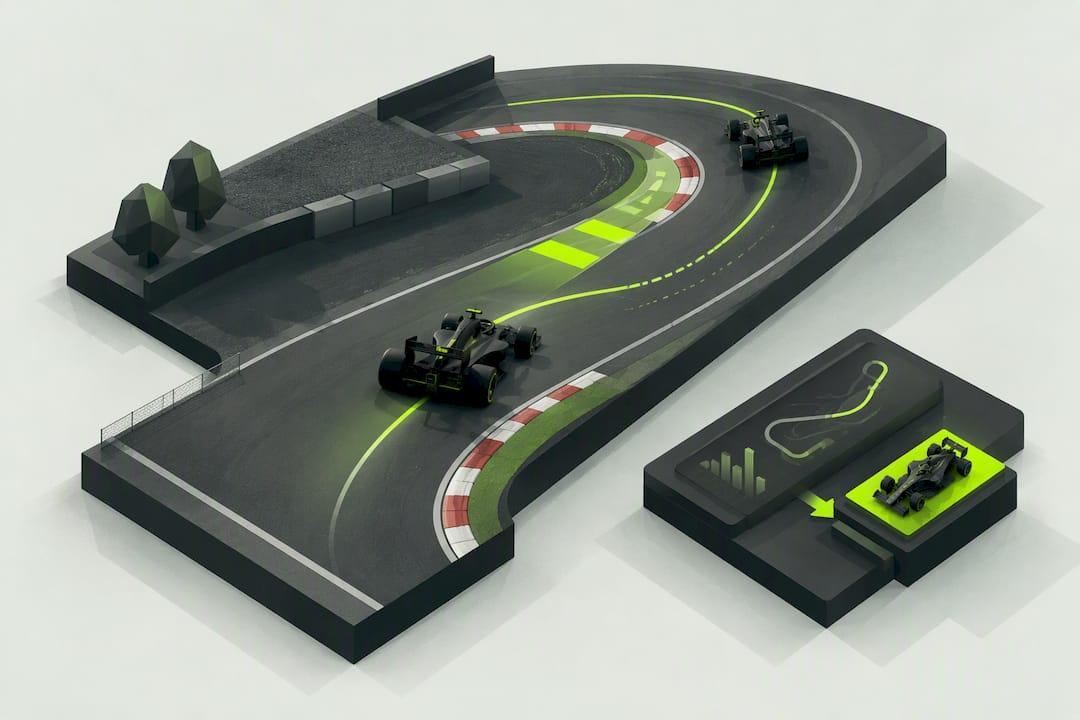
Want faster F1 26 laps tonight? Focus first on braking discipline, Overtake timing, and exit throttle control, then use the drills below. This guide covers 2026 car changes, setup priorities, hotlap examples at Miami and Zandvoort, and a practice structure you can run this week, no guesswork required.
TL;DR:
- Managing energy effectively with Overtake Mode requires saving battery charge for straight-line accelerations rather than using it prematurely.
- Braking and trail-brake consistency are more impactful on lap times than setup adjustments, which should follow after input habits are established.
- Corner exit throttle application is critical, with smooth, gradual increases preventing oversteer, especially on cars utilizing Straight Line Mode.
- Practice drills focusing on fixed visual cues, varying trail-brake length, and Overtake Mode timing improve technical reliability faster than just striving for raw speed.
- Hardware upgrades like load-cell pedals and triple monitors enhance feedback and positioning precision, but technique remains the primary factor for faster laps.
Table of Contents
- What changed for the 2026 cars
- Core driving techniques that actually reduce lap time
- Car setup essentials for F1 26: the minimal knobs that matter
- Hotlap walkthroughs: Miami and Zandvoort
- Practice routines: structuring sessions for Time Trial, Qualifying and Race
- How AI lap analysis turns footage into priority drills
- Hardware and equipment recommendations
- Popular F1 26 sim racing platforms and software
- Physics and tire modeling in F1 26 sims
- Multiplayer strategies and online racing etiquette
- Telemetry analysis and data-driven improvement methods
- The highest-impact priorities for quicker laps tonight
- Try Virew: turn your laps into coaching missions
- FAQ
- Sources
What changed for the 2026 cars
The 2026 Season Pack reworks how the cars behave, and the biggest shift is Active Aerodynamics replacing the fixed wing philosophy of older seasons. Cars now switch between Cornering Mode, which adds downforce and stability through turns, and Straight Line Mode, which flattens the wings for top speed. That switch changes how the car rotates on entry and how much grip you can lean on mid-corner.
Overtake Mode also replaces the old DRS button, but it is a different animal. Instead of a simple drag-reduction bump, the 2026 version delivers a large electrical power boost, roughly 350 kilowatts, when you are within one second of a car at a detection line and your battery has the charge to support it. That ties lap-gain potential directly to energy management rather than just positioning.
Practical consequences for your driving:
- Expect less passive downforce in Straight Line Mode, so braking stability depends more on timing the mode switch correctly.
- Battery state now gates your biggest speed boost, so hoarding charge for the wrong moment costs you a straight.
- Corner exits reward smoother throttle application because grip swings more with aero mode than in older titles.
- Braking points shift slightly lap to lap depending on your aero state entering the zone, so consistency matters more than memorizing a single marker.
Core driving techniques that actually reduce lap time
Most lap time in F1 26 is lost in the first third of a corner, not the apex. Fixing your braking point and your trail-brake pressure fixes more time than any setup tweak.
- Pick one visual cue per corner and commit to it. A board, a curb edge, or a paint line works better than a feel-based guess, especially since Active Aero changes how the car settles under braking.
- Trail-brake just enough to rotate, not to scrub speed. Ease off the brake pedal progressively as you turn in, releasing pressure as the front grips, rather than snapping off the brake and relying on mid-corner throttle to correct your line.
- Roll the throttle instead of mashing it on exit. Lower-downforce corners in 2026 punish an aggressive throttle stab with snap oversteer, particularly on cars running Straight Line Mode through the exit.
- Treat Overtake Mode as a lap-time tool in Time Trial, not just a race weapon. Save it for the longest straight where the speed gain compounds, rather than triggering it the instant it is available.
- Watch for the same three mistakes every session: braking too late and carrying speed past the apex, trail-braking too long and killing exit speed, and mashing throttle before the car is pointed straight.
Pro Tip: Run five consecutive laps focusing on only one corner's braking point each time. Changing one input at a time tells you what actually worked.
Three short drills to build these habits: first, do ten laps braking at the same visual marker every time regardless of how the lap felt, to build consistency before speed. Second, run a session where you deliberately trail-brake too long, then too short, so you can feel the difference and find the middle ground. Third, practice saving Overtake Mode for one specific straight for an entire session, so the timing becomes automatic rather than reactive.
Car setup essentials for F1 26: the minimal knobs that matter
Setup tweaking feels productive, but most drivers gain more from fixing technique first. Once your inputs are consistent, a handful of setup changes matter more than the rest.
Downforce level is the first decision. High-speed circuits reward lower wing angles for straight-line speed, while technical tracks with slow corners reward more downforce even at the cost of top speed. Test one notch at a time rather than jumping extremes.
Tyre pressures are easier to judge by feel than most drivers assume. If the front end feels vague on turn-in across a whole lap, try lowering front pressure slightly. If the rear steps out under throttle on exit, a small rear pressure increase often settles it.
Brake bias shifted too far forward causes front lockups under heavy braking, while bias too far rearward makes the car nervous on trail-brake. Nudge it in small increments and test the same braking zone repeatedly.
For lower-downforce 2026 cars, a slightly softer differential setting can help rotation on corner exit without sacrificing traction, and a touch more front anti-roll stiffness can sharpen turn-in on tracks with fast direction changes.
A quick checklist to try per circuit type:
- High-speed tracks: lower downforce, slightly stiffer rear suspension, bias toward Straight Line Mode usage on exits.
- Technical tracks: higher downforce, softer differential, bias toward Cornering Mode through linked corners.
- Mixed circuits: start at a middle downforce setting and adjust brake bias before touching anything else.
Hotlap walkthroughs: Miami and Zandvoort
Corner-level detail is where most lap time actually hides. Two circuits illustrate the point well.
- Miami, the kink before the long back straight: Brake earlier than it feels necessary, since carrying too much speed here costs you Cornering Mode stability through the direction change. Prioritize a clean exit over a fast entry, because the straight that follows rewards exit speed far more than a slightly tighter entry line.
- Zandvoort, the fast sweeping corners: Use the banking to carry speed, but resist the urge to use the full curb on entry, since it can unsettle the rear just as you need throttle. Stabilize the car with a steady, early throttle application rather than waiting for the exit to floor it.
- General time-loss checks for any sector: on entry, check whether you are braking in a straight line or still turning when you brake; mid-corner, check whether you are coasting (neither braking nor accelerating) for too long; on exit, check whether your throttle application matches how straight the wheel actually is.
To test these changes in Time Trial, run the same corner five times focusing only on exit throttle smoothness, then compare how the car feels rather than chasing a number on the first attempt. Feel for whether the rear stays settled through the exit, not whether the lap looks fast on paper.
Practice routines: structuring sessions for Time Trial, Qualifying and Race
Different session types reward different practice. Treating them the same wastes track time.
- Time Trial sessions: pick one sector, repeat it until the mistake disappears, then move to the next sector rather than running full laps the whole session.
- Qualifying practice: run a proper out-lap to build tyre temperature and battery charge, then commit to a single clean lap rather than multiple half-attempts.
- Race practice: focus on a repeatable lap window you can hold for ten laps in a row, and practice using Overtake Mode economically rather than every time it is available.
- Weekly structure: three one-hour sessions works well, one focused purely on braking consistency, one on a single circuit's sector-by-sector pace, and one on race-length stints that mix tyre management with Overtake decisions.
This structure mirrors how organized sim competition approaches practice. The F1 Sim Racing World Championship runs multi-event seasons that reward consistent pace over single flashy laps, which is exactly what a repeatable practice rhythm builds.
How AI lap analysis turns footage into priority drills
Reviewing your own laps by feel alone makes it easy to miss recurring mistakes. AI lap analysis lets us upload F1 26 lap footage and get a plain-language breakdown of braking points, corner entry, throttle application, and Overtake Mode usage, which turns a vague sense of "that lap felt off" into a specific list of what to fix.
A simple workflow: identify the worst sector from the report, pick two drills that target it directly, then run a clean lap to confirm the fix actually worked before moving to the next sector.

Hardware and equipment recommendations
A direct-drive wheel base paired with load-cell brake pedals makes the biggest difference for feeling trail-brake pressure accurately, which matters more in 2026 given how much grip shifts between Active Aero modes. Budget setups with belt-driven wheels and potentiometer pedals still work for learning technique, but they mask some of the subtle feedback that helps you judge lockups and rear slip.
A triple-monitor setup or a VR headset both improve corner judgment compared to a single screen, mainly because peripheral vision helps you spot apex markers and braking boards earlier. VR adds a stronger sense of speed and depth, which helps with braking point consistency, though it comes with a frame-rate cost that some drivers find distracting during close racing.
Comfort matters more than it gets credit for. Long practice sessions suffer when your seating position causes fatigue before the session's goal is met, so a supportive seat like the Apex Gaming Chair is worth considering if you are running multi-hour practice blocks regularly.
None of this replaces technique work. A better wheel will not fix a late braking point, but it will help you feel the difference between a clean trail-brake and an overcooked one sooner.
Popular F1 26 sim racing platforms and software
F1 26 runs on PlayStation, Xbox, and PC, and the platform choice affects how you practice more than most drivers expect. PC gives access to a wider range of wheel and pedal hardware along with VR support, while console play keeps setup simpler and still supports most force-feedback wheels on the market.
Online play happens through the game's built-in multiplayer lobbies and ranked modes, which handle matchmaking and league-style racing without needing third-party software for casual competitive practice. More structured leagues often organize through community Discord servers and dedicated league platforms that schedule races and track standings across a season.
For lap review, Virew works across PC, PlayStation, and Xbox footage since it analyzes uploaded gameplay video rather than requiring a specific platform's native tools, which matters if your practice group mixes consoles and PC.
Physics and tire modeling in F1 26 sims
Tire behavior in F1 26 is built around temperature and wear interacting with how you drive, not just a fixed grip number. Carrying too much speed into a corner builds heat faster than it helps your lap, and that extra heat early in a stint often costs more grip later than the speed gained on that single lap.
The 2026 car changes add another layer, since Active Aero shifts how much load the tires see through a corner depending on which mode you are in. A tire that would grip fine under Cornering Mode downforce can slide more than expected if you are still in Straight Line Mode through the same corner.

Community handling discussions about the 2026 update point to drivers adjusting suspension and steering setups in response to how grip behaves differently than in prior seasons. Treat these threads as a starting point for testing, not a final answer, since track and car combinations vary enough that a setup that works for one driver's style may not suit yours.
Multiplayer strategies and online racing etiquette
Online races reward patience more than aggression, especially in the opening laps when the field is still tightly packed. Leave more space than feels necessary at the first corner, since a clean start beats a risky overtake that ends both drivers' races.
When defending a position, hold a predictable line rather than weaving, since erratic defensive moves are both against the spirit of clean racing and more likely to cause contact. When attacking, commit to a pass only when you have a clear overlap, not just a slight speed advantage, since a half-committed move usually ends with contact rather than a clean position gain.
Overtake Mode changes multiplayer racecraft meaningfully, since the power boost is large enough to make a poorly timed defensive move costly. Save your own Overtake for a straight where you know you can complete the pass, and be ready for opponents to use theirs at detection lines rather than only on the final straight.
Respecting track limits and racing room matters more in competitive lobbies than casual ones, but building the habit in casual races makes it automatic when it counts in a league race or ranked session.
Telemetry analysis and data-driven improvement methods
Reviewing your own laps on feel catches big mistakes, but it tends to miss small, repeated habits, like consistently trail-braking a fraction too long on left-hand corners. Watching your own replay footage back with a critical eye on braking points, exit lines, and throttle smoothness is a practical way to catch patterns that feel invisible in the moment.
Structured practice helps here too. Running the same corner repeatedly while deliberately varying one input, braking point, trail-brake pressure, or throttle timing, lets you isolate what actually changes the lap rather than guessing from a single good or bad attempt.
Coverage of F1 Esports competitors, including a recent Welsh world champion, consistently points to setup familiarity and repeated practice as what separates top finishers from the rest of the field, not raw reaction speed alone. That lines up with what most sim racers find once they start tracking their own sessions closely: small, consistent habits compound faster than occasional heroic laps.
The highest-impact priorities for quicker laps tonight
Fix braking consistency first, then layer in timed Overtake Mode use and smoother exit throttle. Skip setup tweaks until your inputs are repeatable, since a perfect setup cannot fix an inconsistent braking point. Run two drills tonight: one braking-point repetition, one Overtake timing session.
— Virew
Try Virew: turn your laps into coaching missions
Upload an F1 26 lap and get plain-language coaching on exactly where you are losing time, braking, cornering, or Overtake Mode usage, instead of just a number on a timing screen.
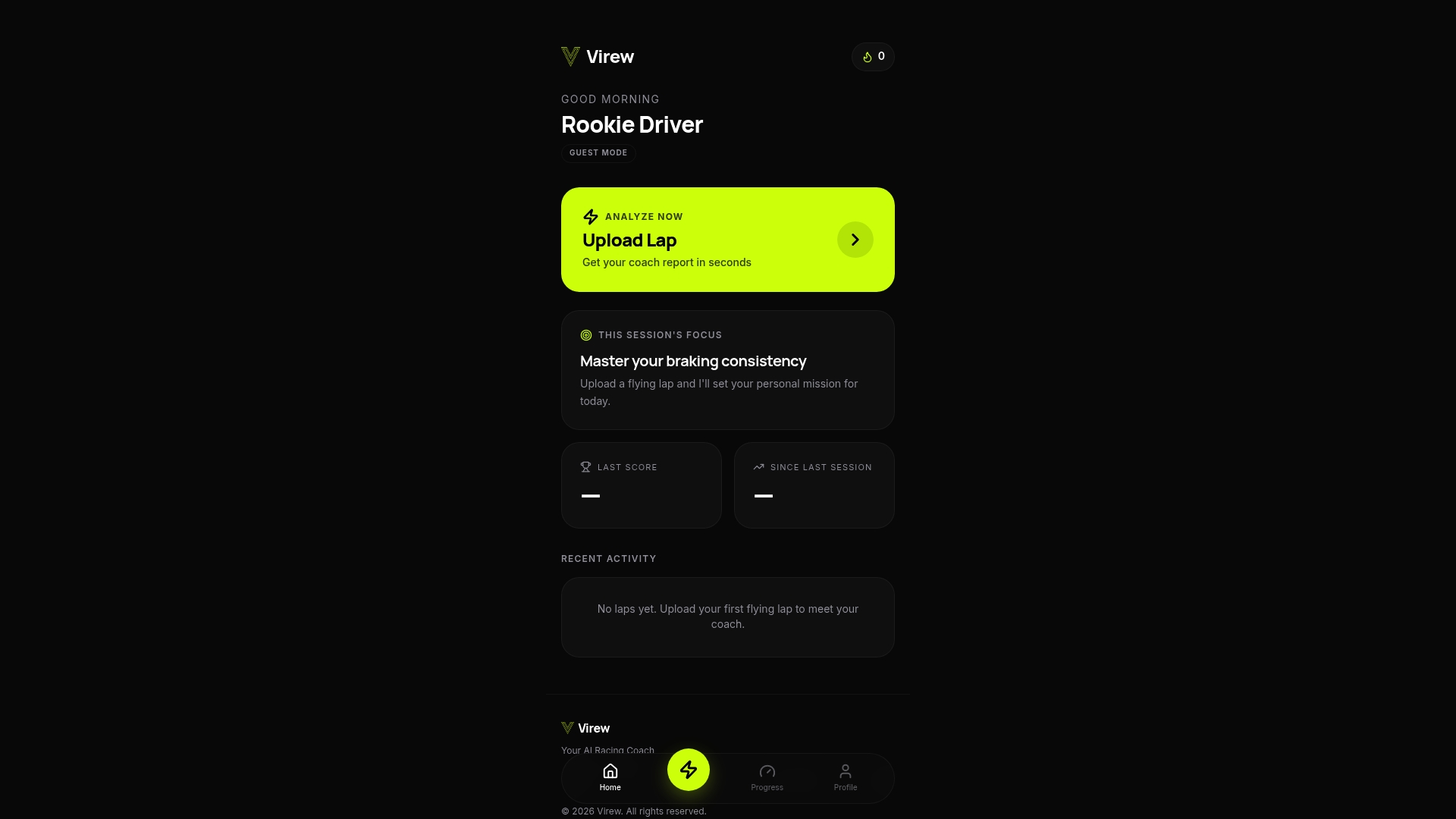
- Start free with limited monthly lap analyses, or upgrade for unlimited analyses and deeper coaching detail.
- See how it works on the lap analysis page or visit Virew to get started.
FAQ
Is there going to be an F1 26 game?
The 2026 season content currently ships as a Season Pack update for F1 25, bringing Active Aerodynamics and a stronger Overtake Mode to the existing game. This guide refers to that 2026-era car behavior throughout, since it reflects the current state of the F1 racing simulator experience.
Is there a F1 race sim game available?
Yes, the official licensed F1 racing simulator is available on PlayStation, Xbox, and PC, with the 2026 Season Pack adding the newest car models and systems. It remains the primary platform most sim racers use for both casual Time Trial practice and competitive league racing.
How much do F1 sim racers get paid?
Pay varies widely and is not something the game itself discloses, but established competitive structures like the F1 Sim Racing World Championship run prize-funded seasons with qualification pathways into professional events. Most sim racers improving their pace are doing so for personal progress or league standing rather than direct payment.
Is the F1 25 a sim racer?
F1 25 functions as a sim-leaning racing title with realistic car handling, setup options, and now 2026-specific systems like Active Aerodynamics and Overtake Mode. It sits closer to simulation than arcade racing, which is why techniques like trail braking and energy management meaningfully affect lap time.
Sources
- Electronic Arts - Experience the Definitive New Era of Formula 1: EA Sports™ F1® 25 2026 Season Pack Available Now
- EA SPORTS™ F1® 25: 2026 Season Pack Brings the 2026 Season to the Grid
- 2023–24 F1 Sim Racing World Championship (Wikipedia)
- Formula One Esports world champion from Wales becomes youngest ever