
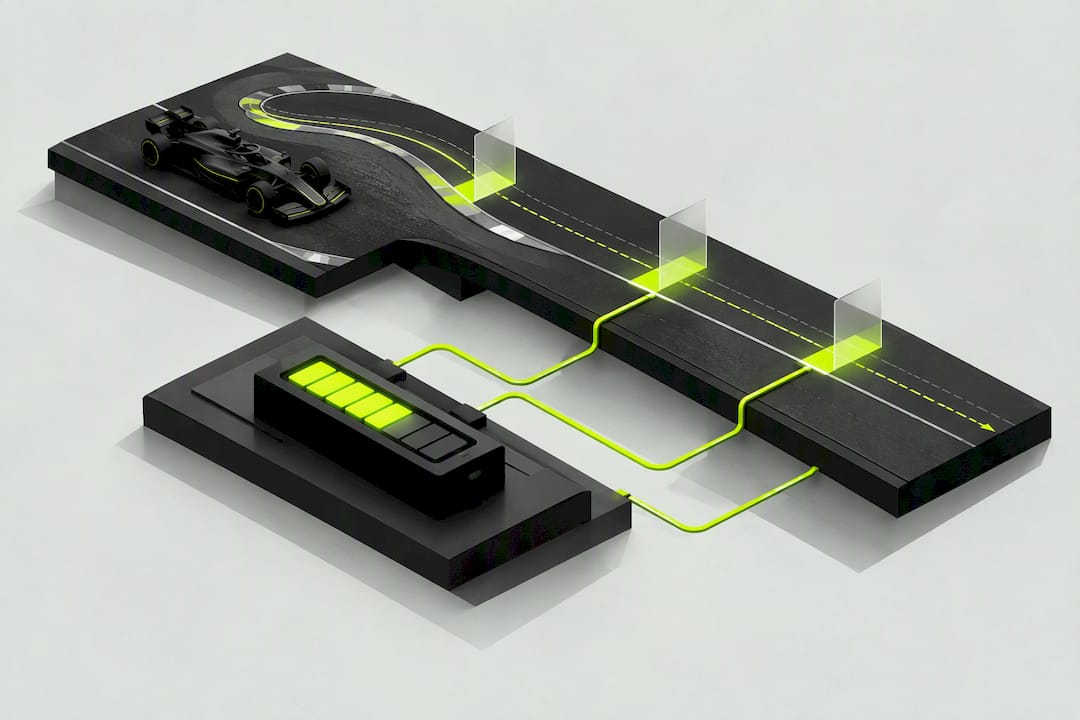
Bank energy through the low-stakes parts of a lap and spend it in short, timed bursts where it actually changes a position or a time. In Time Trial, that means a full pre-charge and one clean burst at exit. In Qualifying, protect the battery on the outlap. In Race, hold a reserve for the final sector.
TL;DR:
- Mismanaging energy recovery can cost up to 0.7 seconds per lap, emphasizing the need for careful harvesting and deployment strategies.
- Effective harvesting methods include lift-and-coast, braking regen, and super clipping, each suited to different track layouts and conditions.
- Proper usage of ERS during qualifying and race sessions involves timing bursts for maximum efficiency, reserving energy for critical moments.
- Common mistakes like deploying too early or never banking energy can be fixed through practice and data analysis, boosting lap times.
- Track characteristics and session-specific rules affect optimal ERS management, making flexibility and disciplined habits crucial for performance.
Table of Contents
- How F1 26's ERS and battery mechanics affect gameplay
- Harvesting methods: lift-and-coast, braking regen, and super clipping
- Deployment tactics by session: Time Trial, Qualifying, and Race
- Common ERS mistakes that cost time and how to fix them
- How data-driven coaching converts these ERS techniques into lap-time gains
- Interaction of ERS with power unit modes and fuel consumption
- Strategies for thermal management of ERS components
- Analysis of ERS reliability concerns and failure modes
- Impact of track-specific characteristics on ERS management
- Comparison of ERS regulation changes from previous seasons affecting strategy
- Why mastering ERS is the high-leverage skill in F1 26
- Try Virew to shorten your ERS learning curve
- FAQ
- Sources
How F1 26's ERS and battery mechanics affect gameplay
F1 26's energy recovery system draws on a vastly more powerful electrical side than previous hybrid generations. The 2026 technical rules push the MGU-K toward roughly 350 kilowatts of output while keeping battery capacity tight, so the car leans much harder on the electrical motor for straight-line speed, according to ESPN's breakdown of the 2026 rules. The in-game model reflects a roughly even split between electrical and combustion power, which means the battery drains faster than drivers are used to from older F1 titles.
That near 50/50 balance changes how you drive every lap. Spend carelessly on a straight you didn't need the boost for, and you'll find the tank empty exactly when an overtaking chance or a defensive move actually needs it. Mistakes here are not cosmetic.

Energy mismanagement can cost 0.5 to 0.7 seconds per lap, a gap that separates a clean qualifying lap from one that gets bumped out of position, according to PlanetF1's reporting. That is a bigger swing than most braking-point errors, and it compounds across a race stint.
Two systems govern how you spend that energy in the moment:
- Overtake Mode activates based on proximity to the car ahead, similar to a modernized DRS trigger, and opens a window for a push.
- Boost is a separate deployment tool you trigger manually, and it behaves differently depending on gear, speed, and how much energy is banked.
These two systems work together rather than as substitutes, according to TheF1DB's explainer on Overtake Mode and Boost. A proximity trigger without saved energy does nothing useful, and a full battery without the right aero state and timing wastes the advantage. Understanding how the 2026 cars handle differently under this new aero and electrical package helps explain why old overtaking habits from previous F1 games fall flat this year.
Harvesting methods: lift-and-coast, braking regen, and super clipping
Harvesting is where most players leave free lap time on the table because they treat it as automatic. The ECU recovers some energy under normal braking, but three techniques let you influence how much comes back and where.
- Lift-and-coast: lift off the throttle 15 to 25 meters earlier than your usual braking point, coast at a reduced load, then brake normally. Judge success by exit speed, not by how early you lifted. If your exit speed out of the corner matches your normal lap, you've harvested energy for free.
- Braking regen: the car recovers energy automatically during braking, and heavier, longer braking zones recover more than short stabs. Bias your harvesting toward the braking zone on tracks with one or two long, heavy stops rather than trying to lift-and-coast through every corner.
- Super clipping: easing off throttle fractionally on a long straight, at a point where active aero is still deployed, recovers extra energy without a real speed cost. Try this first on long full-throttle sections where you're already flat out for several seconds, since the margin for error is bigger there.
Recharge methods always trade recovered energy against some pace loss, and the balance shifts by circuit, according to Silverstone's guide to F1's energy recovery system. A track with long straights and few heavy brakes rewards super clipping more than lift-and-coast, while a stop-and-go layout does the opposite.
Pro Tip: Run the same corner five times in Time Trial, lift-and-coast on three and brake normally on two, then compare exit speed and lap time to see which gained more energy for less time lost.
To lock this in, run two short drills. First, pick one corner with a long braking zone and practice lift-and-coast until your exit speed matches your normal lap three times in a row. Second, find a long straight and practice super clipping without losing more than a tenth at the next braking point. Improvement means the same exit speed with a visibly fuller battery bar, not a slower lap.
Deployment tactics by session: Time Trial, Qualifying, and Race
Deployment should change depending on what the session is actually judging. A Time Trial lap rewards maximum pre-charge and a perfect single burst. A Qualifying lap rewards discipline on the outlap so the flying lap has everything. A Race rewards patience and a reserve.
Time Trial: charge the battery fully before your push lap, then plan one or two bursts of 1 to 2 seconds on the longest straight, ideally while in fourth or fifth gear where the electrical contribution has the most effect on top speed. Short bursts in these gears convert energy into speed more efficiently than spamming boost through a gear change, where some of the benefit is lost to the shift itself.
Qualifying: treat the outlap as a harvesting lap, not a push lap. Lift-and-coast through two or three low-speed corners on the way to the grid or out lap, bank that energy, then spend it only on the flying lap. Be aware that recharge allowances can be adjusted session to session. The FIA reduced the qualifying recharge limit at Suzuka from 9 MJ to 8 MJ ahead of that weekend, according to Formula1, which shows that the numbers behind a session can shift and your usual charge target may not apply everywhere.
Race: bank energy steadily across a stint rather than spending it all in the first few laps. A practical rule many sim racers use is to reserve roughly a fifth of the battery for the final sector of the race, treating it as a buffer for a defensive block or a late attack rather than a number to spend early for a cheap overtake mid-race. Use short bursts in traffic to close a gap before a braking zone, and save the bigger push for a planned attacking window rather than reacting lap by lap.
- Hold mapping is the setup EA's own developer notes recommend for ERS activation, since it gives finer control over burst length than a simple on/off toggle.
- Toggle mapping still works for players who prefer a fixed, repeatable burst length and don't want to manage hold duration manually.
EA's own guidance for the current season pack recommends short 1 to 2 second bursts and switching ERS activation from Toggle to Hold for more precise control, according to EA's F1 26 season edition tips. That single mapping change is often the fastest fix for players who feel like their deployment is inconsistent lap to lap.
Common ERS mistakes that cost time and how to fix them
Most ERS losses in F1 26 come from three repeatable habits, and all three are fixable without changing your car setup.
- Deploying too early out of slow corners. Hitting boost the instant you're on throttle wastes energy on a low-speed exit where it barely helps acceleration. Fix: delay the burst until you're at or near full throttle and the car has started to gain real speed, usually two or three car lengths past the apex.
- Throttle greed mid-corner. Chasing full throttle before the car can take it forces understeer and burns energy fighting the chassis instead of building speed. Fix: feed throttle progressively through the exit phase and let the burst arrive once the car is settled and straight.
- Never banking energy. Spending every scrap of charge as soon as it's available leaves nothing for the moment that actually matters, whether that's a defensive block or a late qualifying lap. Fix: set a mental or visual threshold, such as never dropping below a quarter charge outside a planned burst, until you've built the habit.
To check whether these fixes are working, run a short Time Trial session and compare your exit speed and battery level at the same three corners across five consecutive laps. If exit speed holds steady and the battery bar empties later in the lap than before, the fix is working. If lap time improves but battery drops faster, you're still deploying too early.
How data-driven coaching converts these ERS techniques into lap-time gains
Reading your own driving back is hard, especially for something as fast-moving as a burst window that lasts a second or two. The analysis tool reviews uploaded F1 26 laps and reports where a driver is losing time, including patterns around outlap behavior and corner-exit habits that connect directly to harvest and deploy decisions, without needing telemetry tools or manual data logging.
A simple four-step loop turns that feedback into practice:
- Select a session that matches what you're working on, whether that's a Time Trial push lap or a race stint with a defensive sequence.
- Identify the weak point the coaching report flags, such as an early burst out of a slow corner or a harvesting opportunity missed on a long straight.
- Run two focused drills targeting that exact corner or straight, using the techniques above rather than changing everything at once.
- Re-upload the improved lap and compare the new report against the first one to confirm the fix actually closed the gap.
The most useful first clip to upload is a race lap with a clear defensive or attacking sequence, since it shows both harvesting discipline earlier in the lap and deployment timing under pressure. That single lap typically surfaces more actionable detail than a clean, mistake-free Time Trial lap where nothing went wrong to diagnose.
Interaction of ERS with power unit modes and fuel consumption
Power unit mode settings and ERS deployment are linked, not separate systems. A more aggressive power mode burns fuel faster and tends to demand more from the hybrid system to maintain pace, which means a driver pushing hard on fuel is often also pushing harder on battery reserves at the same time. Running a leaner, more conservative power mode across a race stint reduces fuel burn and gives the ERS system a steadier baseline to recover from, since the combustion side isn't constantly straining to compensate for a depleted battery.
The practical takeaway is to treat fuel saving and energy banking as the same decision rather than two separate dials. If you back off power mode through a sector to save fuel, that is also a good window to lift-and-coast or lean into braking regen, since you're already sacrificing some pace in that section. Trying to save fuel in one phase of the lap while spending maximum battery in another usually just shifts the loss rather than avoiding it. The most efficient race pace comes from aligning both systems around the same low-stakes sections of the track.
Strategies for thermal management of ERS components
Hybrid components generate heat under sustained heavy use, and repeated maximum-duration bursts without recovery windows can degrade performance over a long run. The practical in-game signal is less about a visible temperature gauge and more about deployment consistency: if bursts feel weaker or shorter late in a long stint despite a full-looking battery, that's a sign the system needs recovery time rather than another push.
Spacing bursts out instead of chaining them back to back gives the system a chance to settle between demands. On tracks with multiple long straights, such as a layout with back-to-back high-speed zones, resist the urge to deploy on every one. Pick the one or two straights where the burst matters most for position or lap time, and treat the others as recovery sections. This mirrors how you'd manage tire temperature through a stint: steady, planned use beats constant maximum effort, and it keeps the system responsive when you actually need a strong burst late in the race.
Analysis of ERS reliability concerns and failure modes
The 2026-generation hybrid systems carry more electrical load than previous seasons, and that higher demand means the margin for a harvesting or deployment mistake is smaller before it shows up as lost lap time. In-game, reliability shows up less as a hard failure and more as inconsistency: a burst that doesn't deliver the expected speed gain, or a battery that reads full but underdelivers on a straight where it worked fine a lap earlier.
The most common cause is chaining too many maximum-length bursts without any banking in between, which leaves the system working from a depleted state even when the display suggests otherwise. The fix is the same discipline covered earlier: bank through low-stakes sections, spend in short planned windows, and avoid treating every straight as a deployment opportunity. Drivers who rotate between harvesting and bursting tend to get more consistent results than those who deploy reactively every time the button is available.
Impact of track-specific characteristics on ERS management
Elevation changes and corner types shift how much a track rewards harvesting versus deployment. A circuit with long, heavy braking zones into slow corners, the kind found on tracks with a tight final sector, gives more natural harvesting opportunity under braking regen, so you can afford to spend more freely on the straights that follow. A flowing, high-speed layout with fewer heavy stops gives less harvesting through braking, which makes lift-and-coast and super clipping more important to keep the battery topped up.
Uphill sections demand more from the combustion side to maintain speed, which often pulls more support from the electrical motor at the same time, draining battery faster than a flat straight of the same length. Downhill sections ease that demand and can be a quieter spot to harvest without losing much speed. Reading a track's elevation and corner mix before you commit to a deployment plan matters as much as reading the braking zones themselves, since the same burst that works perfectly on one circuit can leave you short on battery by the final sector of another.
Comparison of ERS regulation changes from previous seasons affecting strategy
The jump to the 2026 technical rules increased electrical output substantially compared to earlier hybrid eras, pushing the MGU-K toward roughly 350 kilowatts while keeping battery capacity constrained, according to ESPN's coverage of the 2026 rule changes. Earlier F1 titles let players lean on the combustion engine for the bulk of straight-line speed and treat the hybrid system as a smaller supplement. That balance no longer holds.
The practical effect in F1 26 is that battery management decisions carry more weight per lap than they did in previous seasons' games. A driver carrying over old habits, spending freely and assuming the combustion engine will cover any shortfall, will find the car noticeably slower on the straights where it matters most. Session-specific recharge allowances, like the Suzuka qualifying adjustment mentioned earlier, add another layer: the numbers behind "how much you can bank" are no longer fixed across every event, so building flexible habits around banking and bursting matters more than memorizing one fixed target.
Why mastering ERS is the high-leverage skill in F1 26
The 2026 rules reward timing and discipline over raw commitment. A driver who brakes a meter later but wastes energy on every straight will lose to one who brakes conservatively and spends with intent. That is a different skill than the one most sim racers trained on in earlier F1 titles, where the hybrid system was a bonus rather than half the car's performance.
Treat ERS practice the way you'd treat a braking point: isolate it, repeat it, measure it. Small, verifiable gains, a cleaner outlap, one well-timed burst per lap, compound faster than chasing a perfect lap all at once.
— Virew
Try Virew to shorten your ERS learning curve
Spotting your own early-deployment habit or a missed harvesting window from the driver's seat is genuinely hard, since it happens in a second or two and feels fine in the moment. Virew looks at the lap you actually drove and points to exactly where energy was spent too early, saved too late, or never banked at all, then ties that feedback to the session type you were running.
- Upload a race lap with a defensive or attacking sequence first, since it shows harvesting discipline and burst timing under real pressure.
- Follow the coaching report's suggested drill for that specific corner or straight rather than reworking your whole lap at once.
- Re-upload after a short practice session to confirm the fix closed the gap it flagged.
Start with the free tier and see how Virew's AI lap analysis works before deciding whether the Pro plan's unlimited analyses fit your practice routine.
FAQ
What is ERS mode in F1?
ERS, the energy recovery system, is the hybrid setup that stores energy harvested from braking and releases it through the MGU-K to add electrical power alongside the combustion engine. In F1 26, managing it well means balancing harvesting techniques like lift-and-coast and braking regen against deployment tools like Boost and Overtake Mode.
Is F1 losing popularity in 2026?
This article focuses on F1 26 gameplay and ERS management rather than the real-world sport's audience trends, so that question falls outside what this guide can answer reliably.
Is there going to be an F1 Manager 26?
This guide covers ERS driving technique in F1 26 and doesn't cover release plans for other F1 titles, so that detail isn't something this article can confirm.
Why did F1 stop pit girls?
This question concerns real-world Formula 1 history rather than F1 26 gameplay, which is the focus of this guide, so it falls outside what this article addresses.
How much time does ERS misuse actually cost per lap?
Energy mismanagement in 2026-style hybrid cars can cost around 0.5 to 0.7 seconds per lap, a gap large enough to decide a qualifying position. The fix is consistent banking through low-stakes sections and short, planned bursts rather than reactive deployment.
Sources
- Revealed: The brutal extent of how punishing energy mistakes will be in F1 2026 — PlanetF1
- F1 2026 Overtake Mode explained: Boost, energy and racing — TheF1DB
- Recharge explained: F1’s 2026 energy recovery system — Silverstone
- F1 25 2026 season edition tips and tricks — EA