
A driver rating in F1 26 is an AI-assessed, session-aware score that sums up your corner-by-corner technique and consistency rather than just your final lap time. It weighs braking, cornering, throttle and ERS use against a benchmark, then flags where you lose the most time. Treat it as a coaching roadmap: find your single biggest weakness and run one focused drill until it closes.
TL;DR:
- Driver ratings are session-specific and differ greatly between Time Trial, Qualifying, and Race, so practice focus should match each session's goals.
- The rating emphasizes corner-by-corner components like braking, cornering, throttle control, and consistency, which explain lap time variations more precisely than lap times alone.
- Improving your rating requires focused drills on your weakest component, running 10-lap blocks, and tracking progress through sub-scores before moving to new exercises.
- Benchmarks vary with conditions and session types, meaning a dry Time Trial score cannot be directly compared to a wet race rating.
- Sudden rating drops often stem from setup changes or hardware issues, not just driver technique, so rule out technical problems before retraining skills.
Table of Contents
- What a driver rating actually measures
- How driver ratings get calculated
- Turning your rating into a practice plan
- How session type changes what the rating rewards
- Common mistakes drivers make with their ratings
- A coach's view on what actually moves the needle
- Where to start putting this into practice
- FAQ
- Sources
What a driver rating actually measures
A driver rating breaks your lap into components that map directly to things you control behind the wheel. Instead of a single number, you get a readout that tells you where to spend your next practice session.
- Braking precision: how close your brake points and pressure are to the ideal for each corner.
- Trail braking behavior: how smoothly you release brake pressure while turning in.
- Corner entry speed: whether you're carrying too much or too little speed into the apex.
- Mid-corner speed: how efficiently you hold the car through the middle of the turn.
- Exit throttle control: how cleanly you get back on power without wheelspin or a late apex.
- ERS and energy deployment: whether you're using your energy store at the right points on track.
- Consistency: how much your lap times and corner execution vary across a stint.
A single bad sector, like a flat-spotted braking zone at Turn 1, drags the whole score down even when the rest of the lap is clean. For outright pace, entry speed and exit throttle tend to matter most. For race results, consistency usually carries more weight than any single quick lap.
How driver ratings get calculated
The scoring process runs through a clear pipeline before it produces a final number, and understanding the steps explains why context changes the result.
- Lap upload: your recorded lap gets ingested as a continuous data stream.
- Segment detection: the system splits the lap into corners and straights.
- Feature extraction: brake markers, apex speed, throttle overlap and ERS use get pulled from each segment.
- Benchmark comparison: your numbers get measured against a reference for that track, session and condition.
- Aggregated component scores: each category (braking, cornering, throttle, consistency) gets its own sub-score.
- Final rating: the sub-scores combine into one overall figure.
Benchmarks differ by session type and weather, so a dry Time Trial lap is never compared against a wet race stint. A published rating taxonomy from EA shows that even official driver ratings combine historical data, recent form, and expert input, which underlines a broader point: any rating reflects relative performance against the benchmark and model chosen, not an absolute truth about your driving.
Turning your rating into a practice plan
A rating only helps if it leads to a drill. The loop is simple: identify your worst component, choose one drill that targets it, run a focused block of reps, then re-check the rating to confirm the fix stuck.
- Identify: open your corner breakdown and find the component with the lowest sub-score.
- Choose one drill: pick a single focused exercise rather than trying to fix three things at once.
- Run reps: commit to a block, 10 laps for Time Trial or a shorter stint for race practice, with no other changes.
- Re-evaluate: check whether the sub-score and lap variance actually improved before moving on.
A few concrete drills map directly to common weaknesses. A braking marker drill has you pick one visual reference and brake at the exact same point for every lap, watching for lockups or early releases. An entry-speed pulse drill has you carry slightly more speed into the apex on alternating laps to find where the car starts to push wide. Exit-throttle modulation means applying power in small, deliberate increments rather than snapping to full throttle, which matters more in the wet where traction is already compromised. ERS timing runs have you deploy energy at the same point on the straight each lap so the gain becomes repeatable rather than accidental.
Set measurable targets instead of vague goals: aim to reduce lap-time variance by hitting the same brake marker on 8 of 10 laps, or to keep exit speed within a tight band through a specific corner. Log the sub-score before and after each block so you can see whether the drill worked.

Pro Tip: Fix one component per session. Chasing braking, exit speed and ERS timing all at once usually improves none of them.
For a deeper walkthrough of converting feedback into lap-time gains, see how to get faster in F1 26.
How session type changes what the rating rewards
A driver rating does not mean the same thing in every session, and treating it that way leads to the wrong practice priorities.
- Time Trial: rewards absolute peak pace, aggressive lines and maximum apex speed since there's no traffic or tire wear to manage. Use it to test single-lap changes in isolation, one variable at a time.
- Qualifying: rewards one clean lap under pressure, so your practice should include a warm-up lap and a mental reset routine between attempts rather than endless flying laps.
- Race: rewards repeatability over any single quick lap. Tire and ERS management, consistent exits under fuel load and clean overtakes all weigh more heavily here, and your rating reflects that by scoring consistency harder.
Applying Time Trial habits like maximum-attack entry speed to a race stint usually costs you tire life and consistency instead of gaining time.
Common mistakes drivers make with their ratings
Misreading a rating can send your practice in the wrong direction just as easily as ignoring it.
- Chasing the overall number: optimizing for a single score instead of fixing the underlying technique often sacrifices consistency for a one-off fast lap.
- Comparing across conditions: a dry Time Trial rating and a wet race rating use different benchmarks, so putting them side by side tells you nothing useful.
- Ignoring sub-scores: the overall figure hides which corner or component actually needs work, so plan sessions around the breakdown, not the headline number.
- Blaming technique too early: a sudden drop in rating can come from a setup change or a hardware calibration issue rather than your driving, so rule that out first.
A driver rating built from corner-by-corner analysis of braking, cornering, throttle and ERS use tells you far more than a single lap time can on its own, since it isolates exactly which phase of the corner is costing you time.
A coach's view on what actually moves the needle
The clearest gains tend to come from boring, repeatable work rather than chasing one perfect lap. A driver whose braking sub-score was weak might pick a single braking marker drill, run a 12-lap block with no other changes, and watch lap variance shrink as the marker becomes automatic. That kind of incremental, repeatable gain beats a sporadic personal best every time, because it survives into qualifying and race conditions, not just a clean Time Trial attempt.
— Virew
Where to start putting this into practice
We built our coaching loop around exactly the process described above: upload a lap, see where you're losing time corner by corner, run a drill, then check your progress against your previous attempt. Our reports separate dry and wet conditions and adjust their feedback by session type, so a Time Trial lap and a race stint get advice suited to what each one actually rewards.
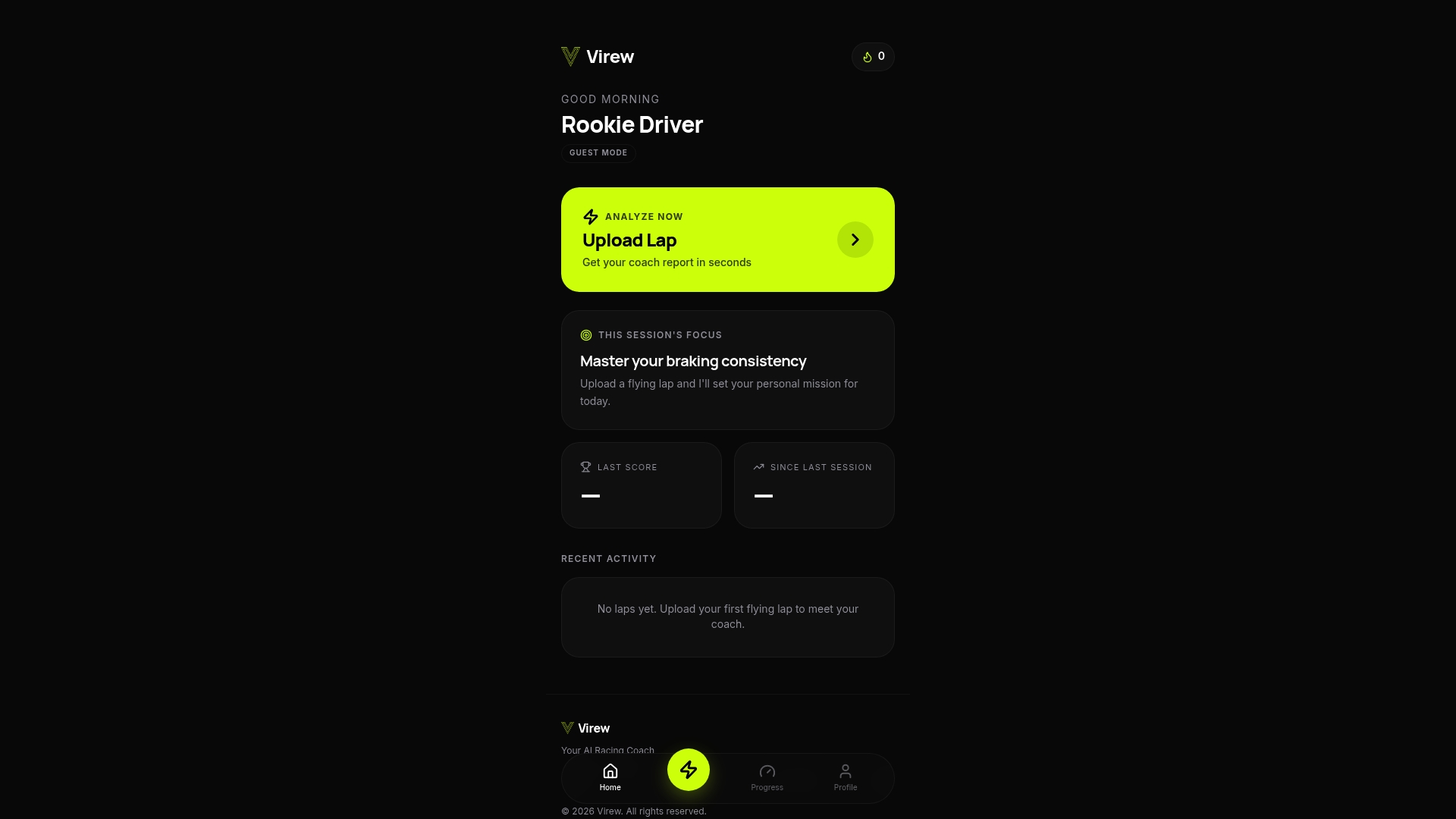
- Session-specific breakdowns: corner sub-scores tailored to Time Trial, Qualifying or Race context.
- Dry and wet separation: feedback never mixes conditions that use different benchmarks.
- Guided drills: practical next steps tied to your weakest component, not generic tips.
Our Free and Pro plans both work on this upload, identify, drill, reupload cycle. Start with our lap analysis to see exactly where your next drill should focus, or read how to use Virew for a step-by-step walkthrough.
FAQ
What does a driver rating measure in F1 26?
A driver rating measures corner-by-corner technique, including braking precision, cornering speed and throttle control, along with lap-to-lap consistency. It gives you a breakdown by component rather than a single lap time, so you can see exactly where time is being lost.
What is a good driver rating score?
There's no universal target because ratings are benchmarked against specific sessions and conditions, so a strong Time Trial score and a strong race score reflect different things. Focus on whether your sub-scores are improving session over session rather than chasing a fixed number.
How often should I check my driver rating?
Check it after every focused practice block rather than after every single lap, since a block of 10 to 12 laps gives a clearer read on whether a drill actually worked. Checking too frequently can lead to overreacting to normal lap-to-lap variance.
Why did my rating drop after a setup change?
A sudden drop often comes from the car behaving differently under braking or in corners rather than your technique getting worse. Confirm your setup and control calibration before assuming you need to retrain a skill.
Can I compare my driver rating between Time Trial and Race?
No, because Time Trial and Race use different benchmarks built around different goals, with Time Trial rewarding peak pace and Race rewarding consistency. Comparing the two directly will point you toward the wrong practice priorities.