
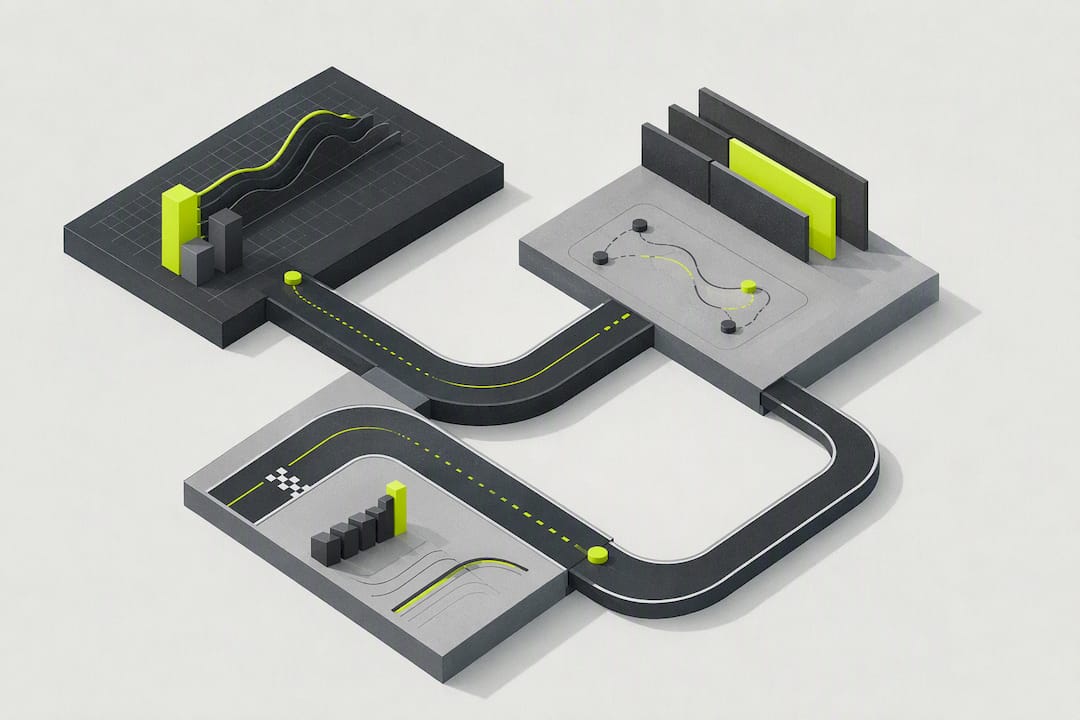
Data driven practice for F1 26 means structuring every session around lap analysis and AI coaching so each run produces one clear change you can test and repeat. The habit to build is Drive, Analyze, Improve, Repeat: drive a clean lap, get specific feedback, apply one fix, then confirm it holds. In a controlled study, coached drivers improved lap times by more than 35% compared to under 20% for self-practice.
TL;DR:
- Focus on specific lap corrections like braking point and turn-in before refining throttle application, as the former impact every corner.
- Validate any coaching advice with three to five consistent laps to ensure it is a genuine improvement rather than a fluke.
- Separate practice blocks for wet and dry conditions to avoid muddy conclusions caused by differing grip levels and handling characteristics.
- Limit focused practice blocks to 15 to 20 laps to prevent fatigue from skewing data and producing misleading feedback.
- Utilize AI coaching systems that deliver clear, actionable instructions and track progress through consistent lap validation instead of raw telemetry.
Table of Contents
- How to structure an effective practice session
- Which cues actually move your lap time
- Practice drills for Time Trial, Qualifying, and Race
- How AI coaching turns lap analysis into plain language advice
- Measuring progress without becoming dependent on feedback
- A coach's micro loop in practice
- Putting the loop to work with an AI racing coach
- Sources
- FAQ
How to structure an effective practice session
A session with no structure produces noisy data and vague conclusions. Splitting your time into clear phases keeps each lap meaningful and makes it obvious when a change actually worked.
- Warmup (3 to 5 laps): build tire temperature and get a feel for grip level before recording anything you plan to act on.
- Focused reps (8 to 12 laps): target one corner or one habit, changing only one variable at a time.
- Immediate check (after every 2 to 3 laps): glance at whether the change felt repeatable, not just faster once.
- End of block review (5 minutes): compare your best lap, your median lap, and how consistent your sector times were.
- Consolidation (3 to 4 laps): run the confirmed change without further tweaks to lock it in.
Dry and wet running should never share a block. Grip levels, braking points, and throttle windows differ enough that mixing them muddies any conclusion you draw, so treat each as its own session with its own baseline. Keep lap counts modest: pushing past 15 to 20 laps in one focused block invites fatigue, and tired laps produce misleading data rather than useful feedback.
Run immediate analysis when you're isolating a single corner, since you want to know right away if the fix is holding. Save deeper end-of-block review for tyre wear, energy management, or full-lap consistency, where the pattern only becomes clear over several laps.

Pro Tip: End every focused block with three "clean confirmation laps" where you change nothing. If your times hold, the fix is real.
Which cues actually move your lap time
Not every correction is worth chasing first. Some cues cost more time when wrong and some are easier to fix, so prioritize by impact versus effort.
- Braking point and pressure: braking too early costs raw time; braking too late costs corner speed and often the next straight.
- Turn-in: a late or early turn-in changes your apex speed and can force a wide exit that kills acceleration.
- Apex placement: clipping the apex too early opens the exit too soon and scrubs speed through the rest of the corner.
- Throttle application: getting back on the power too aggressively causes wheelspin or a snap of oversteer on exit.
- ERS and energy use: in qualifying, deploy for maximum lap time on your fastest sectors; in a race, manage deployment across a stint to protect tire life and energy for defending or attacking.
- Consistency: a driver who repeats a 1:32.8 five times in a row is often racing better than one who mixes a 1:32.1 with a 1:34.0.
One study of a personalized dashboard for sim racing found that translating telemetry into simple, actionable advice worked better for novice and intermediate drivers than showing raw traces, since most drivers need a plain instruction rather than a graph to interpret.
Fix braking and turn-in before chasing throttle refinement. Those two cues touch every corner on the lap, while throttle timing usually only costs you on exit.
Practice drills for Time Trial, Qualifying, and Race
Drills work when they isolate one skill and give you a clear pass or fail signal, not just a feeling that a lap went well.
- Micro-rep single corner drill: pick one corner, run 5 to 8 attempts changing only your braking marker, and treat it as solved once you hit the same apex speed on 3 consecutive clean laps.
- Sector-targeted best lap attempt: warm up for 3 laps, then attempt your best possible time through one sector only, ignoring the rest of the lap, and repeat until your sector time stabilizes within a tenth.
- Consistency block for race pace: run 10 to 15 laps at a sustainable pace while managing tire wear and energy deployment, then check your standard deviation across the stint rather than your single fastest lap.
- Qualifying single-lap drill: run 3 to 4 isolated hot laps with full ERS deployment on your best sectors, resetting between attempts so fatigue doesn't distort the data.
For wet sessions, shorten every drill by roughly a third and widen your success criteria, since grip variance from lap to lap is higher and a single clean lap means less than three clean laps would in the dry.
Pro Tip: If an AI coaching tip improves one lap but the next two clean laps don't match it, treat that first result as noise and revert to your previous baseline.

How AI coaching turns lap analysis into plain language advice
Raw data tells you what happened. Coaching tells you what to do about it, and that distinction is what separates faster improvement from a pile of numbers you never act on.
- Coached drivers in a controlled study showed larger lap-time gains than self-practice, along with less time spent off-track and faster improvement within coached blocks.
- Feedback systems built for sim racers work best when they state a concrete action, such as "brake 5 meters later into this corner" or "hold the trail brake a fraction longer before turn-in," rather than displaying a trace for the driver to interpret alone.
- Coaching statements adapted to F1 26 corners might read: "you're lifting off the throttle too early on exit" or "your turn-in point is costing you apex speed through this chicane."
- Validate any single piece of advice across 3 to 5 laps before trusting it. A one-lap improvement can be a fluke of grip or a lucky exit, not a real fix.
Measuring progress without becoming dependent on feedback
Lap time alone hides a lot. Track your median lap and standard deviation alongside your best lap, since median pace and consistency together predict race outcomes better than a single fast outlier does.
- Track best lap, median lap, standard deviation across a stint, and sector deltas against your own baseline.
- Run a feedback-withdrawal test every few sessions: drive a block with no coaching input and compare it to your coached pace.
- Improvements built on feedback can fade once that feedback disappears, so periodic withdrawal testing helps confirm a skill has actually stuck.
- Cap focused blocks at 15 to 20 laps. Fatigue past that point produces data that looks like regression but is really just tiredness.
A coach's micro loop in practice
Pick one corner. Run 3 reps, apply one AI tip, then test it again. If your apex speed and exit line repeat cleanly across all 3 laps, keep the change. If not, discard it and try the next adjustment.
— Virew
Putting the loop to work with an AI racing coach
An AI racing coach fits directly into the Drive, Analyze, Improve, Repeat loop: upload your F1 26 laps and get per-corner coaching split by session type, with dry and wet conditions treated separately. Start with a free lap analysis to see where your next lap time actually comes from.
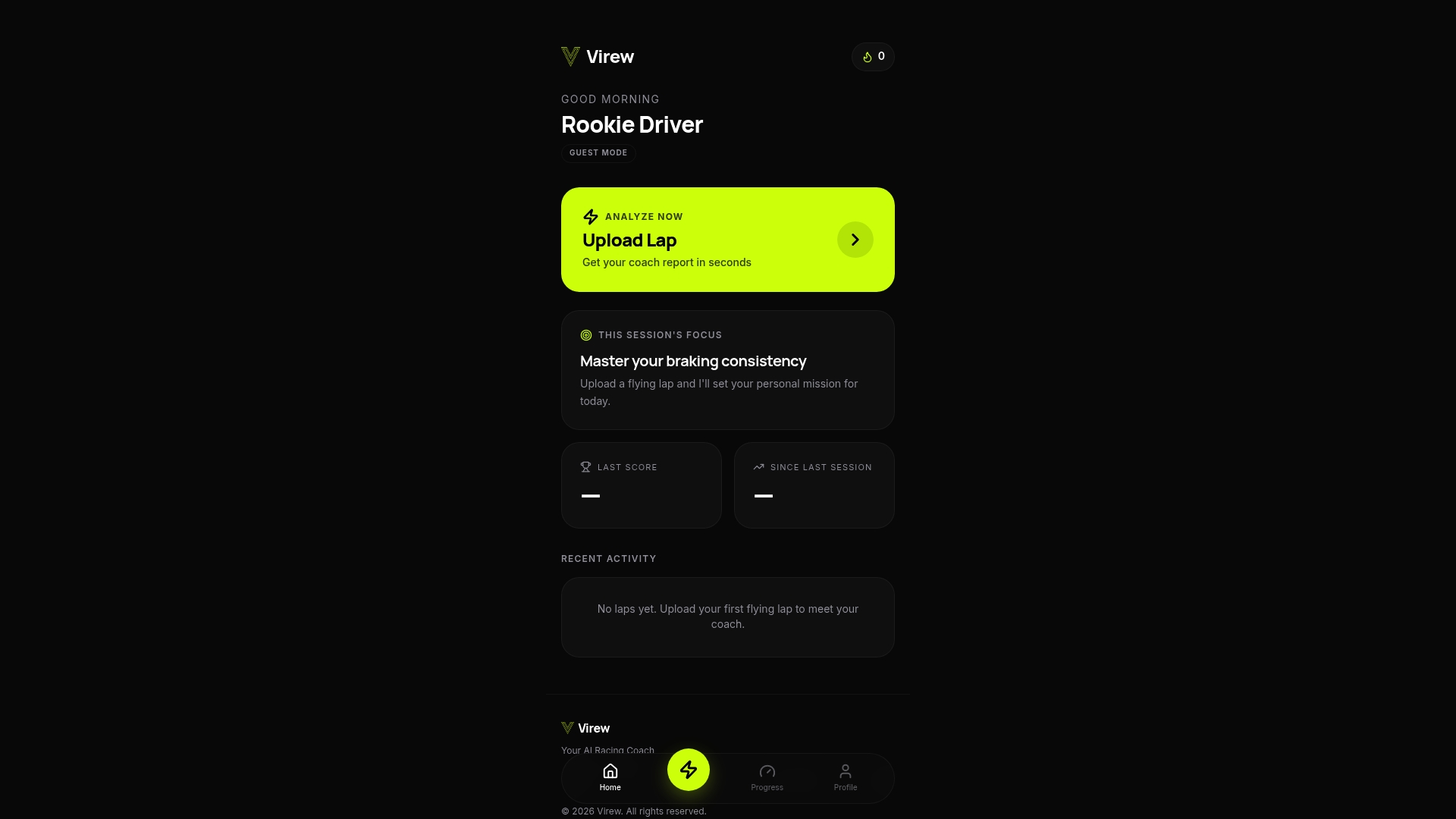
If you want a broader progression plan beyond a single session, the guide to getting faster in F1 26 walks through pacing your improvement over multiple weeks.
Sources
- SimCoachCorpus: A naturalistic dataset with language and trajectories for embodied teaching
- Telemetry-based optimisation for user training in racing simulators
- A personalized dashboard for sim racing
FAQ
What does data driven practice mean for F1 26 sim racers?
It means structuring practice sessions around lap analysis and coaching feedback instead of just running laps and hoping for improvement. Each session targets one specific change, tests it across multiple laps, and confirms it before moving to the next fix.
How many laps should I run before trusting a change?
Aim for 3 to 5 consecutive clean laps showing the same result before you trust an adjustment. A single fast lap can come from a lucky exit or a grip spike rather than a real technique change, so validating across several laps protects you from chasing noise.
Should I practice wet and dry conditions in the same session?
No. Braking points, throttle windows, and grip levels differ enough between wet and dry that mixing them in one data set produces unreliable conclusions. Run separate blocks for each condition and compare progress only within that condition.
How is Qualifying practice different from Race practice?
Qualifying practice focuses on isolated single-lap pace with full energy deployment on your strongest sectors, while race practice prioritizes consistency, tire management, and energy use across a full stint. Treat them as separate drills with separate success criteria rather than one generic practice routine.
Can Virew help me apply this practice loop?
Yes. Virew analyzes uploaded F1 26 laps and gives plain-language, per-corner coaching adapted to session type and weather, which fits directly into a drive, analyze, improve, repeat routine. Details on how the analysis works are on the Virew guide page.