
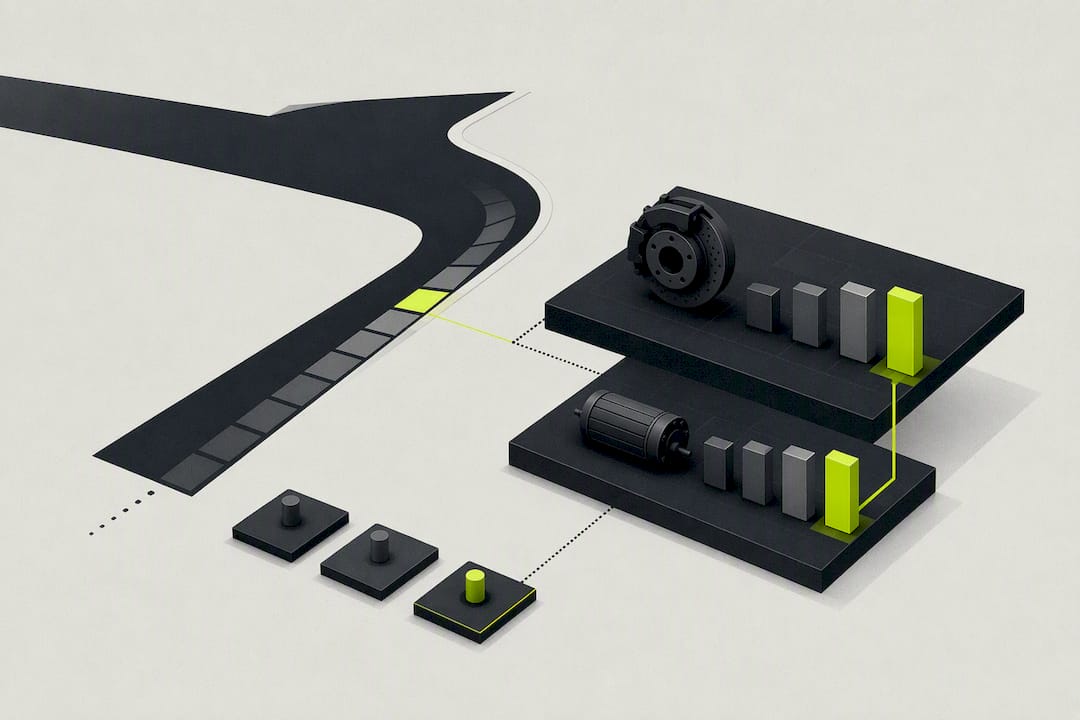
Brake bias is the percent of total braking force sent to the front axle, and there's no single correct number. The right setting shifts with the corner, the session, and the tires under you. In 2026, MGU-K regeneration and brake-by-wire logic changed how rearward bias behaves, so tuning it now means thinking about harvest, not just rotation.
TL;DR:
- In 2026, brake bias adjustments must consider energy harvest and brake-by-wire behavior, which influence rear braking force unpredictably during races.
- Small, session-specific changes in bias can significantly improve corner entry or stability, depending on track layout and driving style.
- Lower peak deceleration and unpredictable rear grip occur if harvest levels are too aggressive or inconsistent, affecting brake performance lap to lap.
- The three-lap test method helps identify optimal bias settings by analyzing real deceleration and tire temperature data, rather than relying solely on feel.
- AI lap analysis tools can pinpoint bias issues more accurately than subjective feel, especially with brake-by-wire masking rear axle dynamics.
Table of Contents
- What Brake Bias Means in F1 26 and What Numbers to Try
- How 2026 Brake-By-Wire and MGU-K Regeneration Change Bias
- Adjusting Bias by Session: Time Trial, Qualifying, Race
- Trail Braking, Lock-Ups, and Pedal Technique
- Spotting Bias Problems Before They Cost You a Lap
- A Simple Drill to Dial In Your Bias
- How AI Lap Analysis Turns Your Laps Into Bias Fixes
- Sources
- FAQ
- How an AI Coaching Perspective Cuts Through the Bias Debate
What Brake Bias Means in F1 26 and What Numbers to Try
A brake bias reading like 54/46 means 54% of braking force goes to the front axle, 46% to the rear. Push the number up (say, to 56%) and the car resists rotation but locks the fronts more readily under heavy braking. Pull it down toward 50% or lower and the rear steps in sooner, giving you quicker turn-in but a real risk of snapping loose if you overdo it. Small moves matter more than they look: slight adjustments noticeably change how a car rotates and how easily it locks up, according to F1 Brake Bias Explained.
Most F1 26 setups start with a front brake bias somewhere moderately forward, with exact values adjusted for car and track. From there:
- Higher front bias (56 to 58%) favors stability into slow, heavy-braking corners like Turn 1 at Bahrain.
- Lower front bias (50 to 53%) helps rotate the car in medium and high-speed direction changes, like Turn 8 at Silverstone.
- Mid-range settings (53 to 55%) work as a general-purpose compromise for tracks with mixed corner types, such as Suzuka.
Treat the dial as fine adjustment, not a fix for a fundamentally wrong setup.
How 2026 Brake-By-Wire and MGU-K Regeneration Change Bias
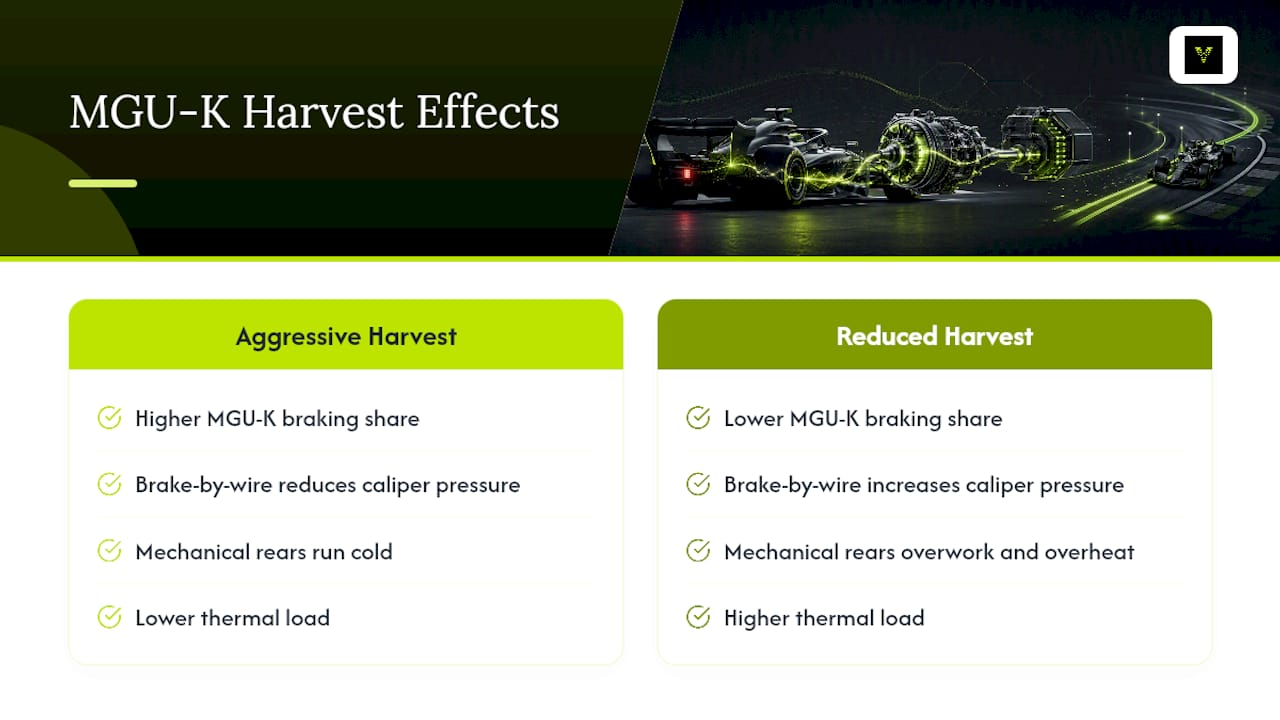
Brake-by-wire on the rear axle isn't new to hybrid-era cars, but the scale of it in 2026 is. The MGU-K harvests energy under braking, and the brake-by-wire system adjusts mechanical rear caliper pressure to keep total rear braking force consistent even as harvest levels vary lap to lap, per F1 Chronicle's breakdown of 2026 brake systems. In plain terms: the rear brakes you feel through the pedal aren't purely mechanical anymore. Part of that stopping power comes from the electric motor, and the system is constantly rebalancing behind the scenes.
The numbers back this up. Braking data for 2026 cars indicates generally lower peak deceleration at some circuits compared to prior seasons, due to increased energy recovery affecting speed reduction, according to Brembo's 2026 braking analysis.
The practical headache is thermal window management. If harvest is aggressive on a low-fuel qualifying lap, the mechanical rear brakes might run cold, leading to unpredictable rear grip at turn-in. If harvest drops off during a long race stint, the rears can overwork and overheat, reducing braking performance when it is most needed. Both extremes cause the same symptom: rotation that feels different from lap to lap even though your bias hasn't moved.
Adjusting Bias by Session: Time Trial, Qualifying, Race
Each session type in F1 26 has a different objective, and your bias strategy should follow it.
- Time Trial rewards aggression. Since you're chasing one clean lap with no tire degradation to manage, push bias 1 to 2% more rearward than your race baseline to sharpen rotation through key corners, especially medium-speed direction changes where a sharper front end saves tenths.
- Qualifying calls for a different approach because your tires start cold. Begin the lap slightly more forward than your ideal race setting to keep the front planted while grip builds, then dial it rearward by 1% once the tires are in their working range, usually by sector two.
- Race strategy favors stability and tire life over one-lap speed. Keep bias closer to neutral or slightly forward for most of the stint, and make small mid-stint tweaks (half a percent to one percent) as fuel burns off and rear grip changes.
For corner-specific adjustments, click rearward before tight, low-speed corners where you need rotation (hairpins at Monaco or the Turn 3 chicane at Baku) and forward before high-commitment braking zones where stability matters more than rotation, like the run into Turn 1 at Monza.
Trail Braking, Lock-Ups, and Pedal Technique
Bias and technique are linked. A more rearward setting rewards trail braking because the rear is already doing more work, so easing off the brake pedal smoothly as you turn in keeps that rear-heavy balance from snapping into oversteer. A forward-biased setup tolerates a firmer, more abrupt release since the front is carrying the load and won't rotate as sharply.
- Ease off the brake pedal gradually through corner entry rather than lifting all at once, especially with rearward bias.
- Watch for front lock-up under heavy braking as the first sign your bias is too far forward for that corner.
- If you're running ABS off, keep bias slightly more forward than you would with ABS on, since you lose the safety net that catches over-aggressive rear bias.
- In a tight hairpin like Turn 6 at the Red Bull Ring, rearward bias and light trail braking rotate the car fast; in a sweeping medium-speed corner like Turn 9 at Bahrain, forward bias keeps things predictable at higher entry speeds.
It's a faster fix than relearning your braking technique from scratch.*
Spotting Bias Problems Before They Cost You a Lap
Telemetry tells you what your hands can't always feel. Watch these signs:
- A brake temperature imbalance between front and rear, especially rears running noticeably colder, points to bias set too far forward for current conditions.
- Repeated lock-ups on the same axle across multiple laps mean your bias hasn't adapted to changing tire or fuel conditions.
- A deceleration trace that dips or spikes unexpectedly mid-braking zone often flags a bias setting fighting against your MGU-K harvest map.
- Sudden, unexpected rotation at turn-in that wasn't there last stint usually means the rears have cooled or heated outside their working window.
When something feels off, don't overhaul the setup. Move bias by 1% to 2% and rerun the same corner. Check your ERS harvest map alongside it, and confirm tire temps are in range before blaming the bias dial for a problem that's actually about tire management.
A Simple Drill to Dial In Your Bias
Run this before locking a race or qualifying setup:
- Do two or three warm-up laps on a conservative, slightly forward bias to get a feel baseline.
- Run three controlled laps at the same heavy braking zone, testing one setting at a time: baseline, then +1% rear, then +1% front, noting how each feels.
- Repeat your hardest braking zone and one medium-speed rotation corner at each setting to see how the trade-offs play out in different corner types.
- Lock in the setting that gave the cleanest decel trace and the least lock-up, and save it as your starting point for qualifying or the race.
Three laps per setting is enough to feel a real difference without burning your whole practice session.
How AI Lap Analysis Turns Your Laps Into Bias Fixes
Guessing at bias from feel alone only gets you so far. Virew's lap analysis reads your actual braking points, deceleration traces, tire temperatures, and ERS harvest behavior from uploaded F1 26 footage, then flags exactly where a bias or technique change would save time. Instead of a generic setup guide, you get coaching tied to the laps you actually drove. Test a change, upload the lap, and let the AI analysis tell you whether that 1% rearward click actually helped or just felt better.
Sources
- F1 Brake Bias Explained: Why One Percent Changes Corner Entry
- Brembo data shows major braking changes for 2026 F1 cars
- F1 Brakes 2026: Disc sizes, brake-by-wire and energy recovery
FAQ
What Does Brake Bias Do in F1 26?
Brake bias controls how much braking force goes to the front axle versus the rear, expressed as a percentage. Higher front bias adds stability but promotes understeer, while lower front bias sharpens rotation but raises the risk of rear lock-up, as explained in this brake bias breakdown.
What Should My Brake Bias Be?
There's no single correct number. Most F1 26 setups use a front brake bias moderately forward, with the exact setting depending on track layout, session type, and driver confidence under braking.
Is Higher or Lower Brake Bias Better?
Neither is universally better. Higher front bias suits heavy-braking, low-speed corners where stability matters most, while lower bias helps rotate the car through medium and high-speed direction changes, especially once tires are warmed up.
What Is the Best Brake Bias for Racing?
For race pace, a setting closer to neutral or slightly forward usually protects tire life and consistency better than an aggressive rearward setup built for one-lap speed. Small mid-stint adjustments of half a percent to one percent as fuel burns off tend to work better than one fixed number for the whole race.
How an AI Coaching Perspective Cuts Through the Bias Debate
Most bias advice online treats it like a single dial you set once and forget. That's backwards. The real skill in F1 26 for 2026 isn't finding a magic number, it's recognizing that your rear brakes are now sharing the job with an electric motor that changes its contribution lap to lap based on harvest. A driver who chases a "perfect" bias setting from a forum post is optimizing for a car that doesn't exist anymore.
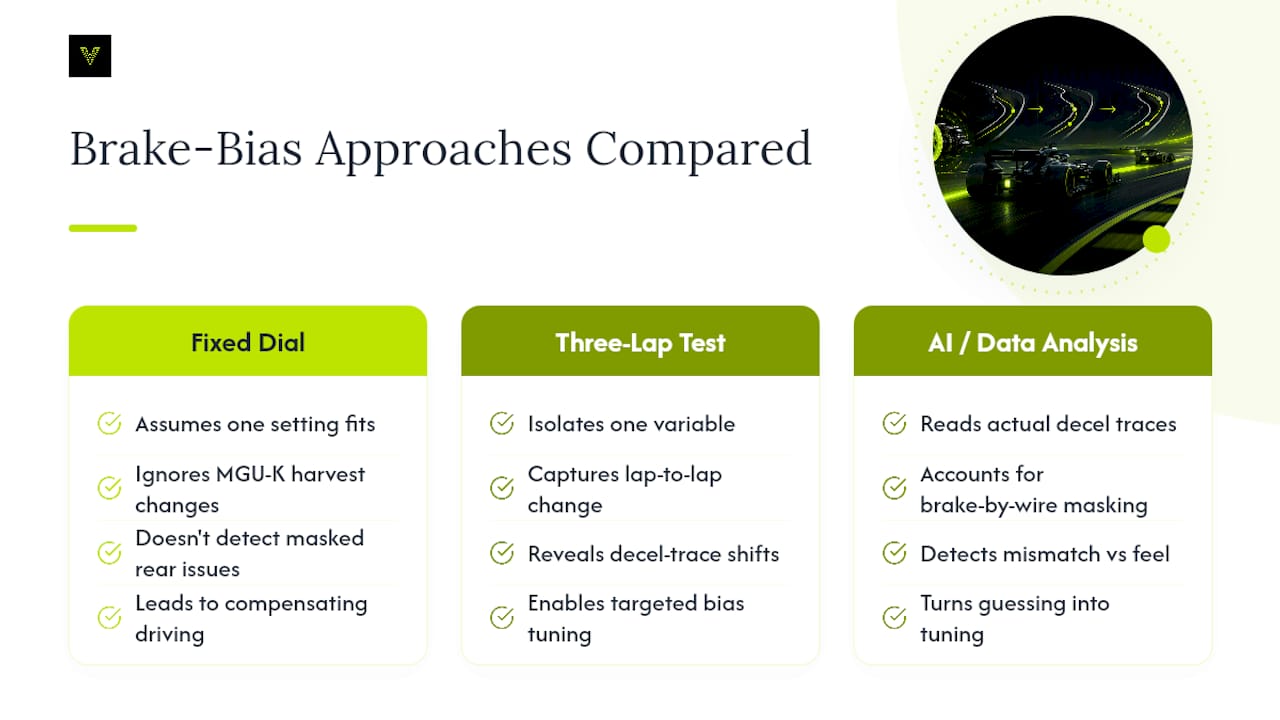
What actually separates faster drivers is treating bias as a conversation with the corner in front of them, not a fixed configuration. The three-lap test method works because it forces you to isolate one variable and watch what actually happens to your decel trace, rather than trusting a feeling that changes with fatigue, tire wear, and fuel load. Most players who plateau on lap time have never run that test. They're driving around a bias problem instead of fixing it, adjusting their braking points to compensate for a setup that fights the MGU-K's harvest curve instead of working with it.
The uncomfortable truth is that feel alone deceives you more in 2026 than it did before, because the brake-by-wire system actively masks some of what's happening at the rear axle. That's exactly the gap data closes. A lap analysis tool that reads your actual decel traces and tire temperatures catches the mismatch between what your hands feel and what your car is actually doing, and that's the difference between guessing at bias and actually tuning it.
— Virew