
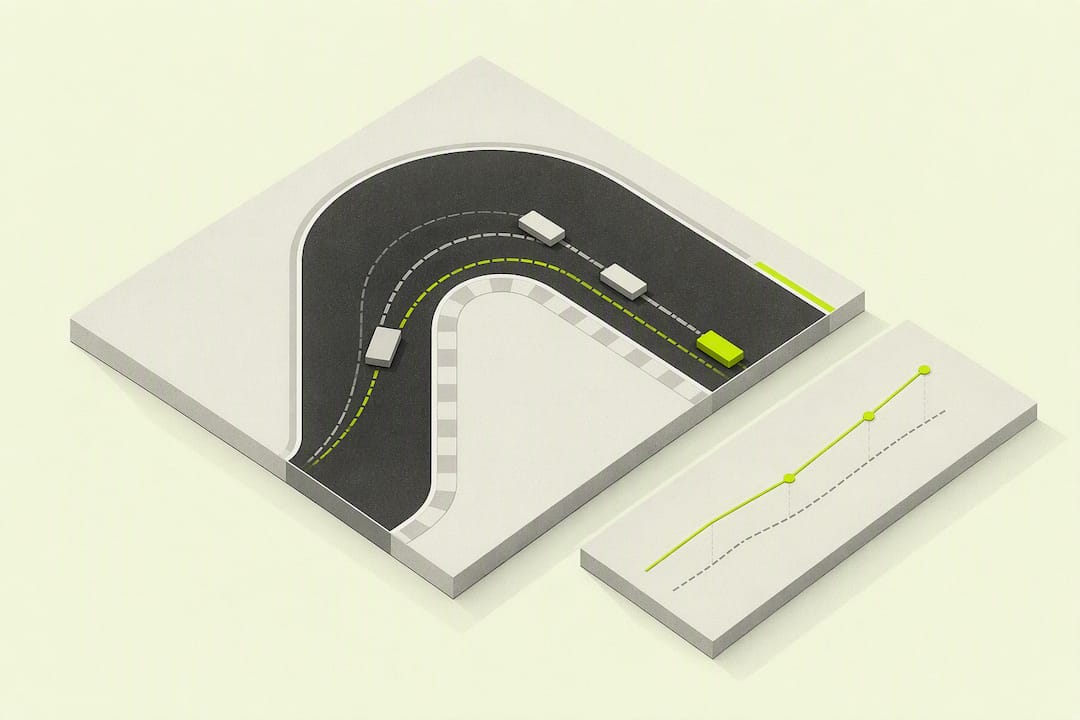
For 90 degree corners in F1 26, brake in a straight line, trail-brake into a late apex, and get on the throttle early rather than chasing mid-corner speed. In Time Trial or Qualifying, attack the entry harder since one lap is all that matters. In races, favor a repeatable input over a heroic one that wrecks your tires. Run three focused laps on the same corner, then check the change in telemetry or a lap analysis before you decide it actually worked.
TL;DR:
- Trail-braking deep into a late apex enhances exit speed, especially in slow, tight 90 degree corners, by straightening the wheel sooner and allowing earlier throttle application.
- Using a fixed, non-moving reference point for braking and executing each phase with smooth, deliberate inputs improves consistency and lap time in high-angle corners.
- Small setup adjustments such as increasing differential preload or softening front and rear ARBs can significantly improve corner stability and predictability without harming overall lap performance.
- Practice should focus on isolating each input—braking, trail-braking, apexing, and throttle—by running dedicated laps before combining them for full corner mastery.
- Telemetry analysis highlights smooth brake-release curves, steady throttle ramps, and stable steering as key indicators of proper technique improvement.
Table of Contents
- Braking, Turn-In, and Exit: The Inputs That Actually Matter
- Setup Changes That Make Right Angle Corners More Predictable
- How Do You Practice 90 Degree Corners for Real Gains?
- Wet-Weather Adjustments for Right Angle Corners
- What Telemetry Should You Send Virew for a 90 Degree Corner?
- The Coaching Take: Stop Chasing Apex Speed
- Turn Lap Analysis Into Faster Corner Exits
- Sources
- FAQ
Braking, Turn-In, and Exit: The Inputs That Actually Matter
Right angle corners punish guesswork more than any other turn shape on the calendar. Get the sequence wrong, either through a late brake or an early throttle stab, and you lose time twice: once on entry, once on the run to the next braking zone. Here's the input order that works, step by step.
- Pick a fixed brake reference. Use a static object, a curb edge, or a painted board rather than a distance marker that moves depending on your speed into the zone. A shadow or a sponsor board on the fence works better than "about here" because it doesn't shift lap to lap.
- Hit initial brake pressure hard, then hold. Aim for near peak braking force at initial application, easing off as speed drops and load transfers forward. Fanatec's braking guidance notes that holding near peak braking force with a smooth, deliberate release generates more front-end grip than a spiked, inconsistent stab.
- Trail-brake into the turn, not through it. For a genuine 90 degree corner, carry meaningful brake pressure a beat longer than you think you need, tapering it as you turn the wheel. Slow, tight corners reward pronounced trail-braking; faster, sweeping bends need only a subtle release, since trail-brake intensity should scale with corner speed rather than following one blanket rule.
- Target a late apex. Clip the corner later than feels natural. This costs you a touch of mid-corner speed but opens the exit, letting you straighten the wheel sooner and get full throttle down earlier. Late apex technique for slow to medium corners consistently produces faster exit speeds than an early, "ideal-looking" apex that just isn't.
- Unwind the wheel before you feed throttle. Squeeze the throttle progressively as the steering angle drops, not before. On low-speed exits, a short-shift out of the corner (grabbing the next gear slightly early) keeps wheelspin down and gets the power to the ground cleaner.
Session context changes how hard you push each of these. In Time Trial, brake a fraction later and trail deeper since you're chasing one clean lap with no tire life to protect. In Qualifying, do the same but leave a small margin, since a lockup here costs you the whole session. In races, back off the aggression slightly on entry and prioritize a clean, repeatable exit over a spectacular one. Consistency across many laps beats one flashy corner that costs you three positions when it goes wrong.
Pro Tip: Say your brake reference out loud during practice, "board, hold, release, turn." Sounds silly, but verbalizing the sequence trains the timing faster than silently repeating the lap.
Setup Changes That Make Right Angle Corners More Predictable
Small setup moves change how forgiving a 90 degree corner feels, and most of them cost almost nothing in other areas of the lap.
- Differential preload. Raise it in small steps, two or three clicks at a time. Higher preload stabilizes the rear during coast and turn-in, letting you commit to the apex without the back end stepping out. It's one of the more underused levers for corner-exit consistency, since a small preload increase gives a large predictability payoff for very little downside elsewhere on track.
- On-throttle and off-throttle differential. Lower the off-throttle diff setting for sharper turn-in rotation. Lower the on-throttle setting for better traction out of slow corners, at the cost of a slightly less playful rear end.
- Front wing and front ARB. A touch more front wing, or a slightly softer front anti-roll bar, adds rotation on entry. This helps the car turn into a 90 degree corner without needing to overwork the brakes.
- Rear wing and rear ARB. More rear wing or a stiffer rear ARB adds exit stability, which matters more than entry grip once you're committed to a late apex and full throttle.
- Brake bias. Move brake bias slightly forward to sharpen turn-in rotation, but watch for front lockups under trail-braking. Move it back a bit if you're locking the fronts on entry to slow corners.
- Tire pressures. For race stints and practice sessions, prioritize consistent core temperatures over chasing the absolute peak grip window. A tire that stays predictable for 15 laps beats one that's fastest for two and falls off a cliff after.
Test each change with a controlled comparison: identical fuel load, identical tires, same corner, three laps before and three laps after. Anything less and you're guessing which variable actually moved the needle.
Pro Tip: Change one setup parameter per test session. Adjusting diff preload and front wing on the same run makes it impossible to know which one fixed (or broke) your exit.
How Do You Practice 90 Degree Corners for Real Gains?
Structured repetition beats mindless lapping every time. Break the corner into isolated pieces before you try to string the whole sequence together at speed.
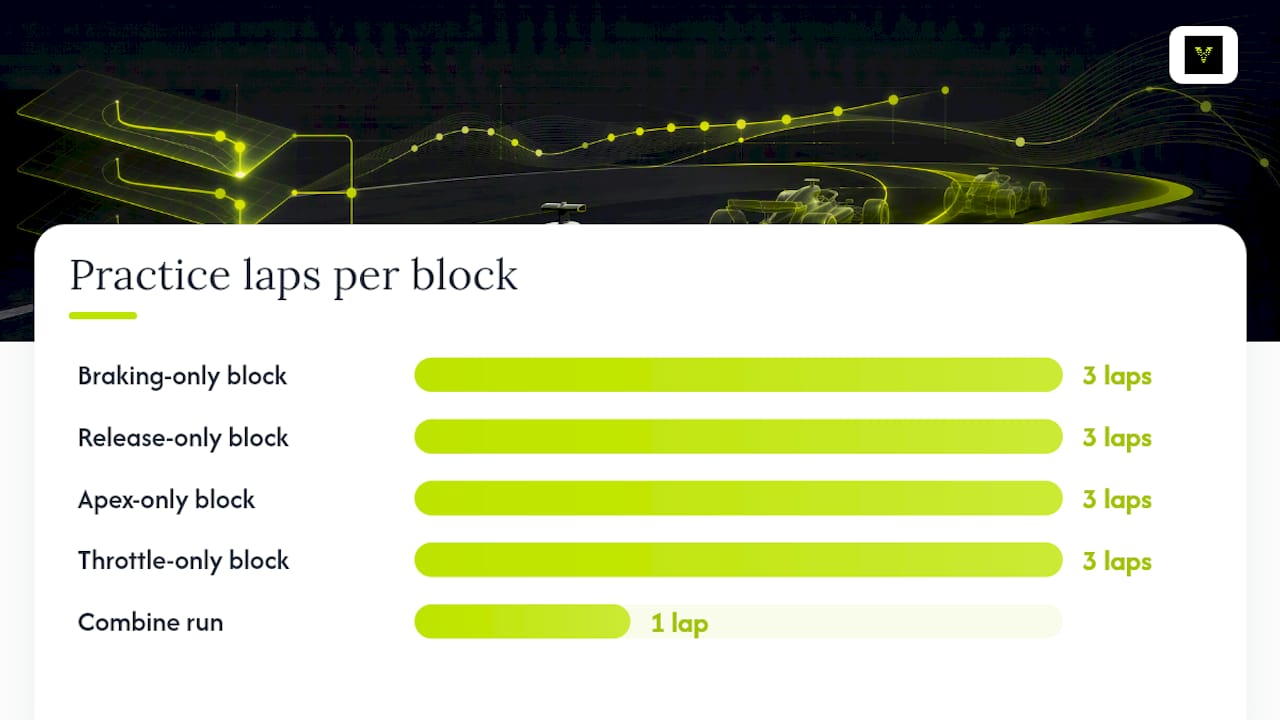
- Braking-only block. Three laps focused purely on hitting your brake reference and pressure target. Ignore the apex and exit entirely.
- Release-only block. Three laps focused on the smoothness of your trail-brake taper as you turn in.
- Apex-only block. Three laps focused on hitting your late apex marker consistently, regardless of entry speed.
- Throttle-only block. Three laps focused on the unwind-then-throttle sequence out of the corner.
- Combine. Run the full sequence together once each piece feels automatic on its own.
This single-variable approach mirrors what most structured sim-racing guides recommend for embedding technique: isolate one input, repeat it, then layer the pieces back together with telemetry comparison rather than trying to fix everything at once.
Use a ghost lap or delta line to compare exit speed before and after each block. A realistic target for a well-drilled 90 degree corner is a 0.1 to 0.3 second exit speed gain once the sequence clicks, measured at the same point down the following straight.
Check three telemetry traces specifically: a smooth, rounded brake-release curve rather than a jagged one; a throttle trace that ramps up steadily rather than spiking; and a steering angle that holds steady through the apex rather than wandering. These three markers reliably indicate whether the technique actually improved or just felt better in the seat.
Time Trial practice should focus on single, isolated attack laps. Race practice should run 8 to 10 lap stints, checking whether your exit speed holds steady on lap 9 the same way it did on lap 2.
Wet-Weather Adjustments for Right Angle Corners
Everything above assumes a dry track. Wet 90 degree corners need a different, more conservative rhythm, not a scaled-down version of the dry technique.
- Shorten and soften your trail-brake phase; carrying dry-level pressure into a wet apex is the fastest way to spin.
- Lift off the throttle slightly earlier before you even reach the brake zone, giving the car time to settle before you ask for rotation.
- Ramp the throttle even more gradually on exit, and short-shift more aggressively than you would in the dry to avoid wheelspin.
- On setup, soften the differential slightly, add a touch more rear preload for stability, and run more wing across the board for grip over outright top speed.
- Run longer warm-up stints before judging your pace. Wet tires and track surfaces need laps to reach a stable temperature window, and chasing lap time before that happens skews your read on the corner entirely.
What Telemetry Should You Send Virew for a 90 Degree Corner?
Upload full replay footage rather than a clipped highlight, and tag the session type, tire compound, and fuel load so the analysis reflects the right context.
- Speed at apex and speed at exit, compared against your best reference lap.
- Brake pressure trace shape, particularly the release curve into turn-in.
- Steering angle waveform through the apex.
- Throttle ramp shape from unwind to full commitment.
Virew's lap analysis separates coaching by session type and by dry or wet conditions, since a Time Trial fix and a race-pace fix for the same corner are rarely identical.
| Metric | What good looks like |
|---|---|
| Exit speed gain | +0.1 to 0.3s per corner after drilling |
| Brake trace | Smooth peak, tapered release |
| Throttle ramp | Steady rise, no spike |
| Steering angle | Stable through apex, no correction |
Run three focused laps, upload them, apply the top two suggested fixes, then repeat the test.
The Coaching Take: Stop Chasing Apex Speed
Most sim racers optimize for the wrong number. Apex speed feels satisfying, but exit speed is what shows up on the next straight's speed trap. Since sims strip away seat-of-the-pants feedback, you're training a "digital feel," built from visual markers and telemetry rather than g-force in your body. The habit that actually works: pick one reference point, fix one input, then verify the change with a lap delta or a Virew analysis instead of trusting how the lap felt.
— Virew
Turn Lap Analysis Into Faster Corner Exits
Virew is the alternative to guessing whether a setup tweak or a later apex actually worked. Instead of squinting at a delta line and hoping, you can upload your laps and get an analysis of where you are losing time in a specific 90 degree corner, and which fixes may earn back time.
The workflow matches the drills in this piece: run three laps focused on one corner, upload them through how to use Virew, and let the analysis flag your braking, entry, and exit deltas instead of relying on feel alone. Free credits cover a handful of lap analyses each month, and a paid subscription unlocks additional features and analysis options if you're working through a whole track's worth of corners rather than one. Start with your last session's worst 90 degree corner and see exactly what Virew's lap analysis recommends you change first.
Sources
- Sim Racing braking technique | Fanatec
- F125 cornering tips
- How Ferrari optimized the SF26's differential to improve corner exit
FAQ
Should I Always Use a Late Apex for 90 Degree Corners?
For most 90 degree corners, yes. A later apex sacrifices a little mid-corner speed for a stronger, earlier exit, which usually nets a faster lap overall.
How Much Should I Trail-Brake Into a Right Angle Corner?
Carry noticeable pressure a beat longer than feels natural for slow, tight 90 degree corners, tapering smoothly as you turn in. Faster sweeping corners need only a subtle release rather than deep trail-braking.
What Telemetry Traces Confirm the Technique Is Working?
Check for a smooth brake-release curve, a steady throttle ramp with no spike, and a consistent steering angle through the apex. All three should move in the right direction if the change actually helped.
Do I Need Different Inputs for Wet 90 Degree Corners?
Yes. Shorten your trail-brake phase, lift off the throttle earlier before the corner, and ramp throttle more gradually on exit to avoid wheelspin on a wet surface.
Is Adjusting Differential Preload Worth It for Corner Exit?
Small preload increases, tested a few clicks at a time, often deliver a noticeable stability gain on exit for very little setup risk elsewhere on the lap.